India Renewable Energy Summit and Clean Transition Goals
Source:PIB ↗
Why It Matters
Directly relevant to India's energy transition targets, Panchamrit goals, and renewable capacity expansion under GS Paper 3.
Summary
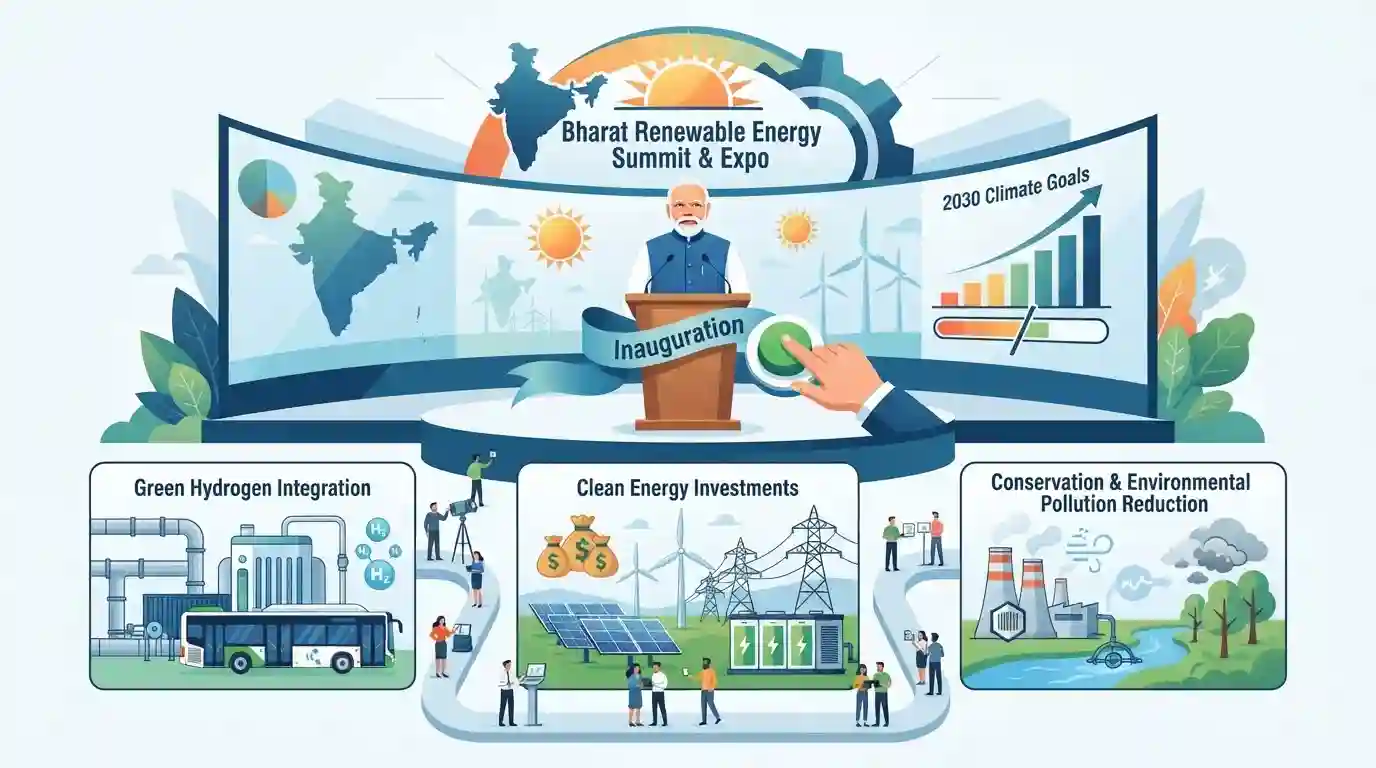
The Prime Minister inaugurated the Bharat Renewable Energy Summit & Expo, highlighting India's rapid strides toward its 2030 climate goals, green hydrogen integration, and clean energy investments.
Key Points
- The Prime Minister inaugurated the Bharat Renewable Energy Summit & Expo, highlighting India's expanding footprint in clean energy.
- The summit focuses on scaling up solar, wind, and green hydrogen capacities to meet India's 2030 non-fossil fuel targets.
- Discussions emphasized public-private partnerships, technology transfer, and innovative financing models for energy transition.
Important Terms
National Green Hydrogen Mission

A national initiative launched to make India a global hub for the production, usage, and export of green hydrogen, aiming for 5 MMT annual capacity by 2030 to cut emissions.
UPSC context
GS Paper III (Environment & Infrastructure). Tests India's climate commitments, decarbonization strategy, and clean tech policy frameworks.
Ministry of New and Renewable Energy
The nodal ministry of the Government of India responsible for conceptualizing and implementing policies, research, and large-scale projects related to renewable energy sources.
UPSC context
GS Paper III (Infrastructure: Energy). Tests institutional governance of India's green energy transition and target tracking.
Prelims Trap
India aims to achieve 500 GW of renewable energy capacity and net-zero emissions by 2030.
Aspirants often confuse India's target of 500 GW of non-fossil fuel capacity by 2030 with a 500 GW renewable energy target or net-zero by 2030 (India's net-zero target year is 2070).
Static Concepts Connected
What are the key pillars of India's Panchamrit climate commitments announced at COP26?
- 500 GW Target: Non-Fossil Capacity: Reach 500 GW of non-fossil electricity capacity by 2030.
- 50% Share: Renewable Energy Share: Meet 50% of energy requirements from renewable energy by 2030.
- Carbon Reduction: Emission Reduction: Reduce total projected carbon emissions by 1 billion tonnes from now to 2030.
- Carbon Intensity: Carbon Intensity: Reduce the carbon intensity of the economy by less than 45% by 2030.
- Net-Zero 2070: Net-Zero Goal: Achieve net-zero carbon emissions by 2070.
Cross-Topic Patterns
Renewables + Critical Minerals Geopolitics
India's massive renewable energy rollout requires critical minerals (lithium, cobalt, rare earths), linking domestic energy goals to global supply chain geopolitics and trade diplomacy.
Green Energy Targets + Fiscal Federalism
Scaling non-fossil capacity intersects with fiscal deficit targets and green bond issuances, bridging climate infrastructure finance with macro-fiscal management.

500 GW by 2030 target and National Green Hydrogen Mission metrics frequently appear in matching or multi-statement Prelims questions.
Linked PYQs · 3
Linked PYQs · 3
- 2026PrelimsGS1
Which of the following statements with regard to Green Hydrogen is/are correct ? 1. It is decarbonized hydrogen obtained from natural gas reforming combined with carbon capture and storage (CCS). 2. It is produced using electrolysis of water with electricity generated by renewable energy. 3. National Green Hydrogen Mission of India aims for abatement of nearly 50 MMT of annual greenhouse gas emissions by 2030. Select the answer using the code given below :
- 2023PrelimsGS1
With reference to green hydrogen, consider the following statements: 1. It can be used directly as a fuel for internal combustion. 2. It can be blended with natural gas and used as fuel for heat or power generation. 3. It can be used in the hydrogen fuel cell to run vehicles. How many of the above statements are correct?
- 2022MainsGS3
Do you think India will meet 50 percent of its energy needs from renewable energy by 2030 ? Justify your answer. How will the shift of subsidies from fossil fuels to renewables help achieve the above objective ? Explain.
