Digi Yatra International Passenger Trials at Major Airports
Source:PIB ↗
Why It Matters
The scaling of Digi Yatra for international passengers represents a critical advancement in India's digital public infrastructure and e-governance landscape, testing the limits of facial recognition technology, data privacy frameworks, and seamless public service delivery in aviation.
Summary
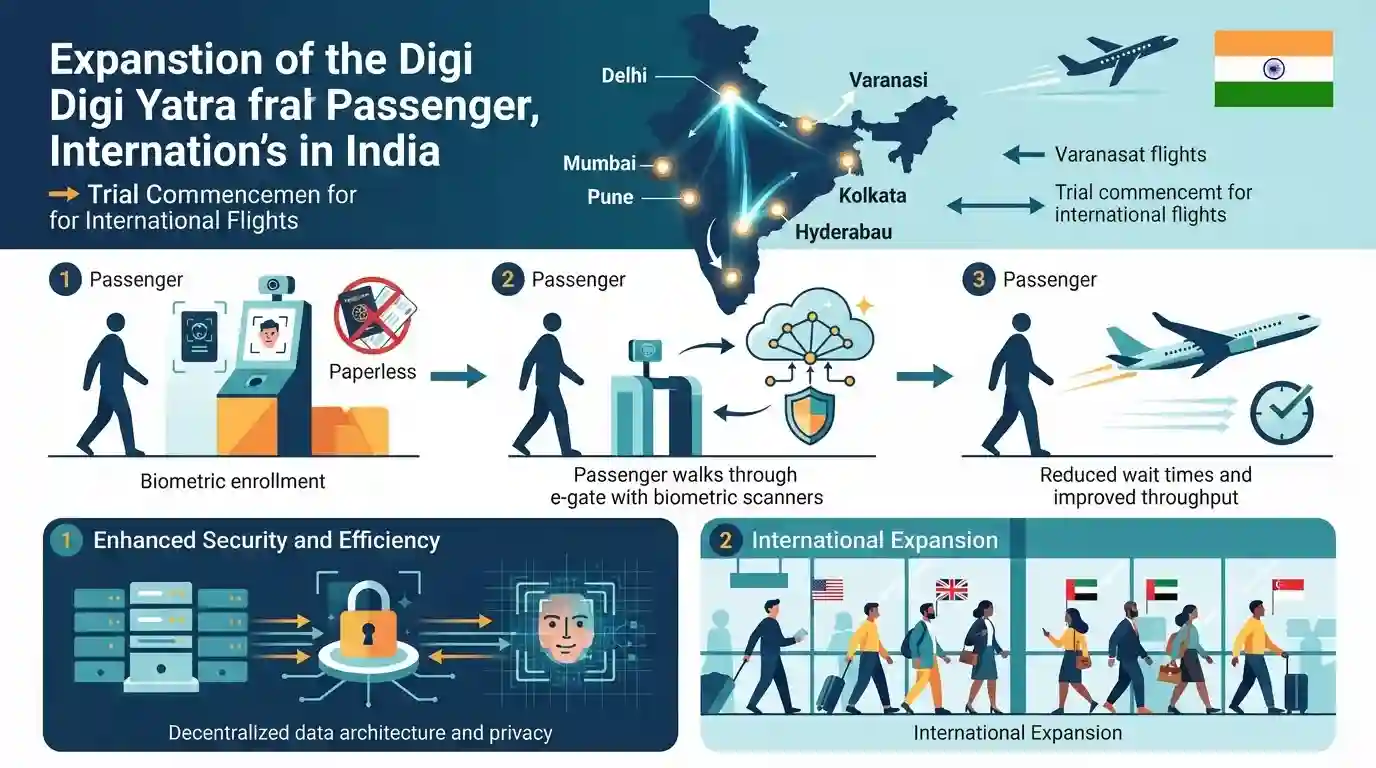
The Digi Yatra initiative has officially commenced trials for international passengers across seven major airports in India—Delhi, Mumbai, Bengaluru, Hyderabad, Kolkata, Pune, and Varanasi. Originally designed for domestic travelers to ensure a paperless, frictionless, and contactless journey using facial recognition technology, this trial marks a major step towards scaling biometric boarding and clearance processes for international travel. The expansion emphasizes enhanced security, reduced wait times, and improved passenger throughput while maintaining privacy-centric decentralized data architecture.
Key Points
- Digi Yatra has expanded its biometric-enabled seamless travel initiative to include international passengers through trials at seven key Indian airports.
- The seven airports hosting the trials are Delhi, Mumbai, Bengaluru, Hyderabad, Kolkata, Pune, and Varanasi.
- The expansion aims to leverage facial recognition technology (FRT) for frictionless processing of international travelers, enhancing security and operational efficiency.
- Data privacy and security remain core components, with the system utilizing a decentralized architecture where traveler credentials are stored securely on their own devices.
Important Terms
Digi Yatra Initiative

An initiative utilizing facial recognition technology to enable paperless, contactless, and frictionless passenger processing and biometric verification across airports in India.
UPSC context
UPSC GS Paper III: E-governance applications, digital public infrastructure, and technology interventions in public service delivery.
Ministry of Civil Aviation
The central government ministry responsible for formulating policies, regulating, and overseeing civil aviation infrastructure and administrative frameworks in India, including the Digi Yatra rollout.
UPSC context
UPSC GS Paper II: Structure, organization, and functioning of Ministries and Departments of the Government.
Digi Yatra Foundation
A joint-venture Section 8 company established to manage the Digi Yatra Central Ecosystem (DYCE) and coordinate digital biometric identity verification standards across Indian airports.
UPSC context
UPSC GS Paper III: Science and Technology applications, institutional mechanisms, and public-private digital infrastructure models.
Static Concepts Connected
What is the institutional structure and data architecture of the Digi Yatra initiative?
- Governance Structure: Operated by the Digi Yatra Foundation, a joint venture (PPP model) involving Airports Authority of India and private airport operators.
- Decentralized Design: Uses a decentralized architecture where encrypted facial templates and ID credentials reside locally on the passenger's smartphone, not on a central database.
- Core Technology: Relies on Facial Recognition Technology (FRT) to automate entry, security clearance, and boarding across aviation touchpoints.
Cross-Topic Patterns
Digital Public Infrastructure and Sovereign Identity
International trials require integrating e-passports with decentralized Verifiable Credentials, bridging digital public infrastructure (DPI) with sovereign identity verification frameworks like India's Aadhaar and DigiLocker ecosystem.
PPP Models in Digital Infrastructure
The Digi Yatra Foundation operates as a not-for-profit PPP between AAI and private airport operators, reflecting new models of infrastructure governance and public service delivery.

Expect a statement-based question distinguishing domestic vs international Digi Yatra protocols, especially e-passport integration and physical ID requirements.
Linked PYQs · 3
Linked PYQs · 3
- 2026PrelimsGS1
Which of the following statements with regard to Black Boxes used in modern aircrafts is/are correct ? 1. They carry a beacon emitting red light pulses to facilitate underwater detection. 2. They record both the cockpit voice and flight data. 3. Their memory units are made using either stainless steel or titanium. Select the answer using the code given below :
- 2025MainsGS2
e-governance projects have a built-in bias towards technology and back-end integration than user-centric designs. Examine.
- 2023MainsGS3
What is the status of digitalization in the Indian economy? Examine the problems faced in this regard and suggest improvements.
