Geological Survey of India and National Mineral Security
Source:PIB ↗
Why It Matters
The leadership and strategic focus of the Geological Survey of India (GSI) are vital for national mineral exploration, critical mineral security, and policy execution under the MMDR Act.
Summary
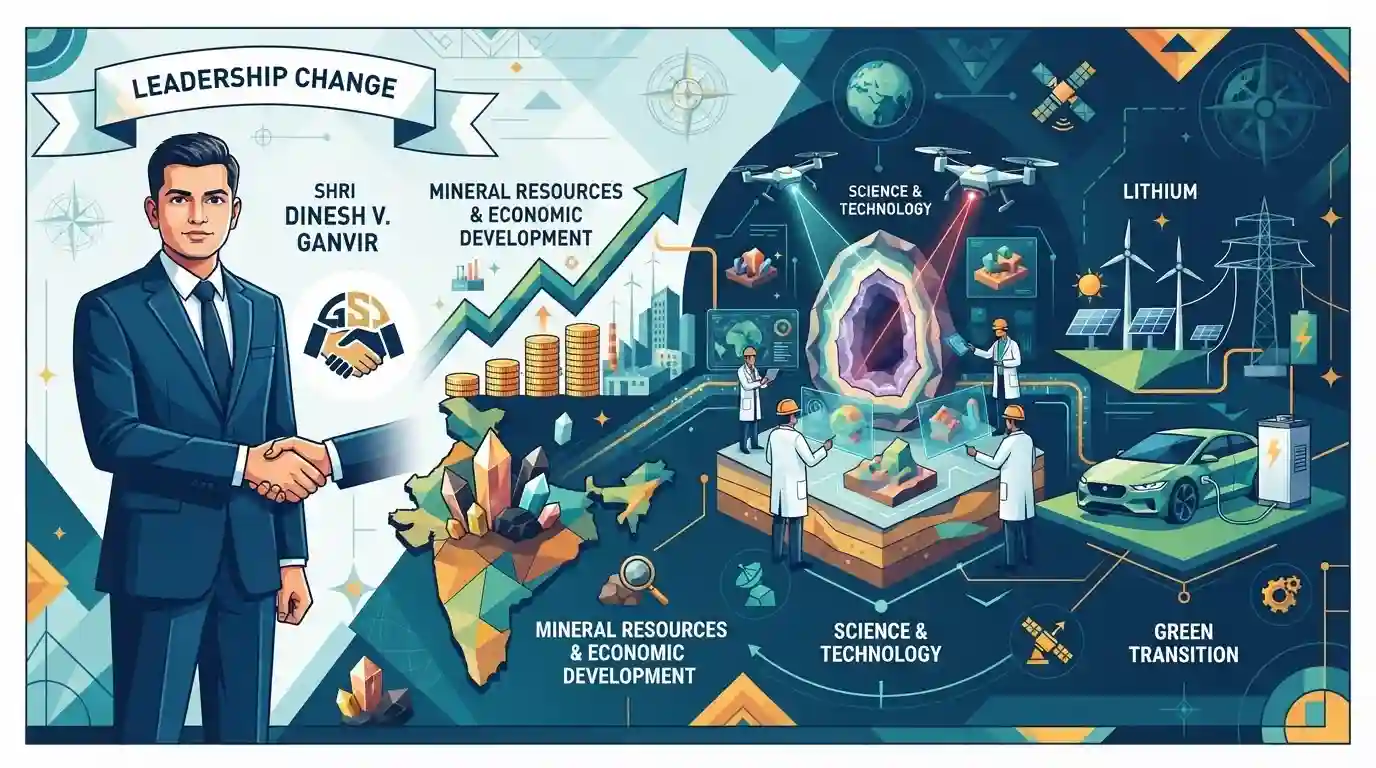
Shri Dinesh V. Ganvir took charge as the Director General of the Geological Survey of India (GSI), reaffirming the organization's focus on national mineral security, technology-driven exploration, and scientific excellence to support India's economic growth and green transition.
Key Points
- Shri Dinesh V. Ganvir assumed charge as the Director General of the Geological Survey of India (GSI).
- He emphasized mineral security, scientific excellence, and technological advancement in mineral exploration.
- The GSI plays a critical strategic role in mapping mineral resources, critical minerals, and strengthening India's energy transition and industrial sectors.
Important Terms
Geological Survey of India

An attached office of the Ministry of Mines, Government of India, founded in 1851 primarily to find coal deposits for the railways, and currently the prime provider of basic earth science information to government, industry, and the general public.
UPSC context
Crucial for GS Paper III (Mineral Resources, Economic Development, Science & Technology). Tests institutional framework for mineral exploration and national mineral security.
GSI
The apex scientific agency of India responsible for conducting geological surveys, mapping, and mineral exploration, functioning under the Ministry of Mines to support industrial growth and the green transition.
UPSC context
Relevant for GS Paper III (Resources, Energy, and Mineral Security). Tests knowledge of key scientific bodies aiding India's economic and energy transition goals.
Prelims Trap
The Geological Survey of India is the supreme regulatory authority responsible for granting mining leases and auctioning mineral blocks across India.
Aspirants often confuse GSI as a regulatory licensing body for mining leases, whereas it is primarily a scientific research and mineral exploration mapping agency under the Ministry of Mines.
Static Concepts Connected
What is the organizational mandate, history, and administrative ministry of the Geological Survey of India (GSI)?
- Historical Roots: Established in 1851 primarily to find coal deposits for the Railways, it is one of the oldest scientific offices of the Government of India.
- Administrative Control: Functioning as an attached office to the Ministry of Mines, GSI is the prime provider of basic earth science information to government, industry, and general public.
- Core Functions: Its main functions include nationwide baseline geoscience data generation, map compilation, and specialized mineral resource assessment and exploration.
Cross-Topic Patterns
Critical Minerals and Green Transition Linkage
GSI's push for critical minerals directly underpins the Critical Minerals Mission and India's net-zero 2070 green energy transition commitments.
Geospatial Tech and National Security
Advanced remote sensing and airborne geophysical surveys by GSI connect mineral exploration to the National Quantum Mission and indigenous tech development.

GSI's mandate, critical mineral mapping, and institutional setup likely to appear in a multi-statement Prelims question on mineral resources.
Linked PYQs · 2
Linked PYQs · 2
- 2025PrelimsGS1
Consider the following statements : I. India has joined the Minerals Security Partnership as a member. II. India is a resource-rich country in all the 30 critical minerals that it has identified. III. The Parliament in 2023 has amended the Mines and Minerals (Development and Regulation) Act, 1957 empowering the Central Government to exclusively auction mining lease and composite license for certain critical minerals. Which of the statements given above are correct?
- 2025MainsGS3
Mineral resources are fundamental to the country's economy and these are exploited by mining. Why is mining considered an environmental hazard? Explain the remedial measures required to reduce the environmental hazard due to mining.
