Paddy Straw Management and CAQM Stubble Burning Review
Source:PIB ↗
આ શા માટે મહત્વનું છે
Stubble burning in northwestern India is a major contributor to winter air pollution crises in the Indo-Gangetic plain and Delhi-NCR. Reviewing ground-level implementation by bodies like CAQM highlights institutional measures, technological adoption (in-situ/ex-situ), and cooperative federalism in tackling environmental challenges.
સારાંશ
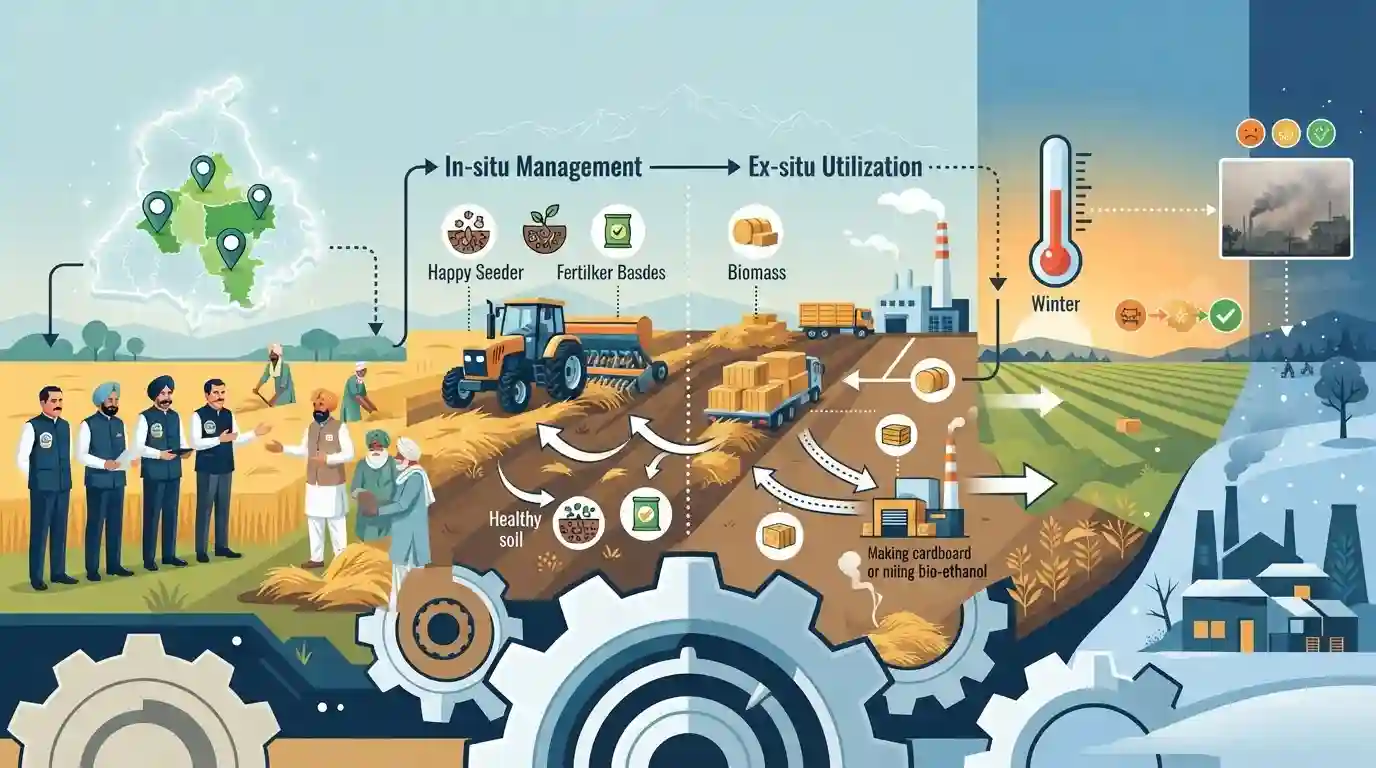
A high-level team from the Commission for Air Quality Management (CAQM) conducted field reviews in the Sangrur, Patiala, and Malerkotla districts of Punjab to evaluate preparedness and enforcement measures for paddy straw management. The review aimed to curb stubble burning through effective in-situ and ex-situ utilization of crop residue, thereby mitigating regional air pollution during the winter season.
મુખ્ય મુદ્દા
- A high-level team from the Commission for Air Quality Management (CAQM) reviewed paddy straw management measures in the Punjab districts of Sangrur, Patiala, and Malerkotla.
- The review focused on minimizing stubble burning incidents through in-situ and ex-situ management strategies ahead of the peak paddy harvesting season.
- Efforts included promoting crop residue management (CRM) machinery, utilizing paddy straw in biomass power plants and industrial boilers, and active monitoring by district administrations.
- The initiative forms part of a multi-agency coordinated approach to curb severe air pollution episodes in the Indo-Gangetic plains and Delhi-NCR during winter.
મહત્વપૂર્ણ શબ્દો
Commission for Air Quality Management (CAQM)

A statutory body established in 2020 under the Commission for Air Quality Management in National Capital Region and Adjoining Areas Act to coordinate, monitor, and plan for air quality management in the NCR and adjoining regions.
UPSC context
UPSC Prelims/Mains (GS Paper III - Environment & Ecology): Important statutory bodies, air pollution governance, and stubble burning mitigation in Northern India.
National Clean Air Programme (NCAP)
India's flagship national-level strategy launched by the MoEFCC in 2019 to reduce particulate matter (PM10 and PM2.5) concentrations by 40% across targeted non-attainment cities by 2025-26.
UPSC context
UPSC Prelims/Mains (GS Paper III - Environment & Pollution): Government policy frameworks, air quality targets, and urban environment management.
પ્રિલિમ્સ ટ્રેપ
CAQM is an advisory executive body established by the Ministry of Environment to monitor air pollution.
CAQM is a statutory body established by a specific 2021 Act, not a constitutional body or a mere executive resolution of the Ministry of Environment.
સંલગ્ન સ્થિર ખ્યાલો
What are the statutory powers and jurisdiction of the Commission for Air Quality Management (CAQM)?
- Statutory Origin: Statutory backing created under the CAQM Act, 2021, replacing the earlier Environment Pollution (Prevention and Control) Authority (EPCA).
- Territorial Reach: Jurisdiction covers Delhi-NCR and adjoining areas in Punjab, Haryana, Rajasthan, and Uttar Pradesh where sources impact NCR air quality.
- Regulatory Powers: Enforcement powers include issuing binding directions, entertaining complaints, setting emission standards, and levying environmental compensation.
What is the difference between In-situ and Ex-situ Crop Residue Management (CRM) strategies?
- In-situ Method: In-situ management incorporates stubble back into the soil using machinery like Happy Seeders, Super Seeders, and Mulchers without removing it.
- Ex-situ Method: Ex-situ management removes straw from the field for industrial use in biomass power plants, bio-ethanol units, and compressed biogas (CBG) plants.
આંતર-વિષય પેટર્ન
Statutory Air Quality Governance + Fiscal Federalism
CAQM's statutory oversight in Delhi-NCR and adjoining states intersects with federal fiscal governance via tied grants under the 15th Finance Commission for air quality improvement.
Crop Residue Management + Circular Bio-Economy
The transition from in-situ CRM machinery subsidies to ex-situ industrial utilization links stubble burning abatement directly to rural circular bio-economy and renewable energy targets.

Expect a statement-based prelims question on CAQM's statutory mandate, jurisdiction, and penal powers vs. advisory role.
સંલગ્ન PYQ · 3
સંલગ્ન PYQ · 3
- 2020MainsGS3
What are the key features of the National Clean Air Programme (NCAP) initiated by the Government of India?
- 2021MainsGS3
Describe the key points of the revised Global Air Quality Guidelines (AQGs) recently released by the World Health Organisation (WHO). How are these different from its last update in 2005? What changes in India's National Clean Air Programme are required to achieve these revised standards?
- 2022PrelimsGS1
Which one of the following has been constituted under the Environment (Protection) Act, 1986?
