Rashtriya Ekta Diwas and National Integration Legacy
Source:PIB ↗
આ શા માટે મહત્વનું છે
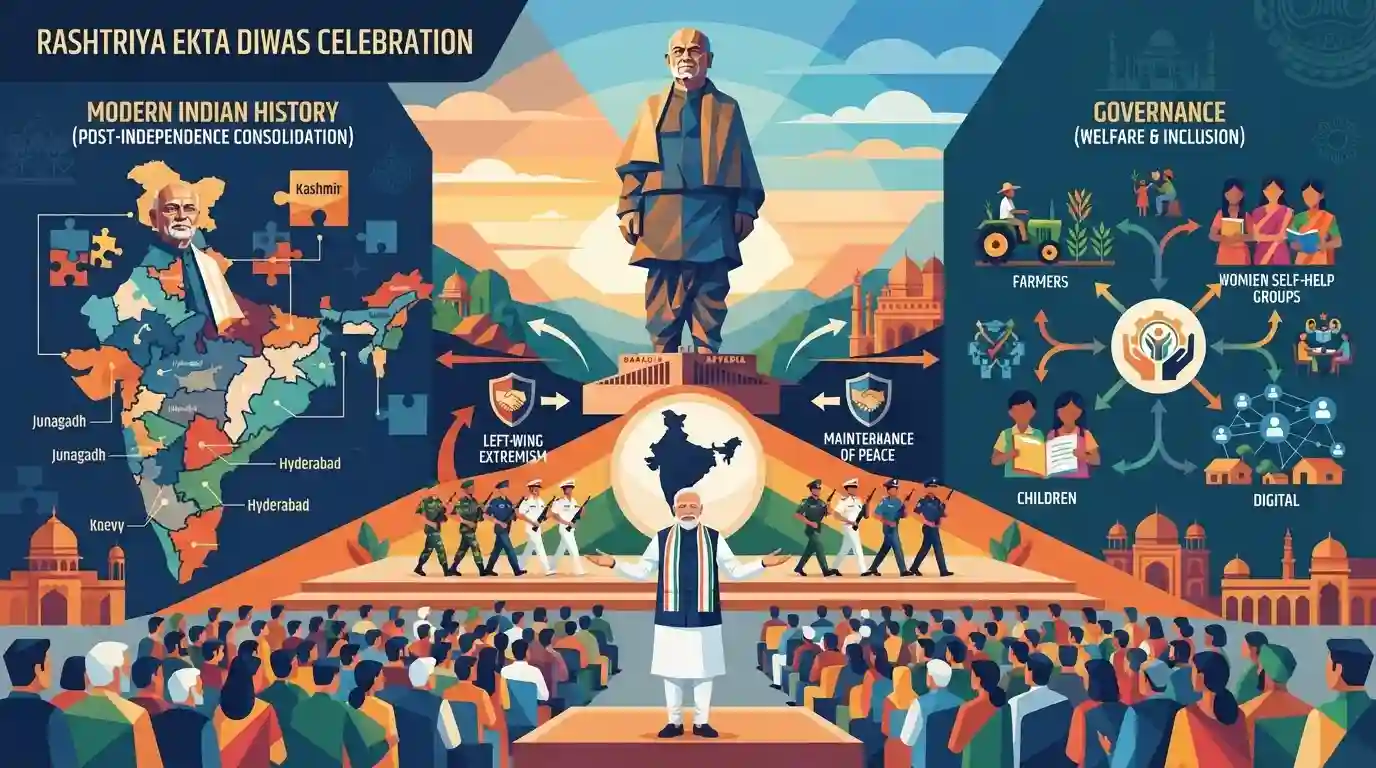
This event underscores the themes of national integration, post-independence consolidation of India led by Sardar Vallabhbhai Patel, internal security, and inclusive governance, which are central to the UPSC syllabus across GS Paper 1, GS Paper 2, and GS Paper 3.
સારાંશ
Prime Minister Narendra Modi participated in Rashtriya Ekta Diwas celebrations commemorating the 151st birth anniversary of Sardar Vallabhbhai Patel at the Statue of Unity in Kevadia, Gujarat. The address highlighted national integration, internal security, unity of the country, and welfare governance inspired by Sardar Patel's vision.
મુખ્ય મુદ્દા
- Prime Minister Narendra Modi participated in the Rashtriya Ekta Diwas celebrations marking the 151st birth anniversary of Sardar Vallabhbhai Patel at Kevadia, Gujarat.
- Stressed the importance of national unity, integrity, and security, drawing inspiration from Sardar Patel's historic role in consolidating the nation.
- Highlighted the government's ongoing push towards inclusive development, poverty alleviation, and robust internal security measures, including combating left-wing extremism.
- Emphasized citizen participation in building a self-reliant and united India ('Ek Bharat Shreshtha Bharat').
મહત્વપૂર્ણ શબ્દો
Rashtriya Ekta Diwas

Observed annually on October 31 to commemorate the birth anniversary of Sardar Vallabhbhai Patel, reinforcing national unity, integrity, and security across India.
UPSC context
UPSC GS Paper I (Modern Indian History - Post-Independence Consolidation) and GS Paper III (Internal Security). Tests knowledge of national integration and legacy of leaders.
સંલગ્ન સ્થિર ખ્યાલો
What were the primary instruments and strategies used by Sardar Patel to integrate princely states into the Indian Union?
- Legal Instrument: Instrument of Accession: Legal document signed by rulers acceding to India on defence, foreign affairs, and communications.
- Interim Pact: Standstill Agreement: Administrative arrangement to maintain existing administrative arrangements pending accession.
- Coercive Action: Police and Military Action: Decisive interventions like Operation Polo (Hyderabad) and Junagadh plebiscite to resolve recalcitrant states.
- Financial Incentives: Privy Purses and Guarantees: Financial allowances provided to former rulers to secure peaceful integration without widespread resistance.
આંતર-વિષય પેટર્ન
Integration of Princely States & Federalism
Sardar Patel's integration strategy of princely states via Instrument of Accession forms the foundational framework for studying India's post-independence federal and administrative evolution under GS Paper I.
Cultural Integration & Cooperative Federalism
Initiatives like Ek Bharat Shreshtha Bharat directly operationalize cultural integration and linguistic harmony, connecting federal governance with cooperative federalism principles in GS Paper II.

Sardar Patel's integration methods combined with contemporary internal security challenges like LWE frequently feature in multi-statement prelims.
સંલગ્ન PYQ · 4
સંલગ્ન PYQ · 4
- 2021MainsGS1
Assess the main administrative issues and socio-cultural problems in the integration process of Indian Princely States.
- 2025MainsGS1
Trace India's consolidation process during early phase of independence in terms of polity, economy, education and international relations.
- 2025MainsGS3
The Government of India recently stated that Left Wing Extremism (LWE) will be eliminated by 2026. What do you understand by LWE and how are the people affected by it? What measures have been taken by the government to eliminate LWE?
- 2022MainsGS2
Besides the welfare schemes, India needs deft management of inflation and unemployment to serve the poor and the underprivileged sections of the society. Discuss.
