Delhi Air Quality Index Trends and October Pollution Data
Source:PIB ↗
ఇది ఎందుకు ముఖ్యం
Understanding trends in urban air quality like Delhi's AQI helps evaluate the efficacy of governance mechanisms such as the CAQM and targeted mitigation strategies under frameworks like the NCAP.
సారాంశం
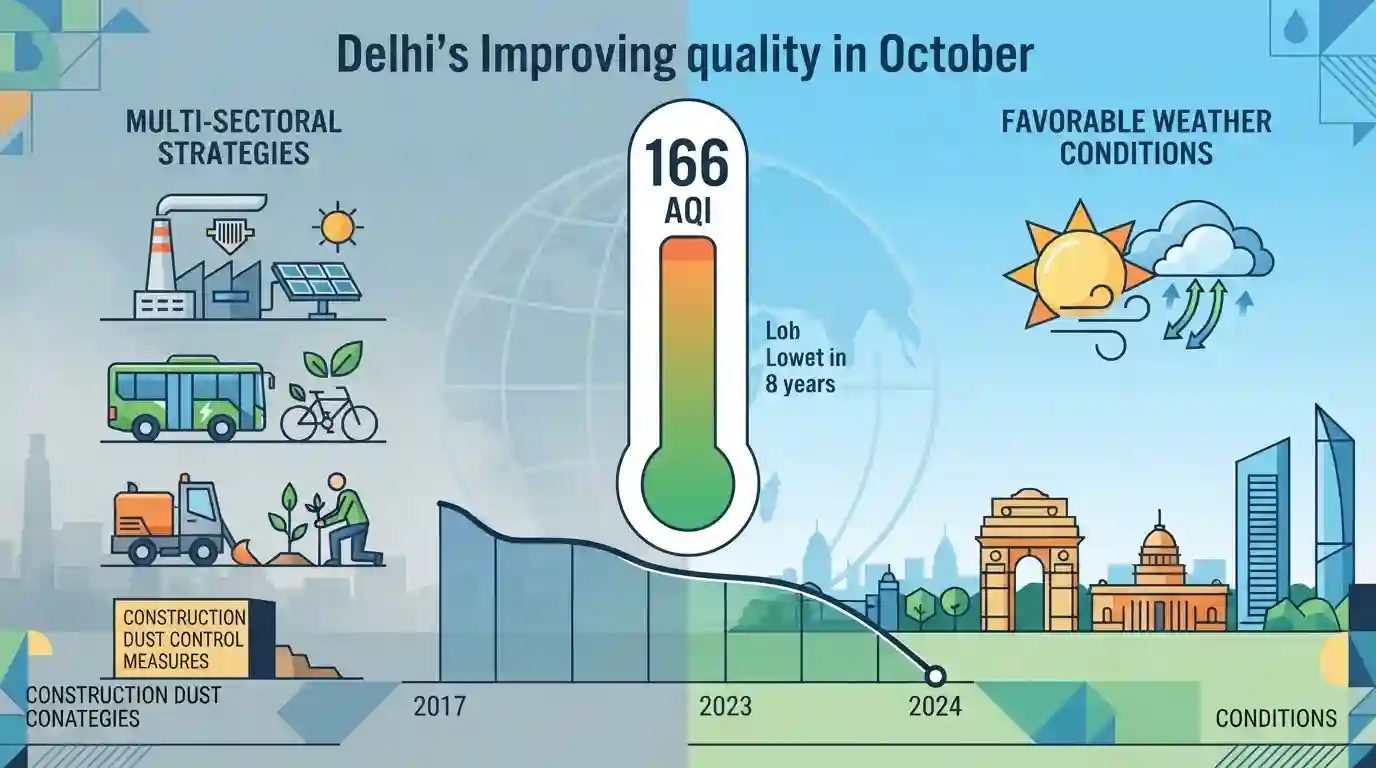
Delhi's average Air Quality Index (AQI) for October reached 166, the lowest in eight years, showcasing the impact of sustained multi-sectoral air pollution mitigation strategies and favorable weather conditions.
ముఖ్య అంశాలు
- Delhi recorded its lowest average Air Quality Index (AQI) for October in the last eight years at 166 in 2025.
- The improvement is attributed to sustained policy interventions, favourable meteorological conditions, and coordinated actions by the Commission for Air Quality Management (CAQM).
- Proactive measures included better stubble management, dust mitigation, and control of industrial and vehicular emissions.
ముఖ్యమైన పదాలు
National Clean Air Programme (NCAP)

India's flagship national strategy launched to reduce particulate matter pollution in targeted cities by up to 40% over defined timeframes.
UPSC context
UPSC GS Paper III (Environment & Ecology): Tests knowledge of government policies, pollution control frameworks, and urban environmental management.
Commission for Air Quality Management in NCR and Adjoining Areas (CAQM)
A statutory body established to coordinate, monitor, and manage air quality governance across the National Capital Region and adjoining areas.
UPSC context
UPSC GS Paper III (Environment & Ecology): Tests understanding of statutory environmental institutions, federal coordination, and anti-pollution interventions.
Central Pollution Control Board (CPCB)
A statutory apex organization under the Ministry of Environment, Forest and Climate Change tasked with promoting clean streams and air, and monitoring national air quality.
UPSC context
UPSC GS Paper III (Environment & Ecology): Important for questions on statutory pollution monitoring bodies and environmental legislation.
ప్రిలిమ్స్ ఉచ్చు
The Commission for Air Quality Management (CAQM) is an advisory body without binding executive powers over state governments.
Aspirants often assume CAQM is a judicial tribunal or an advisory committee, whereas it is a statutory body with overriding powers over state governments in NCR on air pollution matters.
అనుసంధానమైన స్థిర భావనలు
What are the statutory powers and composition of the Commission for Air Quality Management (CAQM)?
- Statutory backing: Statutory Status: Established under the CAQM Act, 2021, superseding the Environment Pollution (Prevention and Control) Authority (EPCA).
- Territorial reach: Jurisdiction: NCR and adjoining areas in Haryana, Punjab, Rajasthan, and Uttar Pradesh.
- Penal powers: Enforcement: Possesses powers to issue directions, entertain appeals, and impose penal penalties/environmental compensation for non-compliance.
అంతర-అంశ నమూనాలు
Airshed Management + Statutory Environmental Bodies
Delhi's AQI improvement showcases how statutory bodies like CAQM coordinate multi-state mitigation strategies across the NCR airshed under Environment Protection Act provisions.

CAQM statutory powers and NCAP targets are frequently tested in Prelims via multi-statement environment governance questions.
అనుసంధాన PYQలు · 2
అనుసంధాన PYQలు · 2
- 2021MainsGS3
Describe the key points of the revised Global Air Quality Guidelines (AQGs) recently released by the World Health Organisation (WHO). How are these different from its last update in 2005? What changes in India's National Clean Air Programme are required to achieve these revised standards?
- 2020MainsGS3
What are the key features of the National Clean Air Programme (NCAP) initiated by the Government of India?
