Tax Devolution Advance Release to States for Capital Spending
Source:PIB ↗
Why It Matters
Tax devolution is a crucial component of India's fiscal federalism. Releasing advance installments directly affects state fiscal health, capital expenditure capacity, and liquidity management, which are core topics under Indian economy and governance (GS Paper III).
Summary
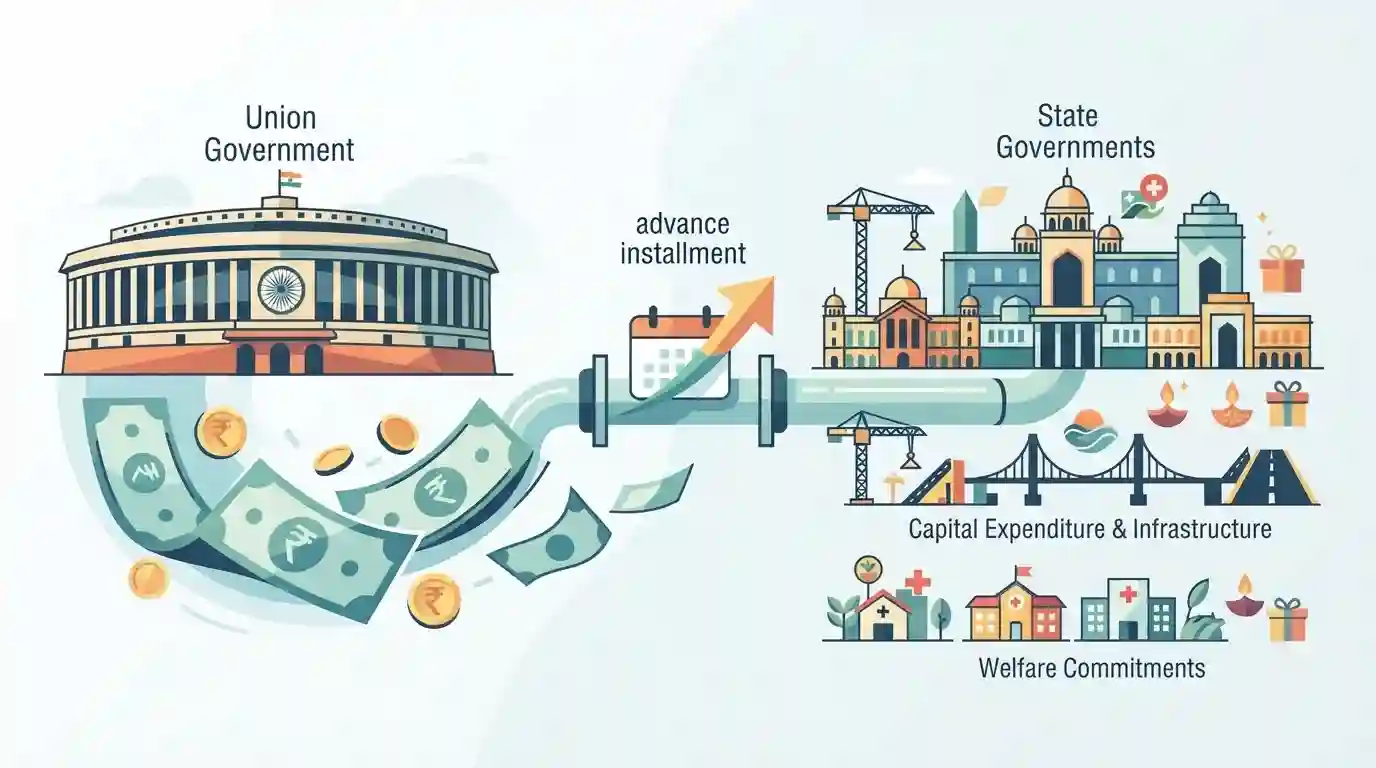
The Union Government has released an advance installment of tax devolution amounting to ₹1,09,019 crore to state governments. The move is intended to provide states with extra liquidity ahead of the festive season, enabling them to expedite capital expenditure, infrastructure projects, and welfare commitments.
Key Points
- The Union Government released tax devolution of ₹1,09,019 crore to State Governments as an advance installment.
- This advance installment is aimed at helping states accelerate capital spending and finance development and welfare-related expenditures during the upcoming festive season.
- Tax devolution is part of cooperative and fiscal federalism where net proceeds of central taxes are shared with states based on Finance Commission formulas.
Important Terms
Tax Devolution

The constitutional distribution of a portion of central tax revenues to state governments, determined by recommendations of the Finance Commission under Article 270 to ensure fiscal federalism.
UPSC context
UPSC CSE GS Paper II (Polity & Governance - Centre-State Financial Relations, Finance Commission). Tests understanding of vertical fiscal imbalance.
Union Government
The central executive authority of India, responsible for national governance, macroeconomic management, and formulating fiscal policies that impact Centre-State financial transfers.
UPSC context
UPSC CSE GS Paper II (Polity & Governance - Federal Structure). Tests the working of executive powers and cooperative federalism.
State Governments
Sub-national administrative bodies in India's federal structure, responsible for regional governance, public welfare, and capital expenditure funded partly through central tax devolution.
UPSC context
UPSC CSE GS Paper II/III (Polity & Governance/Economy - Decentralization, Fiscal Federalism). Tests state financial autonomy and capital spending.
Ministry of Finance
A key ministry of the Union Government responsible for formulating economic policies, managing national finances, preparing the Union Budget, and handling Centre-State tax sharing.
UPSC context
UPSC CSE GS Paper III (Indian Economy - Government Budgeting, Fiscal Policy). Tests institutional mechanisms of public finance management.
Static Concepts Connected
What are the constitutional provisions and principles governing tax devolution between the Centre and States in India?
- Article 270: Constitutional Mandate: Governed primarily by Article 270 of the Constitution, which specifies the collection and distribution of central taxes between the Union and States.
- Cesses & Surcharges: Non-shareable Pool: Cesses and surcharges levied under Article 271 are excluded from the divisible pool and retained entirely by the Union.
- Vertical Split: Vertical Devolution: The overall percentage of divisible central taxes allocated to the states as recommended by the Finance Commission (e.g., 41% by 15th FC).
- Horizontal Split: Horizontal Devolution: Distribution among individual states determined by criteria like income distance, population, area, forest & ecology, and demographic performance.
Cross-Topic Patterns
Tax Devolution & Sub-national Capital Expenditure
Front-loading central tax shares helps sub-national governments fund infrastructure, directly linking fiscal transfers to the capital expenditure push needed for economic recovery.
Finance Commission & Environmental Federalism
Finance Commission devolution formulas balance equity, forest cover, and demographic performance, bridging fiscal federalism with environmental federalism goals.

Article 270 vs Article 271 (Cesses/Surcharges not shareable) and Finance Commission criteria are prime multi-statement prelims traps.
Linked PYQs · 3
Linked PYQs · 3
- 2025MainsGS3
Explain how the Fiscal Health Index (FHI) can be used as a tool for assessing the fiscal performance of states in India. In what way would it encourage the states to adopt prudent and sustainable fiscal policies?
- 2025PrelimsGS1
Which of the following statements with regard to recommendations of the 15th Finance Commission of India are correct? I. It has recommended grants of ₹ 4,800 crores from the year 2022-23 to the year 2025-26 for incentivizing States to enhance educational outcomes. II. 45% of the net proceeds of Union taxes are to be shared with States. III. ₹ 45,000 crores are to be kept as performance-based incentive for all States for carrying out agricultural reforms. IV. It reintroduced tax effort criteria to reward fiscal performance. Select the correct answer using the code given below.
- 2015PrelimsGS1
With reference to the Fourteenth Finance Commission, which of the following statements is/are correct? 1. It has increased the share of States in the central divisible pool from 32 percent to 42 percent. 2. It has made recommendations concerning sector-specific grants. Select the correct answer using the code given below.
