Corporate Social Responsibility in School Education via Vidyanjali
Source:PIB ↗
આ શા માટે મહત્વનું છે
The integration of CSR through digital platforms like Vidyanjali highlights innovative models of resource mobilization for public education, addressing infrastructural deficits and fostering inclusive growth through public-private collaboration.
સારાંશ
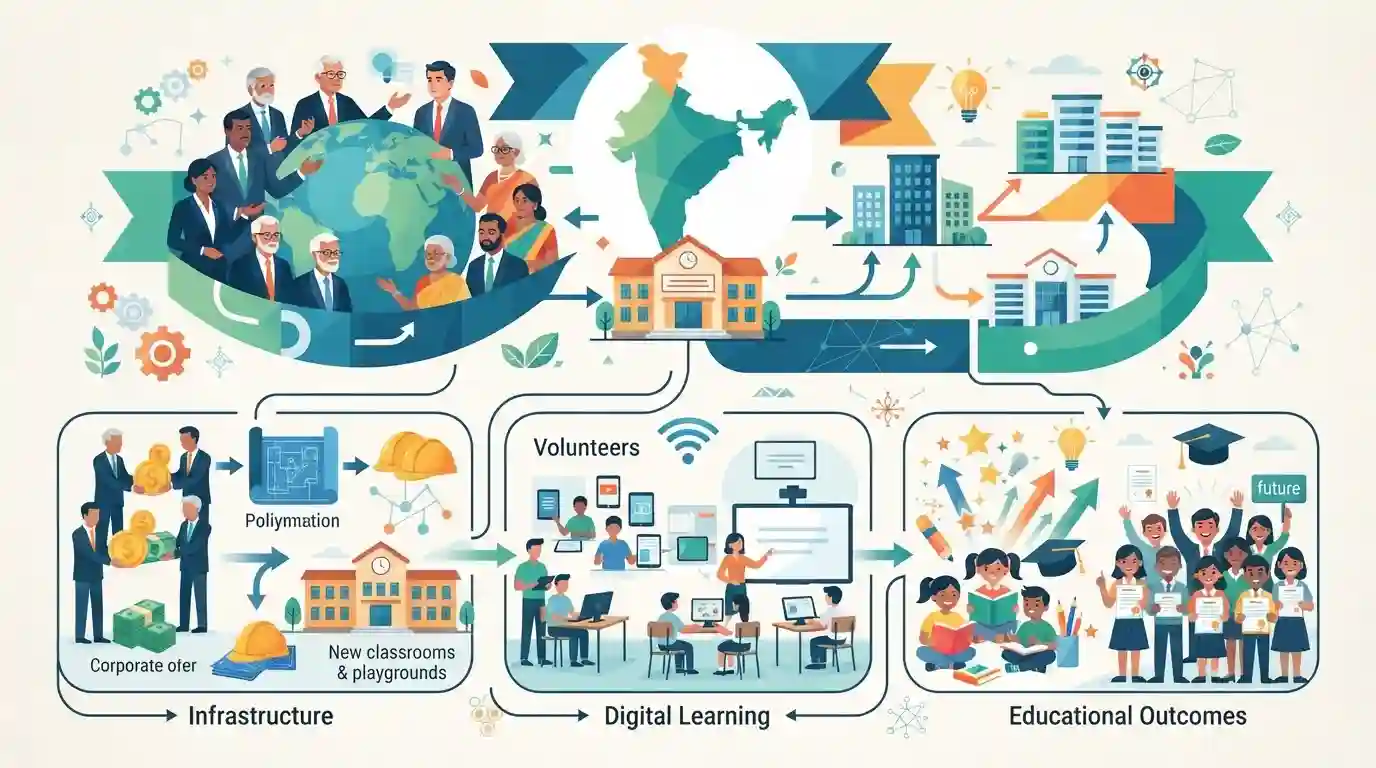
A National CSR Meet for School Education was organised through the Vidyanjali initiative, bringing together corporate leaders, policymakers, and education stakeholders to channel CSR funds toward improving school infrastructure, digital learning, and overall educational outcomes across India.
મુખ્ય મુદ્દા
- The National CSR Meet for School Education was organised to leverage Corporate Social Responsibility (CSR) funds for school infrastructure and development.
- The event highlighted the role of the Vidyanjali portal as a facilitator for bridging gaps in schools through community and corporate participation.
- Emphasis was placed on aligning CSR investments with national educational goals such as foundational literacy, digital infrastructure, and skill development.
- Public-Private Partnerships (PPP) and collaborative governance models were underscored as vital to transforming school education quality in India.
મહત્વપૂર્ણ શબ્દો
Vidyanjali Initiative

A Ministry of Education initiative enabling community members, corporate entities, and volunteers to contribute services, assets, and CSR funds to strengthen government and government-aided school infrastructure across India.
UPSC context
UPSC GS Paper II (Social Sector/Education) — Tests governance mechanisms, school education reforms, and public-private partnerships in human resource development.
Corporate Social Responsibility (CSR)
A statutory obligation under Section 135 of the Companies Act, 2013, requiring qualifying companies to spend 2 percent of their average net profits on social welfare and development activities.
UPSC context
UPSC GS Paper III (Economy/Inclusive Growth) — Tests corporate governance, development financing, and industry contribution to national development goals.
Ministry of Education
The nodal central ministry responsible for formulating national education policy, planning, and implementing school and higher education schemes across India.
UPSC context
UPSC GS Paper II (Governance) — Tests institutional frameworks, policy implementation, and administrative oversight in the social sector.
પ્રિલિમ્સ ટ્રેપ
all registered corporate entities in India are legally mandated to allocate 2% of their profits toward CSR activities like Vidyanjali.
Aspirants often assume CSR contributions are mandatory for all registered companies in India, whereas Section 135 applies only to companies meeting specific net worth, turnover, or net profit thresholds.
સંલગ્ન સ્થિર ખ્યાલો
What are the core provisions and eligible activities under CSR in India as per the Companies Act, 2013?
- Applicability Criteria: Applies to companies with net worth of ₹500 crore+, turnover of ₹1,000 crore+, or net profit of ₹5 crore+ in any financial year.
- Mandatory Spend: Mandates spending at least 2% of average net profits of the preceding three financial years on specified socio-developmental activities.
- Schedule VII: Schedule VII lists eligible activities including eradicating hunger, promoting education, gender equality, environmental sustainability, and rural development.
આંતર-વિષય પેટર્ન
CSR + Public Education Governance
CSR investments in government schools via portals like Vidyanjali directly intersect with corporate governance rules and the cooperative federalism framework in public education delivery.

Vidyanjali portal + Section 135 Companies Act eligibility for education will feature in a matching or statement-based prelims question.
સંલગ્ન PYQ · 2
સંલગ્ન PYQ · 2
- 2013MainsGS3
With a consideration towards the strategy of inclusive growth, the new Companies Bill, 2013 has indirectly made CSR a mandatory obligation. Discuss the challenges expected in its implementation in right earnest. Also discuss other provisions in the Bill and their implications.
- 2022MainsGS3
Why is Public Private Partnership (PPP) required in infrastructural projects ? Examine the role of PPP model in the redevelopment of Railway Stations in India.
