Public Administration Reforms for Viksit Bharat 2047 Vision
Source:PIB ↗
Why It Matters
The address touches upon core themes of governance, civil service accountability, and public institutional capacity required for India's long-term development goals (Viksit Bharat @ 2047), making it highly relevant for GS Paper II.
Summary
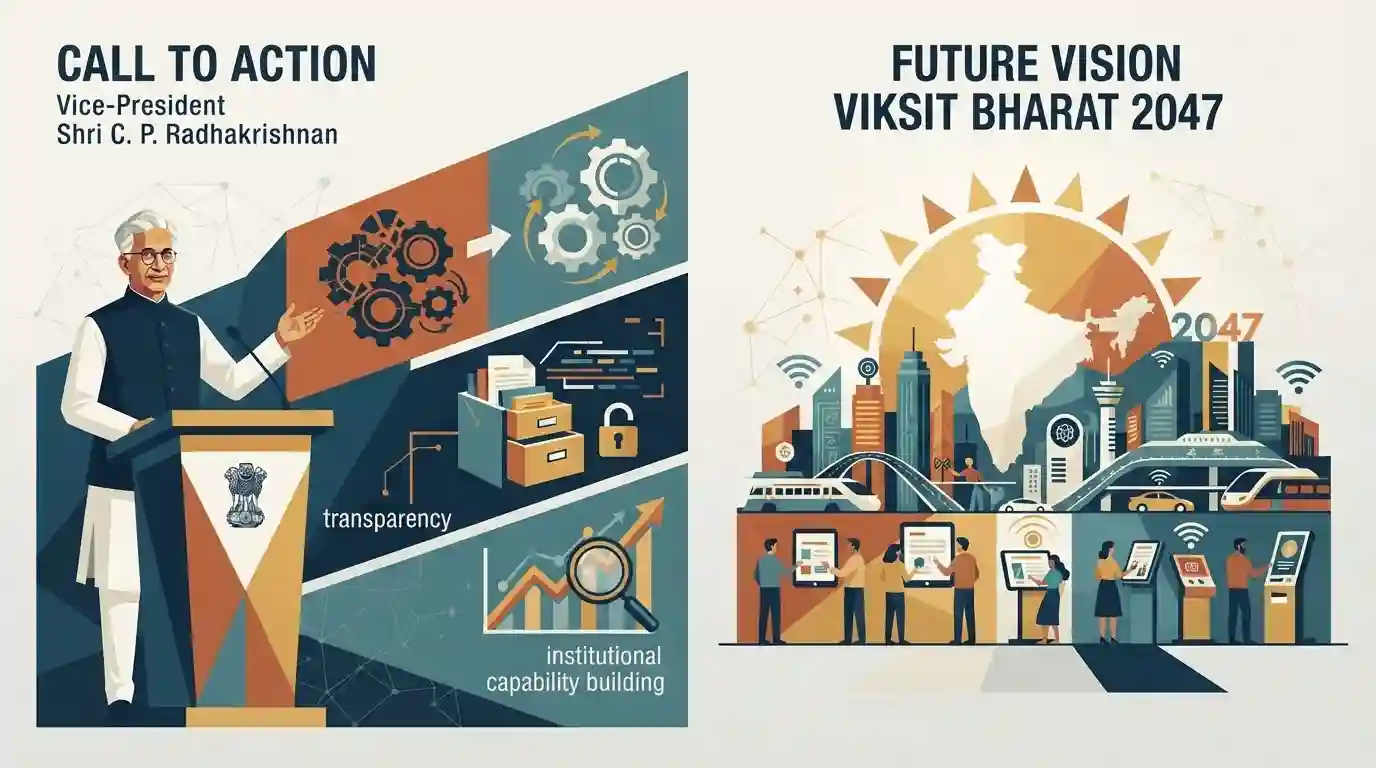
Vice-President Shri C. P. Radhakrishnan delivered an address at the 72nd Annual General Body Meeting of the Indian Institute of Public Administration (IIPA), calling for deep administrative reforms, transparency, and institutional capability building to steer India toward becoming a developed nation (Viksit Bharat) by 2047.
Key Points
- Vice-President Shri C. P. Radhakrishnan addressed the 72nd Annual General Body Meeting of the Indian Institute of Public Administration (IIPA).
- Emphasized the critical need for transformative reforms in public administration to achieve the vision of Viksit Bharat by 2047.
- Highlighted the role of civil servants and institutions like IIPA in fostering citizen-centric governance, accountability, and integrity.
- Stressed leveraging technology and innovation to streamline public service delivery and bridge governance gaps.
Important Terms
Viksit Bharat @ 2047

India's vision and policy framework to transform the nation into a developed country by the centenary of its independence in 2047, focusing on economic growth, social inclusion, and good governance.
UPSC context
UPSC Mains GS Paper III (Economy/Development) & GS Paper IV (Governance): Tests long-term policy vision, inclusive growth, and strategic planning goals.
Indian Institute of Public Administration (IIPA)
A premier research and training institution established in 1954 to build capacities in public administration, policy formulation, and governance for civil servants in India.
UPSC context
UPSC Mains GS Paper II (Governance/Civil Services): Tests institutional framework for administrative training, capacity building, and civil service reforms.
Static Concepts Connected
What is the genesis and institutional role of the Indian Institute of Public Administration (IIPA)?
- Genesis: Established in 1954 on the recommendation of American public administration expert Paul H. Appleby to reform administrative systems.
- Leadership: The Vice-President of India serves as the ex-officio President of the IIPA General Body.
- Mandate: Functions as a premier research and training hub for public administration, civil services capacity building, and policy analysis in India.
Cross-Topic Patterns
Capacity Building + Digital Public Infrastructure
Civil services reform initiatives like Mission Karmayogi intersect with e-governance infrastructure, transitioning administrative training from rule-based to role-based competency frameworks.

Expect match-the-following or statement-based questions on the origin, ex-officio heads, and mandates of premier training institutes like IIPA.
Linked PYQs · 2
Linked PYQs · 2
- 2024MainsGS2
The Doctrine of Democratic Governance makes it necessary that the public perception of the integrity and commitment of civil servants becomes absolutely positive. Discuss.
- 2020MainsGS2
Institutional quality is a crucial driver of economic performance". In this context suggest reforms in Civil Service for strengthening democracy.
