NAMASTE Scheme and Sanitation Worker Occupational Safety
Source:PIB ↗
কেন এটি গুরুত্বপূর্ণ
It addresses critical governance and social justice issues regarding the welfare, safety, and rehabilitation of vulnerable informal workers like sanitation workers, tying into inclusive growth and statutory obligations against manual scavenging.
সারসংক্ষেপ
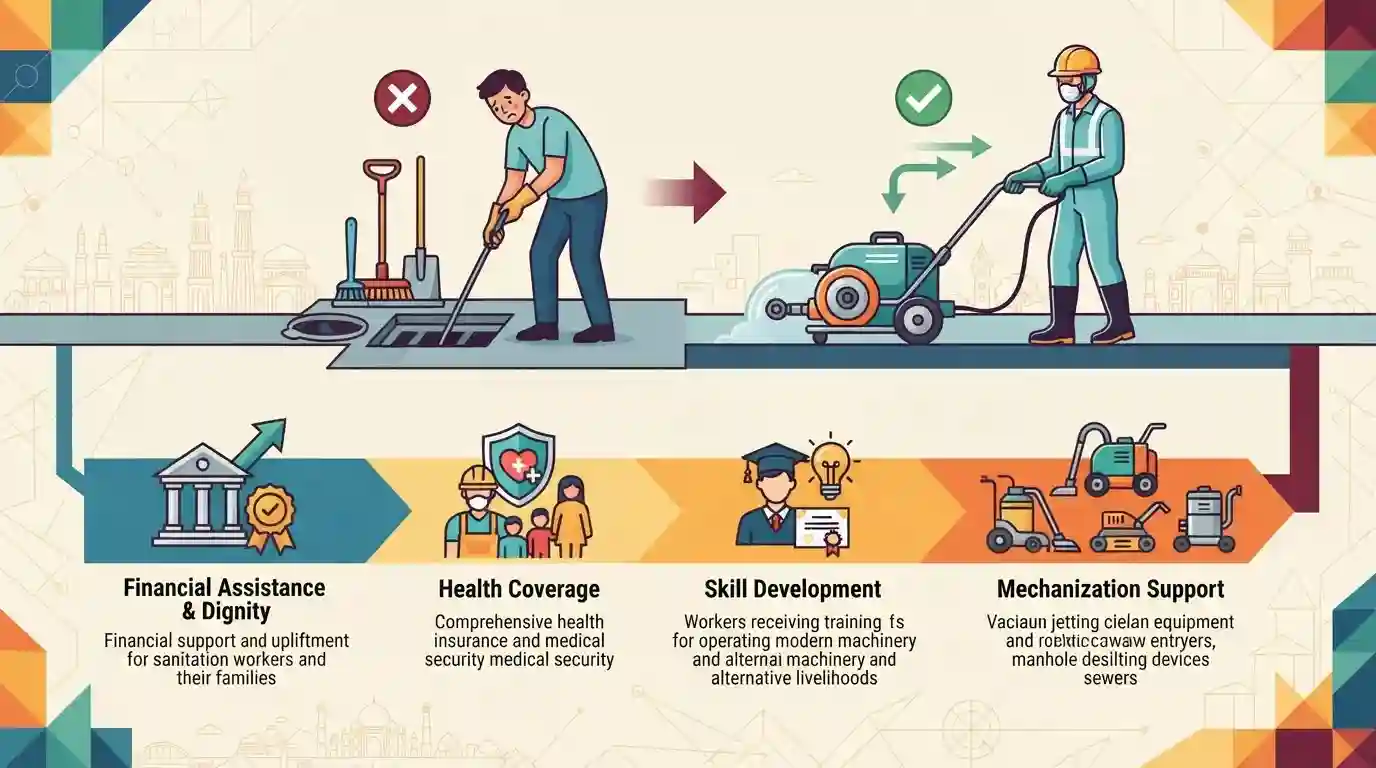
The article discusses India's strategic push toward ensuring dignified work, occupational safety, and comprehensive welfare for sanitation workers, moving away from hazardous manual labor. Highlighting initiatives like the NAMASTE scheme, it outlines measures such as mechanization of cleaning operations, financial assistance, health coverage, and skill development to uplift vulnerable sanitation communities and eradicate manual scavenging.
মূল বিষয়
- Transition from hazardous manual scavenging and unhygienic sanitation work to mechanized, dignified, and safe sanitation ecosystems.
- Implementation of the National Action for Mechanised Sanitation Ecosystem (NAMASTE) scheme focusing on safety, legal protection, and livelihood enhancement for sanitation workers.
- Provision of capital subsidies, skill development, health insurance (via Ayushman Bharat PM-JAY), and safety gear to sanitation workers and their dependents.
- Addressing social stigma, occupational health risks, and lack of formal social security through targeted welfare interventions and institutional support.
গুরুত্বপূর্ণ শব্দ
National Action for Mechanised Sanitation Ecosystem (NAMASTE)

A central sector scheme jointly launched by MoSJE and MoHUA to achieve zero fatalities in sanitation work, replace hazardous manual scavenging with mechanized cleaning, and provide holistic welfare and financial security.
UPSC context
UPSC GS Paper II (Welfare Schemes, Social Justice). Evaluates government interventions for vulnerable communities, occupational safety, and eradication of manual labor.
Prohibition of Employment as Manual Scavengers and their Rehabilitation Act 2013
Landmark legislation that completely prohibits manual scavenging, outlaws insanitary latrines, and mandates the identification and legal rehabilitation of manual scavengers.
UPSC context
UPSC GS Paper II (Social Justice, Legislation). Tests legal frameworks protecting marginalized castes and enforcement challenges in eradicating degrading practices.
Ministry of Social Justice and Empowerment
The nodal ministry at the central level responsible for welfare, social protection, empowerment, and rehabilitation policies for marginalized groups including sanitation workers and Safai Karamcharis.
UPSC context
UPSC GS Paper II (Governance and Institutional Mechanisms). Crucial for understanding policy formulation and execution for vulnerable sections.
National Safai Karamcharis Finance and Development Corporation (NSKFDC)
A central public sector undertaking under the Ministry of Social Justice and Empowerment tasked with financial assistance and skill development for Safai Karamcharis and manual scavengers.
UPSC context
UPSC GS Paper II & III (Inclusive Growth, Economic Empowerment). Important for questions on institutional financing and skill programs for marginalized communities.
প্রিলিমস ফাঁদ
NAMASTE scheme is solely implemented by the Ministry of Social Justice and Empowerment.
Aspirants often assume NAMASTE is implemented exclusively by the Ministry of Social Justice and Empowerment, overlooking its joint execution with the Ministry of Housing and Urban Affairs.
সংযুক্ত স্থির ধারণা
What are the key statutory provisions and institutional mechanisms against manual scavenging in India?
- 2013 Legislation: Prohibition Act 2013 bans manual scavenging entirely, penalizes construction of unsanitary latrines, and mandates rehabilitation of identified workers.
- NSKFDC Mandate: NSKFDC acts as the nodal apex corporation under the Ministry of Social Justice and Empowerment for economic upliftment of safai karamcharis.
- Judicial Mandates: Supreme Court rulings in 2023 directed states to ensure compensation of ₹10 lakhs for sewer death victims and absolute mechanization of cleaning.
আন্তঃবিষয় প্যাটার্ন
Manual Scavenging and Constitutional Fundamental Rights
The Prohibition of Employment as Manual Scavengers Act 2013 intersects with Articles 17 (Untouchability) and 23 (Prohibition of forced labour) under Fundamental Rights.
Welfare Schemes and Universal Healthcare Coverage
Integrating sanitation workers into Ayushman Bharat PM-JAY links targeted welfare schemes with broader universal healthcare coverage initiatives in India.

NAMASTE scheme's dual ministry mandate and inclusion of waste pickers make it a prime candidate for a multi-statement prelims question.
সংযুক্ত PYQ · 3
সংযুক্ত PYQ · 3
- 2024MainsGS3
Discuss the merits and demerits of the four 'Labour Codes' in the context of labour market reforms in India. What has been the progress so far in this regard?
- 2016MainsGS3
How globalization has led to the reduction of employment in the formal sector of the Indian economy? Is increased informalization detrimental to the development of the country?
- 2017MainsGS2
To ensure effective implementation of policies addressing water, sanitation and hygiene needs the identification of the beneficiary segments is to be synchronized with the anticipated outcomes." Examine the statement in the context of the WASH scheme.
