Telangana Urged to Maximize Free Trade Agreements for Exports
Source:PIB ↗
কেন এটি গুরুত্বপূর্ণ
Understanding FTA utilization and state-level export promotion strategies is crucial for India's trade policy and economic growth, aligning directly with GS3 syllabus requirements on international trade and economic development.
সারসংক্ষেপ
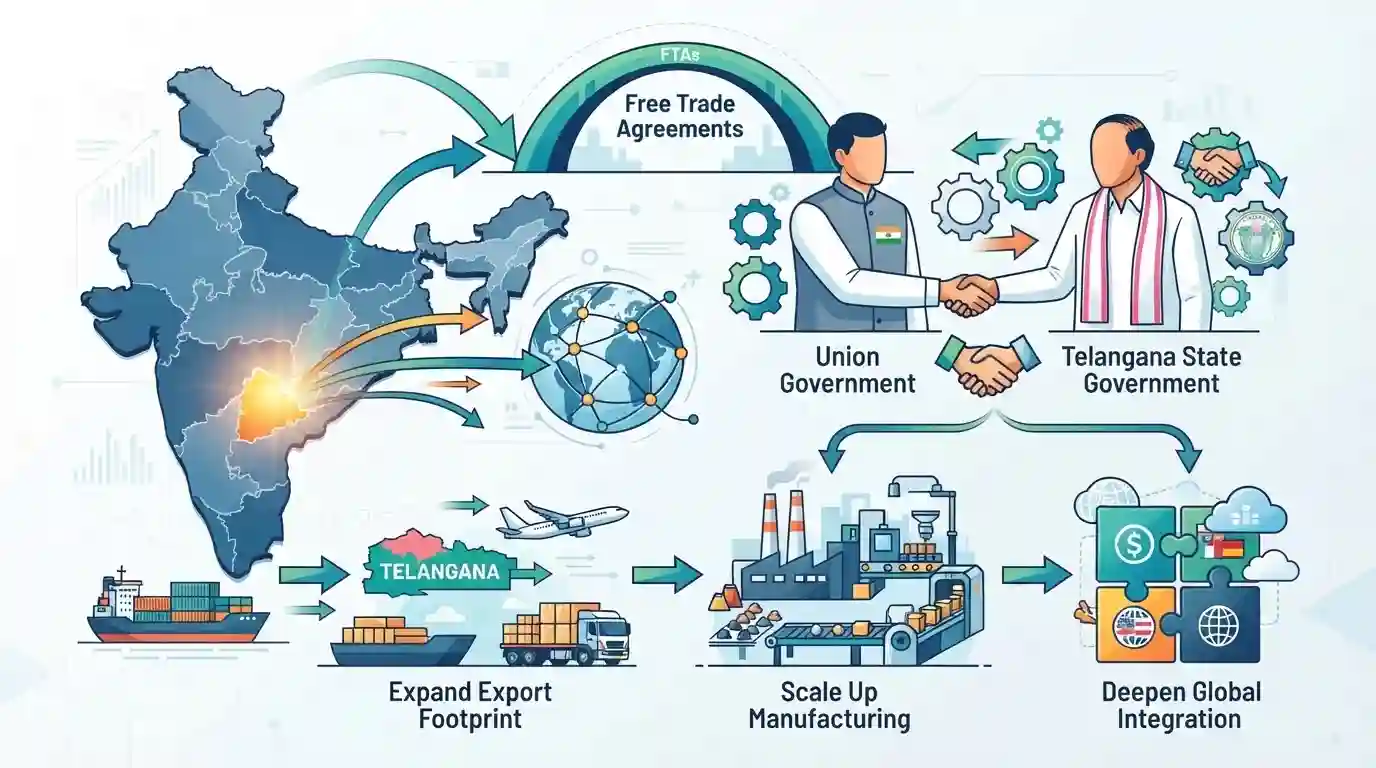
Union Minister of Commerce and Industry Shri Piyush Goyal called upon the state of Telangana to actively utilize Free Trade Agreements (FTAs) to expand its export footprint, scale up manufacturing, and integrate deeply into global value chains. The address underscored the need for enhanced synergy between the Centre and states to promote export competitiveness, leverage local strengths, and maximize the benefits of international trade pacts.
মূল বিষয়
- Union Minister Shri Piyush Goyal urged Telangana to leverage Free Trade Agreements (FTAs) to boost exports and global market integration.
- Emphasized the importance of enhancing FTA utilisation rates among domestic industries and MSMEs.
- Highlighted the role of state-level participation, export promotion, and tapping into unique local products including Geographical Indication (GI) tagged goods.
- Discussed strengthening cooperative federalism to drive export-led economic growth at the state level.
গুরুত্বপূর্ণ শব্দ
Free Trade Agreements (FTAs)

International pacts between countries to reduce or eliminate tariffs and non-tariff barriers on trade in goods and services, promoting market access and global integration.
UPSC context
UPSC GS Paper 3 (International Relations / Economy): Important for understanding global trade dynamics, bilateral pacts, export competitiveness, and India's trade policy.
Ministry of Commerce and Industry
The nodal central government ministry responsible for formulating and implementing foreign trade policy, promoting exports, regulating industries, and negotiating international trade agreements.
UPSC context
UPSC GS Paper 2 & 3: Crucial for questions on governance, export promotion schemes, industrial policy, and institutional frameworks for economic development.
প্রিলিমস ফাঁদ
signing a Free Trade Agreement automatically ensures full export benefits and high utilization across all domestic industries and MSMEs without requiring compliance checks.
Aspirants often assume signing an FTA automatically grants duty-free access for all domestic goods, overlooking that strict Rules of Origin (RoO) compliance often results in low utilization rates (10-30%).
সংযুক্ত স্থির ধারণা
What are the key operational hurdles and compliance requirements in Free Trade Agreements (FTAs)?
- Origin Criteria: Rules of Origin (RoO) criteria determine the economic nationality of traded goods to prevent tariff-shifting by non-member nations.
- Non-Tariff Barriers: Non-Tariff Barriers (NTBs) such as sanitary and phytosanitary (SPS) measures often restrict developing nation exports despite zero tariffs.
- Low Utilisation: Information asymmetry and complex certification procedures contribute to India's low FTA utilization rate among MSMEs.
আন্তঃবিষয় প্যাটার্ন
FTAs & Rules of Origin Compliance Hurdles
India's low FTA utilization rate among MSMEs (10-30%) stems from complex Rules of Origin compliance, mirroring WTO trade remedy compliance hurdles.
GI Tags & Districts as Export Hubs
Promoting GI-tagged goods like Tandur Redgram connects state-level export hubs with global value chains under cooperative federalism.

Low FTA utilisation + Rules of Origin compliance challenges for MSMEs is a high-yield conceptual area for prelims.
সংযুক্ত PYQ · 2
সংযুক্ত PYQ · 2
- 2025MainsGS3
What are the challenges before the Indian economy when the world is moving away from free trade and multilateralism to protectionism and bilateralism? How can these challenges be met?
- 2024MainsGS2
What changes has the Union Government recently introduced in the domain of Centre-State relations ? Suggest measures to be adopted to build the trust between the Centre and the States and for strengthening federalism.
