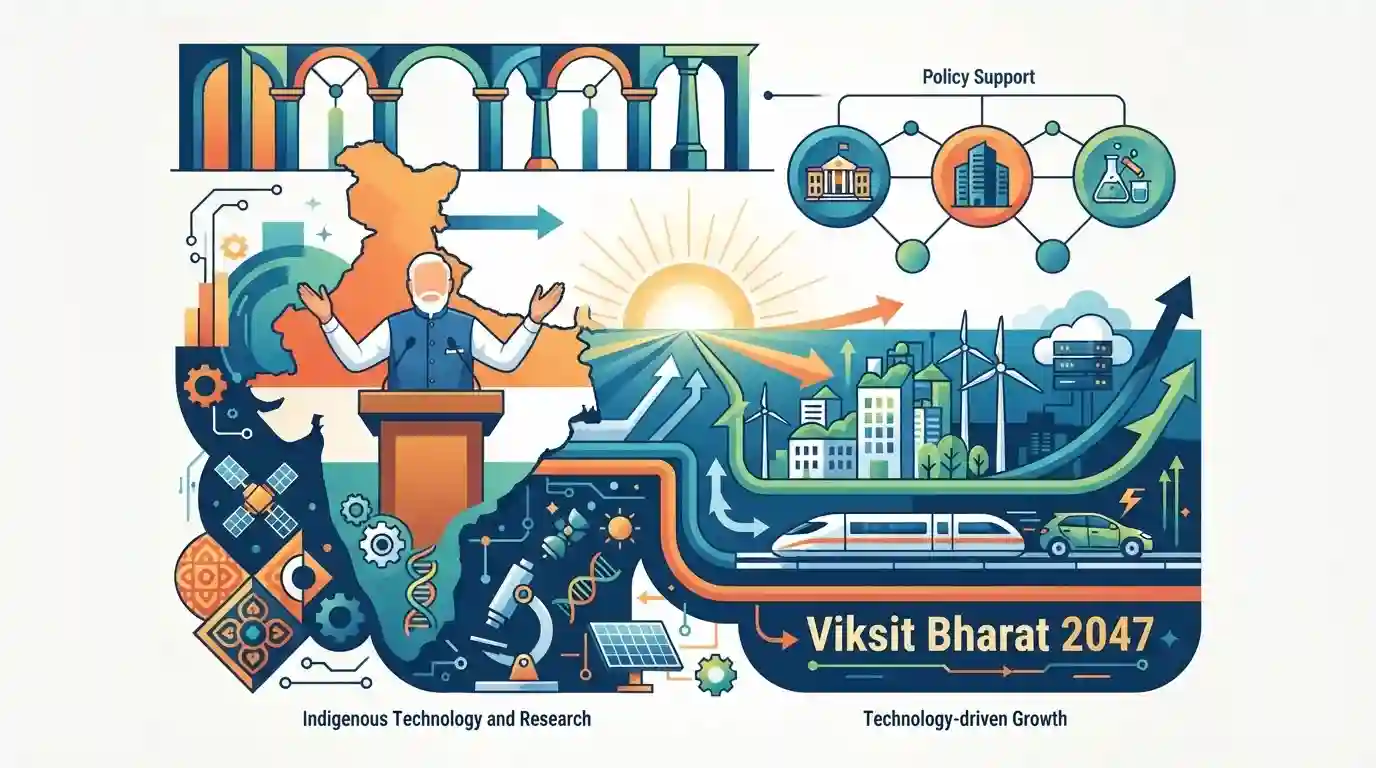
ESTIC Conference: Indigenous Technology and Viksit Bharat 2047 Vision
Source:PIB ↗
কেন এটি গুরুত্বপূর্ণ
The themes discussed in ESTIC 2026 directly align with India's goals of self-reliance (Atmanirbhar Bharat) and technology-driven development for Viksit Bharat 2047, making it relevant for questions on science and technology policy and national development.
সারসংক্ষেপ
The conclusion of ESTIC 2026 featured a call by Union Minister Dr Jitendra Singh for leveraging technology, science, and innovation to drive national transformation and fulfill the vision of Viksit Bharat by 2047, emphasizing indigenous research and development and institutional collaborations.
মূল বিষয়
- The ESTIC 2026 conference concluded with a strong emphasis on technology-led transformation to achieve Viksit Bharat by 2047.
- Union Minister Dr Jitendra Singh highlighted the critical role of science, technology, and innovation (STI) in driving socio-economic growth and self-reliance.
- The event stressed strengthening industry-academia-research collaboration to foster indigenous technology development.
গুরুত্বপূর্ণ শব্দ
Viksit Bharat 2047

India's national roadmap and vision to transform into a fully developed nation by the centenary of its independence in 2047, encompassing economic growth, social inclusion, and technological self-reliance.
UPSC context
Important for GS Paper III (Economic Development & Growth) and Essay paper, testing strategies for India's long-term socio-economic development and policy targets.
Ministry of Science and Technology
The central government ministry responsible for formulating policies, promoting research and development, and coordinating scientific and technological activities across India through its departments like DST, DBT, and DSIR.
UPSC context
Important for GS Paper III (Science and Technology - Policy & Interventions), testing institutional frameworks and governance of India's STI ecosystem.
সংযুক্ত স্থির ধারণা
What are the core institutional pillars of India's Science, Technology, and Innovation policy ecosystem?
- ANRF Mandate: The Anusandhan National Research Foundation aims to seed, grow, and promote R&D and foster a culture of research in universities and laboratories.
- Industry-Academia Link: Encouraging joint ventures between public research institutions, universities, and private industries to accelerate commercialization of indigenous technologies.
- Atmanirbhar Tech: Focusing on domestic design, development, and manufacturing to reduce strategic dependencies and achieve technological self-reliance.
আন্তঃবিষয় প্যাটার্ন
Indigenous R&D and IP Commercialisation
India's push for indigenous R&D and Viksit Bharat 2047 directly relies on patent landscape reforms, IPR frameworks, and funding structures like the Anusandhan National Research Foundation (ANRF).
Industry-academia linkages in STI policy
Bridging industry-academia gaps mirrors previous institutional push mechanisms seen in initiatives like PM-STIAC and NITI Aayog's innovation clusters.

Viksit Bharat 2047 timelines + STI policy frameworks will likely feature in matching or statement-based Prelims questions.
সংযুক্ত PYQ · 2
সংযুক্ত PYQ · 2
- 2025MainsGS3
How can India achieve energy independence through clean technology by 2047? How can biotechnology can play a crucial role in this endeavour?
- 2016MainsGS3
Why is nanotechnology one of the key technologies of the 21st century? Describe the salient features of Indian Government's Mission on Nanoscience and Technology and the scope of its application in the development process of the country.
