People's Plan Campaign: Grassroots Decentralized Planning Framework
Source:PIB ↗
Why It Matters
The People's Plan Campaign is central to strengthening grassroots democracy and local-level planning, directly aligning with UPSC GS2 themes of decentralization, local governance, and implementation of public policies at the village level.
Summary
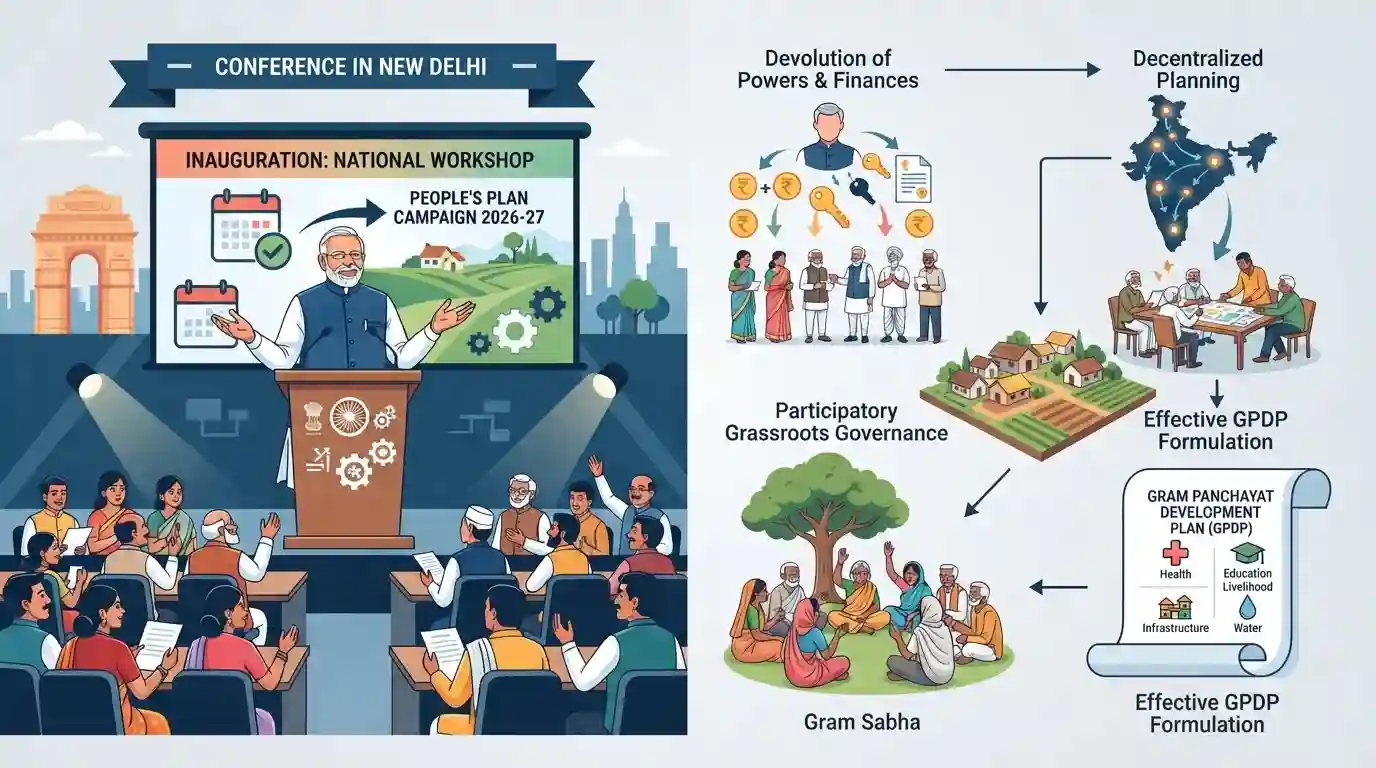
Union Minister Shri Rajiv Ranjan Singh inaugurated the National Workshop on People’s Plan Campaign 2026-27 in New Delhi, aiming to foster decentralized planning and participatory grassroots governance by formulating effective Gram Panchayat Development Plans (GPDPs).
Key Points
- Union Minister Shri Rajiv Ranjan Singh inaugurated the National Workshop on People’s Plan Campaign (PPC) 2026-27 in New Delhi.
- The campaign focuses on strengthening grassroots democracy, bottom-up planning, and participatory governance through the formulation of comprehensive Gram Panchayat Development Plans (GPDPs).
- It emphasizes the convergence of resources, local economic development, and sustainable development goals (SDGs) at the local level.
Important Terms
People’s Plan Campaign 2026-27

A nationwide participatory planning campaign ('Sabki Yojana, Sabka Vikas') launched by the Ministry of Panchayati Raj to formulate inclusive Gram Panchayat Development Plans through active Gram Sabha involvement.
UPSC context
Important for GS Paper II (Polity & Governance - Grassroots Democracy, Decentralization, Local Government). Tests decentralized planning implementation.
Gram Panchayat Development Plan (GPDP)
A comprehensive annual and perspective development plan formulated by Gram Panchayats based on local needs, covering the 29 subjects listed under the Eleventh Schedule of the Constitution.
UPSC context
Important for GS Paper II (Polity & Governance - Panchayati Raj Institutions). Tests statutory planning functions of rural local bodies.
Ministry of Panchayati Raj
The nodal central ministry responsible for advocacy, capacity building, and policy formulation for the effective functioning of Panchayati Raj Institutions across India.
UPSC context
Important for GS Paper II (Polity & Governance). Tests the institutional framework and administrative oversight of rural local governance.
Prelims Trap
Gram Panchayats have absolute autonomy in levying taxes and executing all 29 Eleventh Schedule subjects without state oversight.
Aspirants often assume Panchayats have independent constitutional taxation powers; however, taxes must be authorized by state legislation and are complemented by central/state grants.
Static Concepts Connected
What are the core constitutional provisions governing Panchayati Raj Institutions in India?
- Constitutional Basis: Part IX of the Constitution contains Articles 243 to 243-O added by the 73rd Constitutional Amendment Act, 1992.
- Eleventh Schedule: The Eleventh Schedule enumerates 29 functional items placed within the purview of Panchayats (Article 243G).
- Three-Tier Structure: Mandates a three-tier system of Panchayats at village, intermediate, and district levels in states with a population exceeding 20 lakhs.
Cross-Topic Patterns
Local Governance + E-Governance Initiatives
Decentralized planning under PPC directly implements the 73rd Amendment and operationalizes the 29 subjects of the Eleventh Schedule through digital integration via eGramSwaraj.
Inclusive Growth + Localization of SDGs
The PPC campaign explicitly drives the localization of SDGs at the grassroots level, linking fiscal decentralization with global climate and social targets.

PPC & GPDP convergence with the 11th Schedule subjects and eGramSwaraj is a high-yield area for multi-statement prelims questions.
Linked PYQs · 2
Linked PYQs · 2
- 2022MainsGS2
To what extent, in your opinion, has the decentralisation of power in India changed the governance landscape at the grassroots?
- 2020MainsGS2
The strength and sustenance of local institutions in India has shifted from their formative phase of 'Functions, Functionaries and Funds' to the contemporary stage of 'Functionality'. Highlight the critical challenges faced by local institutions in terms of their functionality in recent times.
