National Coastal Mission and Climate Resilience Strategies for India
Source:PIB ↗
কেন এটি গুরুত্বপূর্ণ
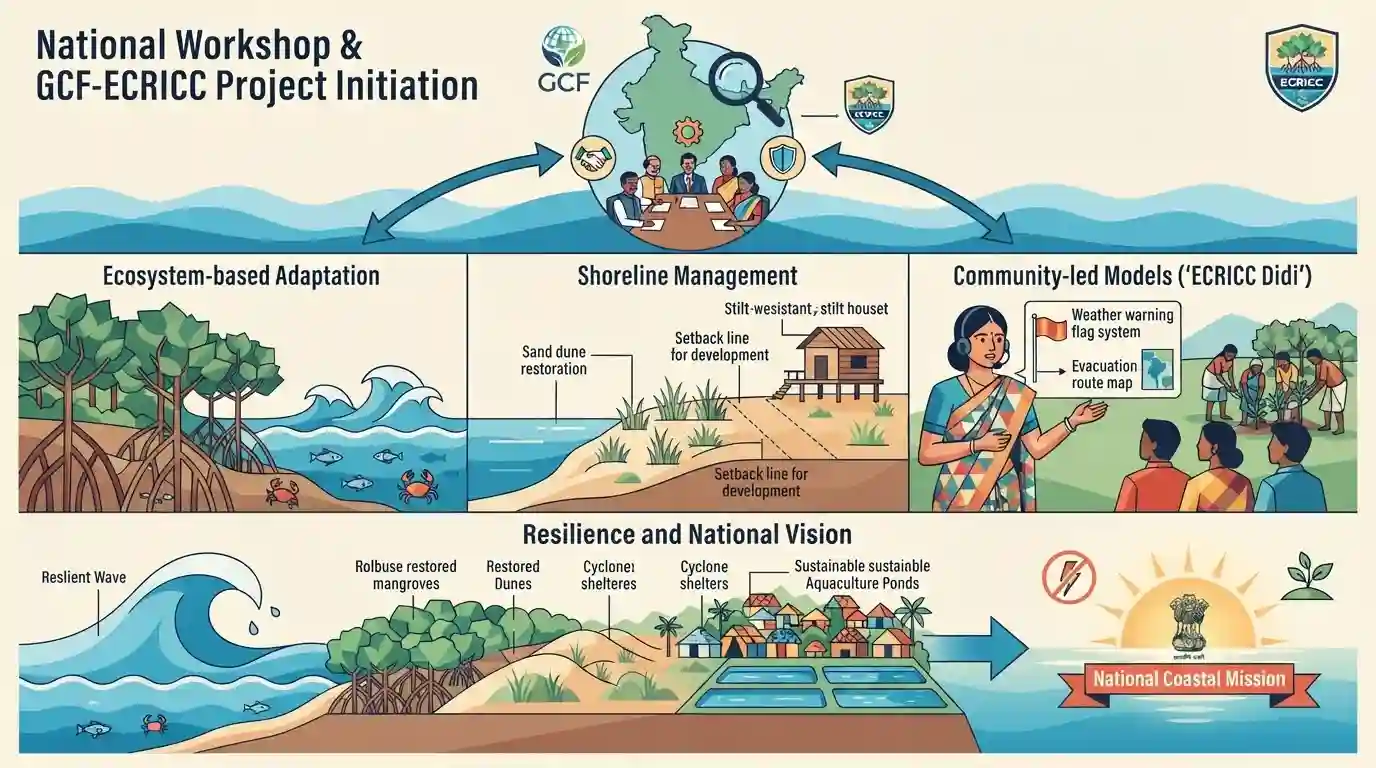
It highlights India's institutional and financial mechanisms (such as GCF projects and the upcoming National Coastal Mission) to mitigate climate change risks, sea-level rise, and coastal erosion while supporting vulnerable coastal communities and promoting the Blue Economy.
সারসংক্ষেপ
The Ministry of Environment, Forest and Climate Change organized a national workshop on enhancing coastal resilience through adaptive strategies under the GCF-ECRICC project. The initiative underscores ecosystem-based adaptation, shoreline management, and community-led models like 'ECRICC Didi' to combat climate risks along India's coastline, paving the way for the National Coastal Mission.
মূল বিষয়
- The Ministry of Environment, Forest and Climate Change (MoEFCC) inaugurated a National Workshop on ‘Enhancing Coastal Resilience through Adaptive Strategies’ in New Delhi on October 29-30, 2026.
- The workshop is part of the Green Climate Fund (GCF) project - Enhancing Climate Resilience of India’s Coastal Communities (GCF-ECRICC), active in Andhra Pradesh, Maharashtra, and Odisha.
- The project focuses on restoring critical coastal ecosystems like mangroves, seagrasses, salt marshes, and coral reefs to protect biodiversity and livelihoods.
- The 'ECRICC Didi' model was highlighted as a community-based climate champion initiative empowering women from coastal communities.
- The National Coastal Mission will act as a fulcrum for building on GCF-ECRICC outcomes to scale up coastal resilience and adaptive planning across states.
গুরুত্বপূর্ণ শব্দ
Enhancing Climate Resilience of India’s Coastal Communities (GCF-ECRICC)

A major climate adaptation project supported by the Green Climate Fund and implemented by MoEFCC and UNDP to bolster the resilience of vulnerable coastal communities in states like Andhra Pradesh, Maharashtra, and Odisha.
UPSC context
UPSC Paper III: Environmental Conservation and Climate Change Adaptation. Tests knowledge of international climate funding mechanisms and community-led adaptation strategies.
Green Climate Fund (GCF)
The world's largest dedicated climate fund established under the UNFCCC to help developing countries finance ambitious climate mitigation and adaptation actions.
UPSC context
UPSC Paper III: Environment and International Conventions. Tests understanding of global climate finance architectures and funding bodies.
National Coastal Mission
A proposed national initiative intended to scale up climate adaptation, shoreline management, and ecosystem restoration models derived from projects like ECRICC across India's coastline.
UPSC context
UPSC Paper III: Disaster Management and Coastal Ecosystems. Important for questions on national policies addressing sea-level rise and coastal vulnerability.
Ministry of Environment, Forest and Climate Change (MoEFCC)
The nodal Union ministry in India charged with planning, promoting, and coordinating environmental, forestry, and climate change policies and programmes.
UPSC context
UPSC Paper II & III: Governance and Environmental Administration. Tests institutional frameworks for environmental protection and policy implementation.
প্রিলিমস ফাঁদ
The GCF-ECRICC project is an exclusively domestic centrally sponsored scheme funded entirely through the consolidated fund of India.
Aspirants often confuse centrally funded national missions with externally aided projects; GCF-ECRICC is specifically backed by the Green Climate Fund, not domestic budgetary support alone.
সংযুক্ত স্থির ধারণা
What are the primary institutional financing mechanisms and institutional frameworks for climate change adaptation in India?
- GCF Role: Green Climate Fund is the financial mechanism of the UNFCCC established to assist developing countries in adaptation and mitigation practices.
- NAFCC Support: National Adaptation Fund for Climate Change (NAFCC) supports adaptation core activities in states particularly vulnerable to climate change impacts.
- NAPCC Missions: National Action Plan on Climate Change (NAPCC) comprises eight core national missions including the National Mission on Sustaining the Himalayan Ecosystem and Strategic Knowledge.
আন্তঃবিষয় প্যাটার্ন
Climate Finance Meets Decentralized Governance
Coastal adaptation initiatives bridge climate finance frameworks (GCF) with local governance mechanisms under the 73rd/74th Constitutional Amendments for decentralized disaster management.
Gender Mainstreaming in Climate Action
The ECRICC Didi model highlights the intersection of gender mainstreaming (SDG 5) with climate resilience (SDG 13) in vulnerable rural coastal economies.

Match GCF-ECRICC project states (AP, Maharashtra, Odisha) and core funding mechanisms in a statement-based prelims question.
সংযুক্ত PYQ · 3
সংযুক্ত PYQ · 3
- 2022MainsGS3
Explain the causes and effects of coastal erosion in India. What are the available coastal management techniques for combating the hazard?
- 2024MainsGS3
What is disaster resilience? How is it determined? Describe various elements of a resilience framework. Also mention the global targets of Sendai Framework for Disaster Risk Reduction (2015–2030).
- 2023MainsGS3
The Intergovernmental Panel on Climate Change (IPCC) has predicted a global sea level rise of about one metre by AD 2100. What would be its impact in India and the other countries in the Indian Ocean region?
