PMEGP Margin Money Subsidy for Micro Enterprise Development
Source:PIB ↗
Why It Matters
The MSME sector is a critical pillar of India's economy, contributing significantly to GDP, manufacturing output, and employment generation. Schemes like PMEGP provide essential credit support and margin money subsidies to encourage youth entrepreneurship and foster inclusive regional development, aligning directly with Mains GS3 syllabus requirements.
Summary
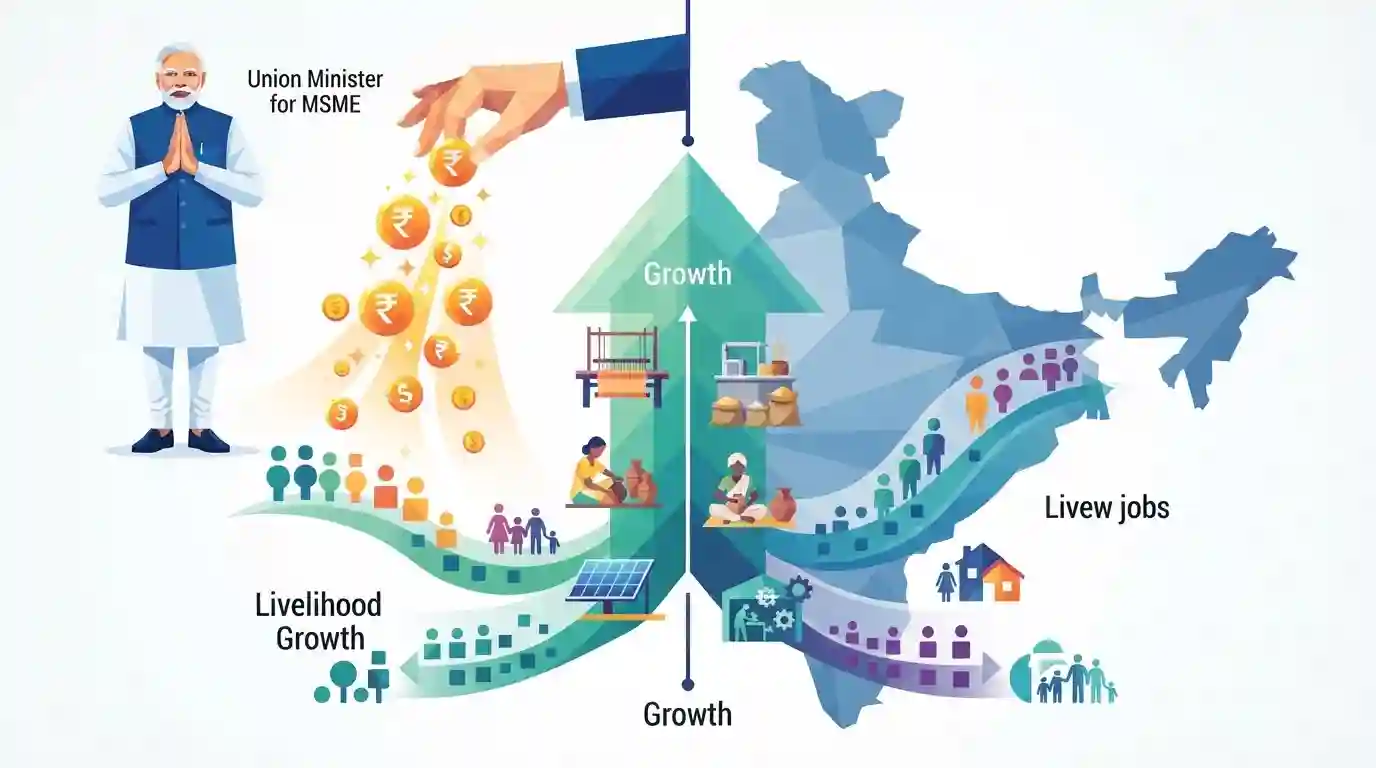
Union Minister for MSME Shri Jitan Ram Manjhi released ₹1,000 Crore in Margin Money Subsidy under the Prime Minister's Employment Generation Programme (PMEGP) to support 11,333 new micro enterprises nationwide, driving employment generation and grassroots industrial growth.
Key Points
- The Union Minister for MSME released ₹1,000 crore as Margin Money Subsidy under the Prime Minister's Employment Generation Programme (PMEGP).
- The financial assistance aims to support the establishment of 11,333 new micro enterprises across India.
- PMEGP is a credit-linked subsidy scheme aimed at generating self-employment opportunities through micro-enterprises in non-farm sectors.
- The initiative promotes grassroots entrepreneurship and economic empowerment, boosting manufacturing and service sectors.
Important Terms
Prime Minister's Employment Generation Programme (PMEGP)

A central sector credit-linked subsidy scheme administered by the Ministry of MSME and implemented by KVIC to generate continuous employment opportunities through new micro-enterprises in rural and urban areas.
UPSC context
UPSC Paper III (Indian Economy & Inclusive Growth) - tests knowledge of government employment schemes, entrepreneurship, and credit-linked subsidies.
Ministry of Micro, Small and Medium Enterprises (MSME)
The apex executive body in the Government of India responsible for formulating and administering rules, regulations, and laws relating to micro, small, and medium enterprises.
UPSC context
UPSC Paper III (Economy) - tests structural policies, industrial development, and employment generation in the MSME sector.
Khadi and Village Industries Commission (KVIC)
A statutory body established under an Act of Parliament that functions under the Ministry of MSME to plan, promote, and implement khadi and village industry programs in India.
UPSC context
UPSC Paper III (Economy) - tests institutional bodies supporting rural industrialization, traditional artisans, and grassroots employment.
Prelims Trap
PMEGP is a direct cash transfer scheme deposited straight into the beneficiary's bank account without any bank loan component.
Aspirants often confuse PMEGP with direct cash transfer schemes; it is actually a credit-linked subsidy scheme channeled via banks through KVIC.
Static Concepts Connected
What are the key implementing features and financial parameters of the PMEGP scheme?
- Nodal Agency: Implemented nationally by the Khadi and Village Industries Commission (KVIC) under the Ministry of MSME as a central sector credit-linked subsidy scheme.
- Subsidy Structure: Margin money subsidy ranges from 15% to 35% of project cost based on beneficiary category and rural/urban location.
- Project Ceilings: Maximum project cost is ₹50 lakh for manufacturing and ₹20 lakh for service/trading sectors.
- Origin Merger: Formed by merging PMRY and REGP schemes to foster non-farm employment.
Cross-Topic Patterns
PMEGP Subsidy and RBI Priority Sector Lending
PMEGP credit-linked subsidies intersect with priority sector lending (PSL) mandates, where commercial banks must meet micro-enterprise lending quotas set by RBI.
Rural Industrialisation and Decentralised Enterprise Ecosystems
Gramin industrialisation through KVIC ties rural self-employment back to rural infrastructure schemes like Rurban Mission and SVAMITVA property mapping.

PMEGP financing patterns, KVIC implementing role, and project cost ceilings are frequent matches for matching-list questions.
Linked PYQs · 2
Linked PYQs · 2
- 2023PrelimsGS1
Consider the following statements with reference to India: 1. According to the 'Micro, Small and Medium Enterprises Development (MSMED) Act, 2006', the 'medium enterprises' are those with investments in plant and machinery between ₹ 15 crore and ₹ 25 crore. 2. All bank loans to the Micro, Small and Medium Enterprises qualify under the priority sector. Which of the statements given above is/are correct?
- 2023MainsGS3
Faster economic growth requires increased share of the manufacturing sector in GDP, particularly of MSMEs. Comment on the present policies of the Government in this regard.
