Atal Vayo Abhyuday Yojana and Senior Citizen Welfare in India
Source:PIB ↗
Why It Matters
With India's population rapidly ageing, policies targeting the welfare, social security, and dignity of senior citizens under schemes like Atal Vayo Abhyuday Yojana are crucial for GS2 Governance and Social Justice syllabi.
Summary
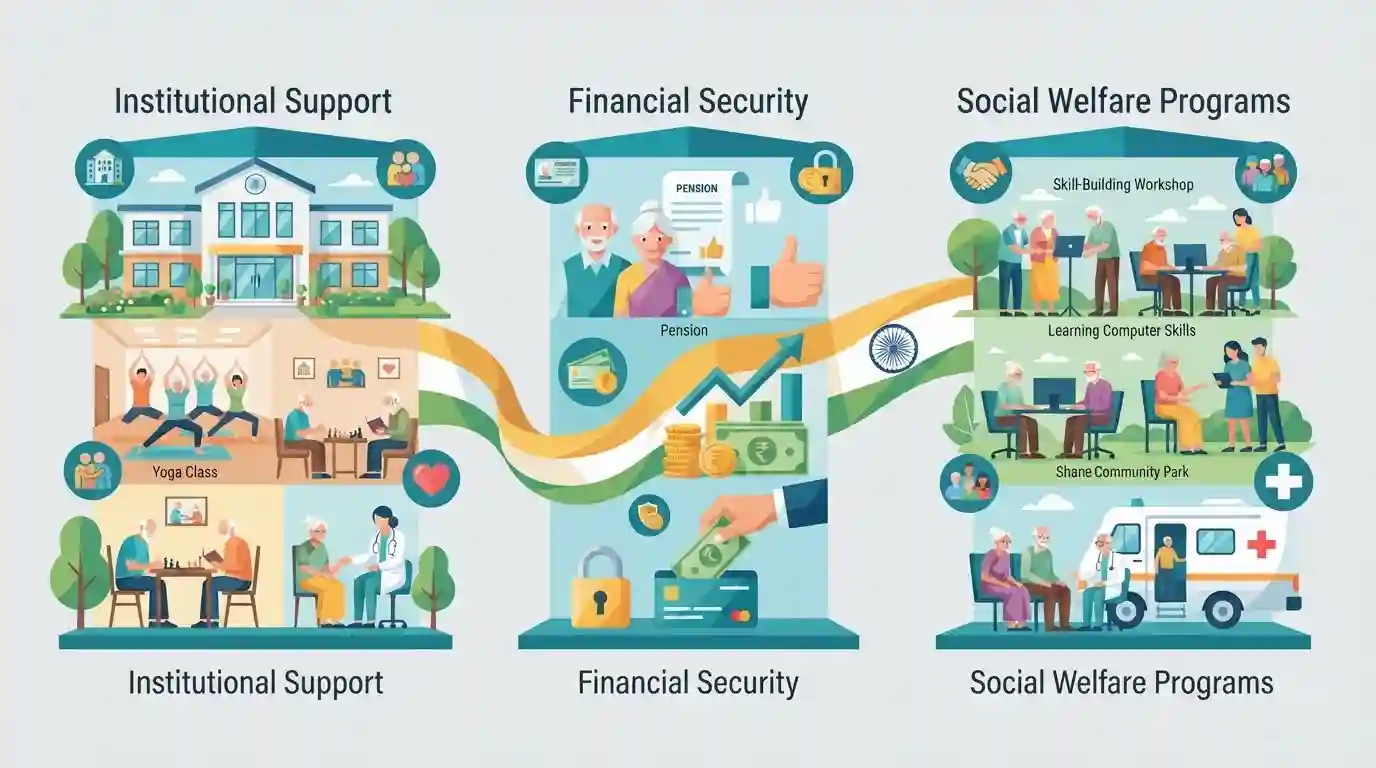
The article highlights the implementation and impact of the Atal Vayo Abhyuday Yojana (AVYAY), a comprehensive scheme by the Ministry of Social Justice and Empowerment designed to promote dignified ageing and welfare of senior citizens in India through institutional support, financial security, and social welfare programs.
Key Points
- Atal Vayo Abhyuday Yojana (AVYAY) is a central sector scheme aimed at empowering senior citizens and ensuring their dignified ageing in India.
- The scheme focuses on financial security, healthcare, intergenerational bonding, and institutional care for the elderly population.
- Addresses the demographic transition and rising share of the elderly demographic cohort in India's population.
- Involves community-based initiatives, old age homes, and capacity-building programs to support vulnerable senior citizens.
Important Terms
Atal Vayo Abhyuday Yojana (AVYAY)

An umbrella central sector scheme by the Ministry of Social Justice and Empowerment aimed at empowering senior citizens, ensuring their financial security, health, and dignified ageing through various institutional and community interventions.
UPSC context
GS Paper II (Social Justice - Welfare schemes for vulnerable sections). Crucial for questions on elderly welfare, demographic dividends, and geriatric care.
National Action Plan for Senior Citizens (NAPSC)
A comprehensive umbrella plan earlier known by this name, restructured into AVYAY, designed to improve the quality of life of older persons by providing basic amenities like shelter, food, medical care, and livelihood opportunities.
UPSC context
GS Paper II (Government Policies & Interventions). Tests understanding of policy evolution and framework changes for senior citizen welfare.
Ministry of Social Justice and Empowerment
The nodal central ministry responsible for formulating and implementing policies, welfare schemes, and legislative measures for the empowerment of marginalized, vulnerable, and disadvantaged groups, including senior citizens.
UPSC context
GS Paper II (Governance and Polity). Important for identifying nodal agencies implementing social security and welfare mandates.
Static Concepts Connected
What are the key institutional and financial frameworks for senior citizens in India under constitutional and statutory mandates?
- Constitutional Mandate: Constitutional Basis: Article 41 of the DPSP directs the State to make effective provision for public assistance in cases of old age, sickness, and disablement.
- Statutory Framework: Statutory Right: The Maintenance and Welfare of Parents and Senior Citizens Act, 2007 legally obligates children and heirs to provide maintenance for senior citizens.
- Nodal Scheme: Umbrella Scheme: AVYAY subsumes programs like IPSrC for old age homes, RVY for assistive devices, and establishes the Elderline (14567) helpline.
Cross-Topic Patterns
Demographic Dividend vs. Silver Economy Fiscal Pressures
The rising median age intersects with fiscal deficit debates, as expanding non-contributory pensions for a projected 23 crore elderly by 2036 strains social sector allocations in Union Budgets.

Expect a statement-based question pairing AVYAY components (IPSrC, RVY, Elderline) with ministry nodal responsibilities or demographic projections.
Linked PYQs · 2
Linked PYQs · 2
- 2023MainsGS2
“Development and welfare schemes for the vulnerable, by its nature, are discriminatory in approach.” Do you agree? Give reasons for your answer.
- 2019MainsGS2
Performance of welfare schemes that are implemented for vulnerable sections is not so effective due to absence of their awareness and active involvement at all stages of policy process. Discuss.
