India expands maritime partnerships in Busan for shipbuilding
Source:PIB ↗
हे का महत्त्वाचे आहे
This article reflects India's proactive policy push to position itself as a major maritime, shipbuilding, and recycling hub, aligning domestic industrial growth (Make in India) with global environmental standards and international strategic partnerships.
सारांश
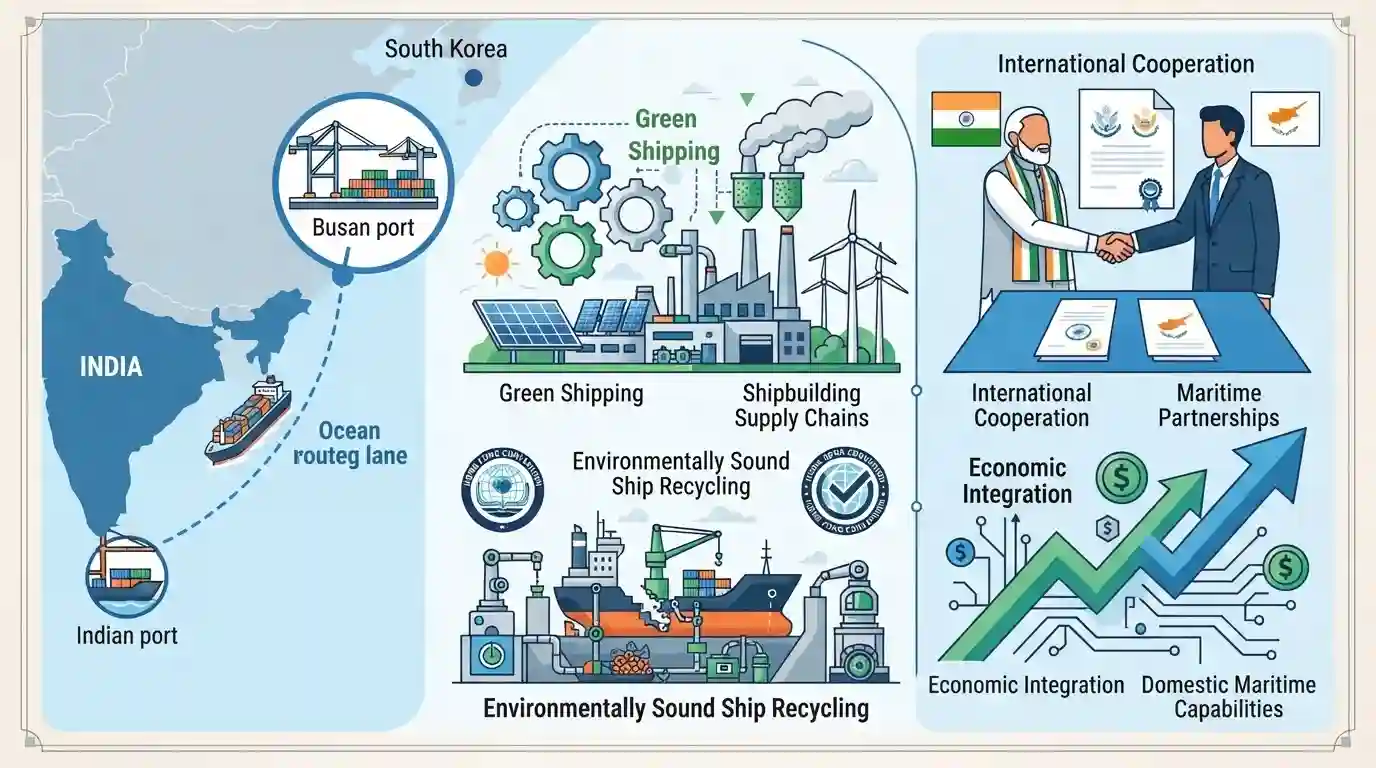
India expanded its maritime partnerships at Busan, South Korea, focusing on shipbuilding supply chains, green shipping, and safe, environmentally sound ship recycling. The engagements highlighted cooperation with international partners like Cyprus and alignment with global frameworks like the Hong Kong Convention to boost India's domestic maritime capabilities and economic integration.
मुख्य मुद्दे
- India expanded its global maritime footprint and partnerships at Busan, focusing on shipbuilding supply chains, green shipping, and ship recycling.
- Discussions emphasized strengthening bilateral ties with nations like Cyprus and exploring robust ship recycling standards compliant with international norms like the Hong Kong Convention.
- The outreach highlights India's strategic vision to emerge as a global hub for manufacturing, shipbuilding, and maritime logistics, reducing reliance on foreign hubs.
महत्त्वाच्या संज्ञा
Hong Kong International Convention

An international treaty adopted under the International Maritime Organization (IMO) that sets global standards for safe, environmentally sound ship recycling and prevents environmental and health risks from hazardous materials.
UPSC context
GS Paper III (Environment & Infrastructure); tests knowledge of international environmental conventions, green shipping standards, and ship-recycling regulations.
International Maritime Organization (IMO)
A specialized agency of the United Nations responsible for regulating international shipping, ensuring maritime safety, security, and the prevention of marine and atmospheric pollution by ships.
UPSC context
GS Paper II (IR & UN Bodies) and Paper III (Infrastructure); tests awareness of global maritime governance and transnational environmental norms.
Ministry of Ports, Shipping and Waterways
The apex ministry of the Government of India responsible for the formulation and administration of policies, regulations, and infrastructure development concerning ports, shipping, and waterways.
UPSC context
GS Paper III (Infrastructure, Economic Development); tests policy frameworks for port-led development, maritime logistics, and manufacturing supply chains.
पूर्वपरीक्षा सापळा
India's compliance with the Hong Kong Convention is purely voluntary and lacks statutory backing under domestic law.
Aspirants often assume India ratified the Hong Kong Convention only recently or relies entirely on unverified domestic guidelines, ignoring that the Recycling of Ships Act, 2019, formally operationalized HKC norms.
संबंधित स्थिर संकल्पना
What are the key statutory provisions of the Recycling of Ships Act, 2019 in India?
- HKC Alignment: Statutory backing: Formally adopts the standards of the IMO's Hong Kong International Convention for the safe and environmentally sound recycling of ships.
- IHM Mandate: Hazardous Materials: Mandates an Inventory of Hazardous Materials (IHM) for ships before they enter recycling facilities.
- Yard Authorization: Facility Authorization: Requires recycling yards to obtain specific authorization certificates complying with strict environmental and worker safety norms.
- Alang Dominance: Alang Hub: Governs major recycling hubs like Alang in Gujarat, ensuring alignment with global green shipping standards.
आंतर-विषय नमुने
Ship Recycling Standards + International Environmental Law
Global conventions like the Hong Kong Convention intersect with domestic legislation (Recycling of Ships Act, 2019) and international trade rules under the WTO.
Maritime Manufacturing + Domestic Industrial Policy
Efforts to position India as a global shipbuilding hub connect directly with the Make in India initiative and PLI schemes for manufacturing.

Expect a multi-statement question on the Hong Kong Convention, Alang hub, and India's Recycling of Ships Act, 2019.
संबंधित PYQ · 3
संबंधित PYQ · 3
- 2025MainsGS3
Why is maritime security vital to protect India's sea trade? Discuss maritime and coastal security challenges and the way forward.
- 2024MainsGS2
Discuss the geopolitical and geostrategic importance of Maldives for India with a focus on global trade and energy flows. Further also discuss how this relationship affects India's maritime security and regional stability amidst international competition ?
- 2026PrelimsGS1
In what way(s) does the Vizhinjam International Seaport represent a structural shift in India's maritime trade and logistics policy? 1. By functioning exclusively as a domestic cargo hub to reduce reliance on coastal shipping and eliminate the need for foreign collaborations. 2. By focusing primarily on passenger cruise tourism and heritage shipping to increase Kerala's profile as a maritime heritage destination. 3. By leveraging its natural deep draft and strategic location to reduce dependence on foreign trans-shipment ports, enhance revenue retention, and reposition India in regional maritime trade. Select the answer using the code given below :
