Artificial Intelligence Application in Food Processing Sector
Source:PIB ↗
हे का महत्त्वाचे आहे
It highlights the convergence of emerging technologies (AI) with the food processing sector, which is crucial for reducing waste, optimizing supply chains, and boosting value addition in India's agro-economy.
सारांश
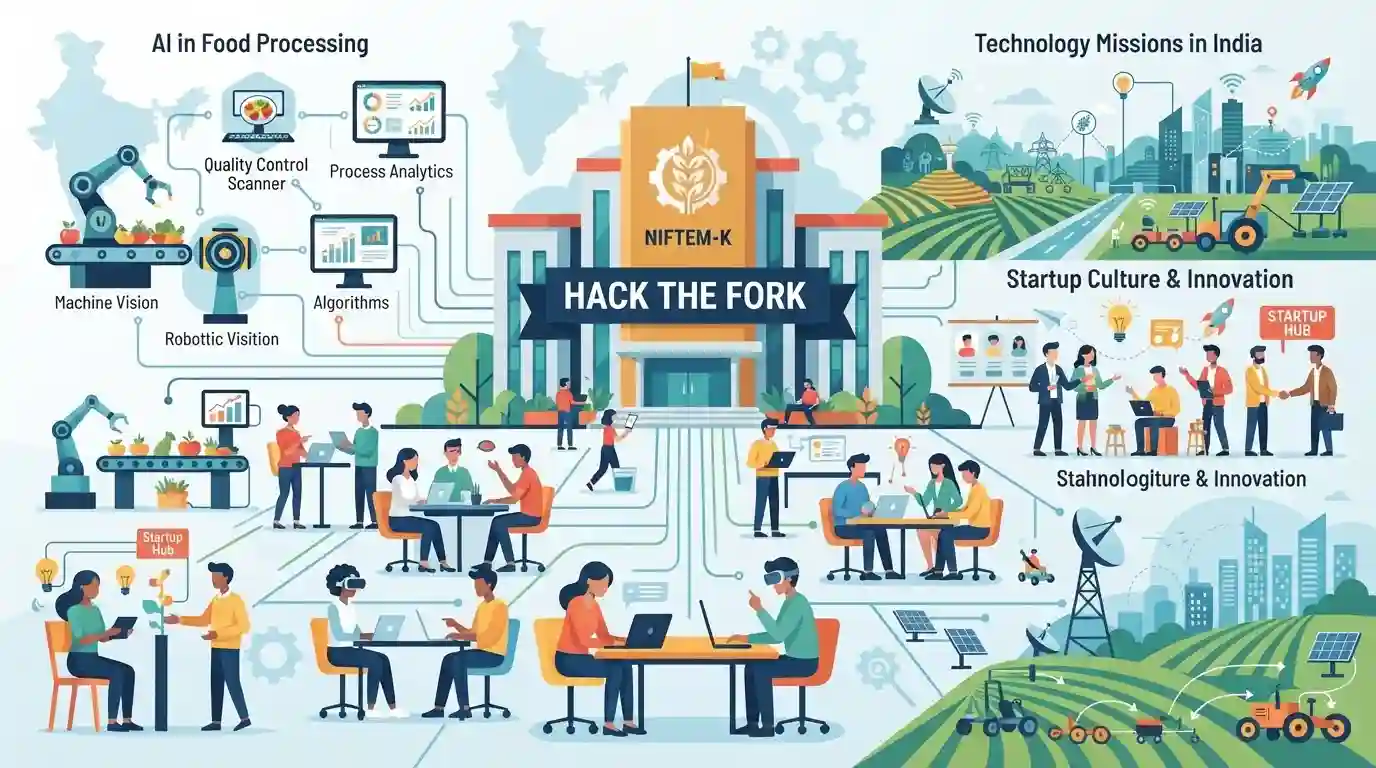
NIFTEM-K hosted 'Hack the Fork', India's first AI-driven food tech hackathon, to foster innovation, startup culture, and technological interventions in the food processing sector.
मुख्य मुद्दे
- NIFTEM-K (National Institute of Food Technology Entrepreneurship and Management, Kundli) hosted India's first Artificial Intelligence (AI) × Food Tech hackathon, titled 'Hack the Fork'.
- The event aimed to integrate advanced technological solutions like AI, Machine Learning, and data analytics into the food processing and technology ecosystem.
- It served as a platform for students, developers, startups, and innovators to build practical solutions for supply chain optimization, food safety, quality control, and waste reduction.
- Aligns with India's broader vision of leveraging emerging technologies for economic growth, modernization of the food processing industry, and fostering a startup-driven innovation culture.
महत्त्वाच्या संज्ञा
Hack the Fork

India's first AI-driven food tech hackathon hosted at NIFTEM-K to foster innovation, startup culture, and technological interventions in smart proteins and food processing.
UPSC context
UPSC Mains GS Paper III (Technology, Economic Development): Tests knowledge of emerging technologies (AI), food processing innovation, and startup incubations.
NIFTEM-K
An Institute of National Importance under the Ministry of Food Processing Industries, located in Kundli, Haryana, dedicated to education, research, and entrepreneurship in food technology.
UPSC context
UPSC Mains GS Paper III (Food Processing): Tests institutional frameworks promoting agricultural value addition, food science research, and industry-academia linkages.
Ministry of Food Processing Industries
The central government ministry responsible for formulating and implementing policies to facilitate the growth of India's food processing sector and minimize post-harvest losses.
UPSC context
UPSC Mains GS Paper III (Agriculture/Food Processing): Tests administrative structures, flagship schemes (PMKSY), and policies for agro-processing industry growth.
पूर्वपरीक्षा सापळा
NIFTEM-K operates under the administrative control of the Ministry of Agriculture and Farmers Welfare.
NIFTEM-K is often mistakenly thought to be under the Ministry of Agriculture and Farmers Welfare, but it actually operates under the Ministry of Food Processing Industries.
संबंधित स्थिर संकल्पना
What is the administrative status and mandate of NIFTEM under the Indian regulatory framework?
- Administrative Control: NIFTEM-K (Kundli, Haryana) and NIFTEM-Thanjavur (Tamil Nadu) are institutions of national importance operating under the Ministry of Food Processing Industries (MoFPI).
- Core Mandate: Mandated to promote entrepreneurship, research, skill development, and professional education in food technology and management.
आंतर-विषय नमुने
AI in Food Processing + PMFME Scheme
Integrating AI into food processing supports the PM Formalisation of Micro Food Processing Enterprises (PMFME) scheme by upgrading traditional units with modern tech for better quality control and traceability.
Food Tech Innovation + Agricultural Supply Chains
Post-harvest loss reduction through IoT and AI directly addresses supply-side inflation and complements the National Agriculture Market (e-NAM) digital infrastructure.

AI applications in agriculture/food processing likely to be tested via statement-based questions on value chain bottlenecks.
संबंधित PYQ · 3
संबंधित PYQ · 3
- 2025MainsGS3
Examine the scope of the food processing industries in India. Elaborate the measures taken by the government in the food processing industries for generating employment opportunities.
- 2022MainsGS3
Elaborate the scope and significance of the food processing industry in India.
- 2019MainsGS3
Elaborate the policy taken by the Government of India to meet the challenges of the food processing sector.
