Narcotics Control Bureau Operation Trident Against Drug Trafficking
Source:PIB ↗
Why It Matters
The article is directly relevant to India's internal security challenges, particularly drug trafficking and narco-terrorism in the vulnerable Northeastern region bordering international drug production zones.
Summary
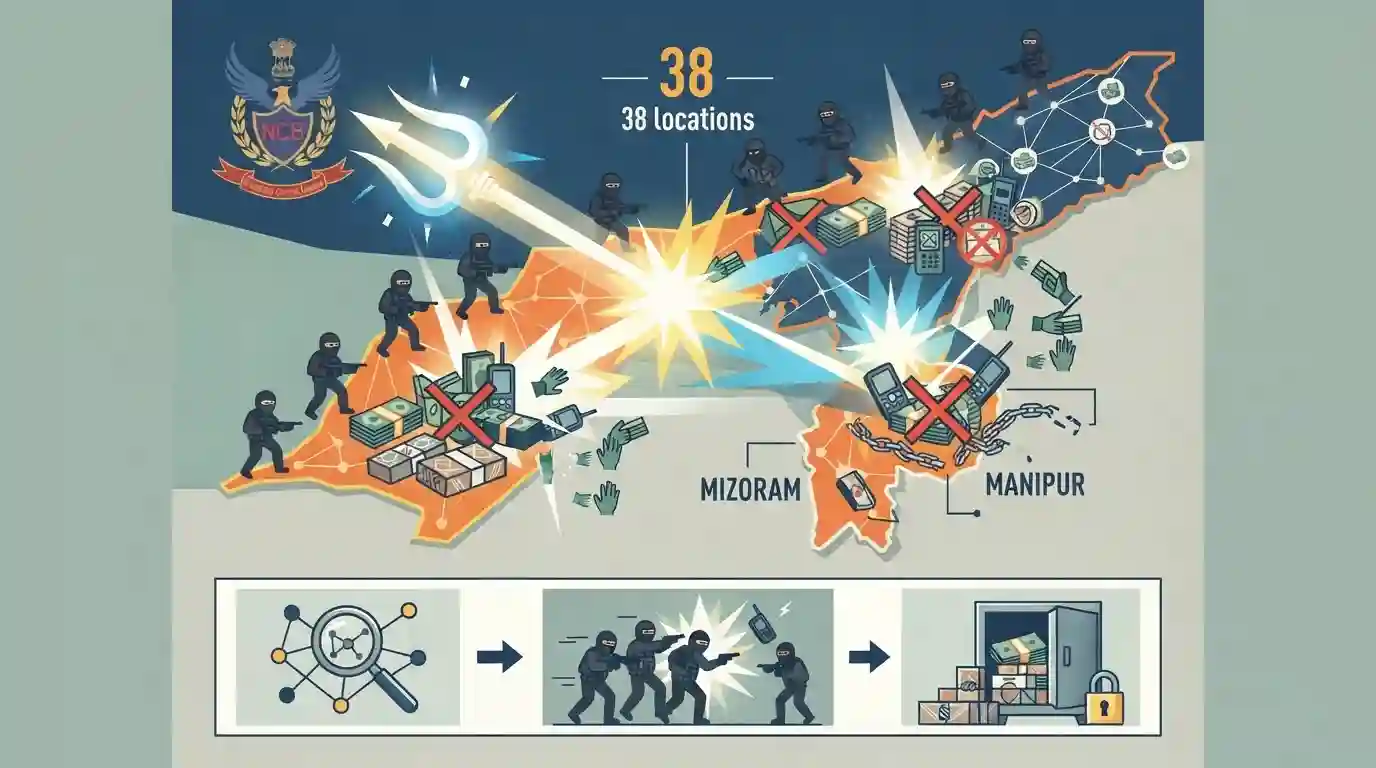
The Narcotics Control Bureau (NCB) launched 'Operation Trident', executing coordinated simultaneous strikes across 38 locations in Assam, Mizoram, and Manipur to dismantle drug trafficking rings in Northeast India.
Key Points
- The Narcotics Control Bureau (NCB) launched 'Operation Trident' targeting drug trafficking networks.
- 38 teams conducted simultaneous raids across 38 locations in Assam, Mizoram, and Manipur.
- The operation highlights the government's zero-tolerance policy against drug cartels and narco-terrorism in the Northeast region.
Important Terms
Operation Trident

A coordinated counter-narcotics crackdown launched by the Narcotics Control Bureau across Assam, Mizoram, and Manipur, targeting transnational drug cartels and financial hawala networks along the India-Myanmar-Bangladesh border.
UPSC context
Important for GS Paper III (Internal Security - Border Management, Narco-terrorism and Drug Trafficking). Tests awareness of regional anti-drug offensives and transnational crime syndicates.
Narcotics Control Bureau (NCB)
The apex nodal agency in India responsible for combating drug trafficking and abuse under the Narcotic Drugs and Psychotropic Substances (NDPS) Act, operating under the Ministry of Home Affairs.
UPSC context
Important for GS Paper III (Internal Security - Institutional mechanisms against organized crime and drug trafficking). Tests statutory roles of central law enforcement agencies.
Prelims Trap
The Narcotics Control Bureau (NCB) functions as an independent investigative arm directly under the Ministry of Defence.
Aspirants often assume the NCB is a police force under the Ministry of Defence or Ministry of Law, but it operates as the apex coordinating agency under the MHA.
Static Concepts Connected
What are the key statutory powers and institutional mandates of the Narcotics Control Bureau (NCB) in India?
- Statutory Origin: Created under Section 4(1) of the Narcotic Drugs and Psychotropic Substances (NDPS) Act, 1985 to enable the central government to combat drug abuse and trafficking.
- Administrative Control: Functions as the apex nodal agency for drug law enforcement under the Ministry of Home Affairs (MHA), coordinating actions across state police and central departments.
- International Mandate: Responsible for implementing India's international obligations under UN conventions on narcotic drugs and psychotropic substances.
Cross-Topic Patterns
Golden Triangle + Northeast Insurgency linkages
Porous international borders shared with Myanmar facilitate both insurgent logistics and heroin/methamphetamine smuggling through the Golden Triangle.
Narco-terrorism + PMLA financial investigations
Targeting hawala channels and freezing 1,424 bank accounts operationalises PMLA provisions against organized cross-border syndicates.

NCB's mandate under NDPS Act and financial disruption via property attachment will likely feature in internal security mcqs.
Linked PYQs · 3
Linked PYQs · 3
- 2024MainsGS3
Explain how narco-terrorism has emerged as a serious threat across the country. Suggest suitable measures to counter narco-terrorism.
- 2023MainsGS3
The use of unmanned aerial vehicles (UAVs) by our adversaries across the borders to ferry arms/ammunitions, drugs, etc., is a serious threat to the internal security. Comment on the measures being taken to tackle this threat.
- 2019MainsGS3
Cross-border movement of insurgents is only one of the several security challenges facing the policing of the border in North-East India. Examine the various challenges currently emanating across the India-Myanmar border. Also, discuss the steps to counter the challenges.
