Urban Local Bodies Autonomy and Decentralized Governance
Source:PIB ↗
Why It Matters
Directly addresses structural bottlenecks in India's urban local governance, such as financial devolution and functional autonomy of ULBs, which is a recurring core theme in GS Paper II.
Summary
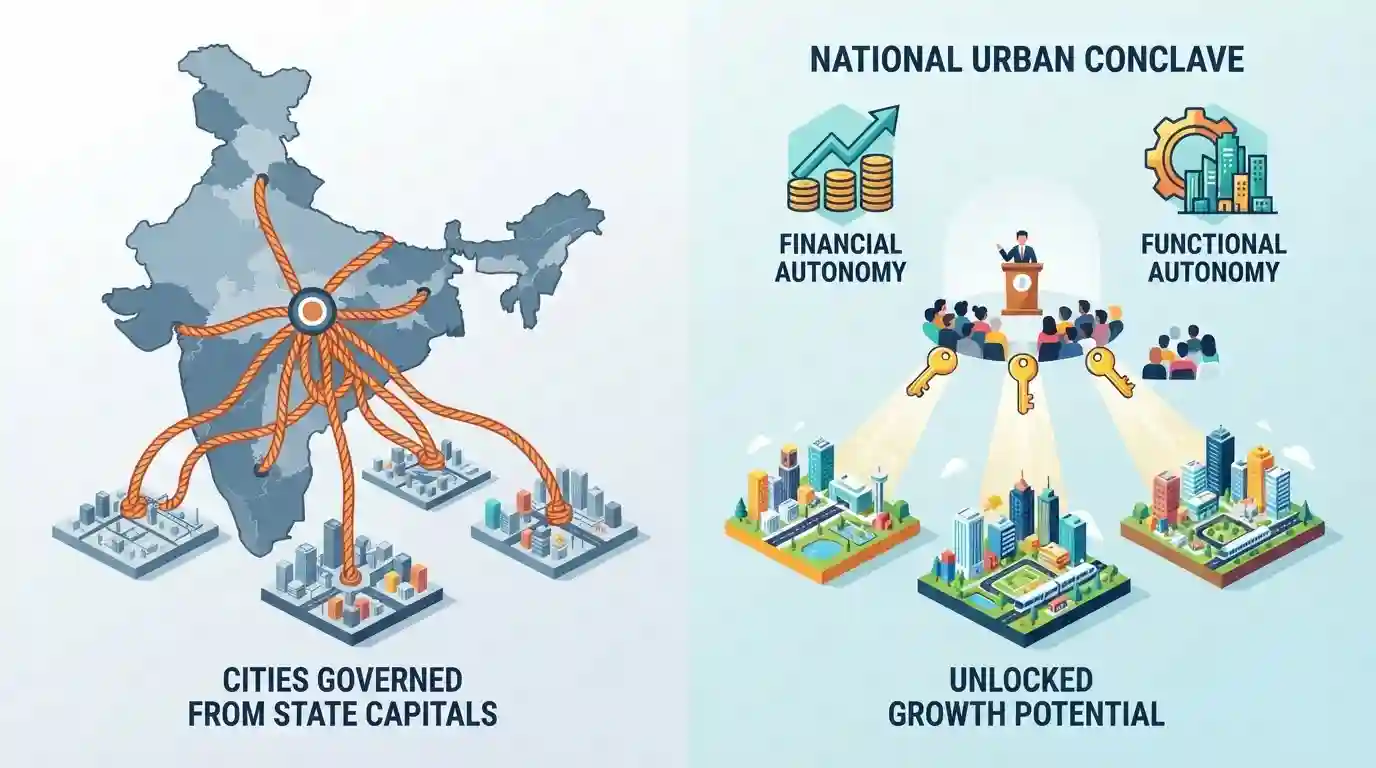
At the 2nd National Urban Conclave, NITI Aayog Member Shri Rajiv Gauba emphasized the necessity of empowering city governments with financial and functional autonomy, stating that cities cannot be effectively governed from state capitals, to unlock India's urban growth potential.
Key Points
- Shri Rajiv Gauba stressed that cities cannot be efficiently managed from state capitals and require empowered city governments.
- The 2nd National Urban Conclave focused on unlocking India's economic growth potential through urban transformation.
- Key issues highlighted include financial and functional constraints of Urban Local Bodies (ULBs).
- Effective decentralization is crucial for sustainable urban development and good governance.
Important Terms
74th Constitutional Amendment Act

A landmark 1992 constitutional amendment that institutionalized urban local bodies in India, adding Part IX-A and the Twelfth Schedule to decentralize power and ensure local self-governance.
UPSC context
UPSC GS Paper II (Polity & Governance) — tests devolution of powers, urban local government, and decentralized planning structures.
NITI Aayog
India's premier policy think tank established in 2015 to foster cooperative federalism, replace the Planning Commission, and drive strategic, bottom-up national development.
UPSC context
UPSC GS Paper II (Governance) — tests institutional bodies, cooperative federalism, and policy advisory roles in developmental planning.
Prelims Trap
The 74th Constitutional Amendment Act made financial and functional autonomy mandatory for all Urban Local Bodies across India.
The 74th Amendment Act gave constitutional status to ULBs, but devolution of the 3Fs (Funds, Functions, Functionaries) was left optional and depends entirely on state legislation.
Static Concepts Connected
What are the core structural challenges plaguing Urban Local Bodies (ULBs) in India under the 74th Constitutional Amendment framework?
- Incomplete Devolution: Lack of 3Fs devolution: States have resisted transferring Funds, Functions, and Functionaries to elected municipal bodies, retaining control via state line departments.
- Parallel Agencies: Parastatal proliferation: State-level development authorities and special-purpose agencies routinely bypass elected municipal councils, fragmenting local accountability.
- Fiscal Distress: Weak own-source revenues: ULBs raise less than 0.6% of GDP through property taxes and user charges, making them heavily dependent on intergovernmental fiscal transfers.
Cross-Topic Patterns
Urban Governance + Municipal Bond Markets
Urban local body funding constraints directly hinder municipal bond issuances, tying fiscal federalism to capital market development and municipal debt sustainability.
Parastatal Agencies vs Constitutional Decentralization
The proliferation of parastatal agencies bypassing elected mayors mirrors the tension between state-level planning boards and district planning committees under Article 243ZD.

Expect a multi-statement Prelims question on the 3Fs (Funds, Functions, Functionaries) devolution status under the 74th Amendment Act.
Linked PYQs · 3
Linked PYQs · 3
- 2023MainsGS2
“The states in India seem reluctant to empower urban local bodies both functionally as well as financially.” Comment.
- 2024MainsGS2
Analyse the role of local bodies in providing good governance at local level and bring out the pros and cons merging the rural local bodies with the urban local bodies.
- 2022MainsGS2
To what extent, in your opinion, has the decentralisation of power in India changed the governance landscape at the grassroots?
