Ramsar Sites in India and Wetlands Conservation Management
Source:PIB ↗
हे का महत्त्वाचे आहे
Wetlands and Ramsar sites are a recurring, high-yield theme in both Prelims and Mains (GS Paper III) under environment, biodiversity, and conservation policies.
सारांश
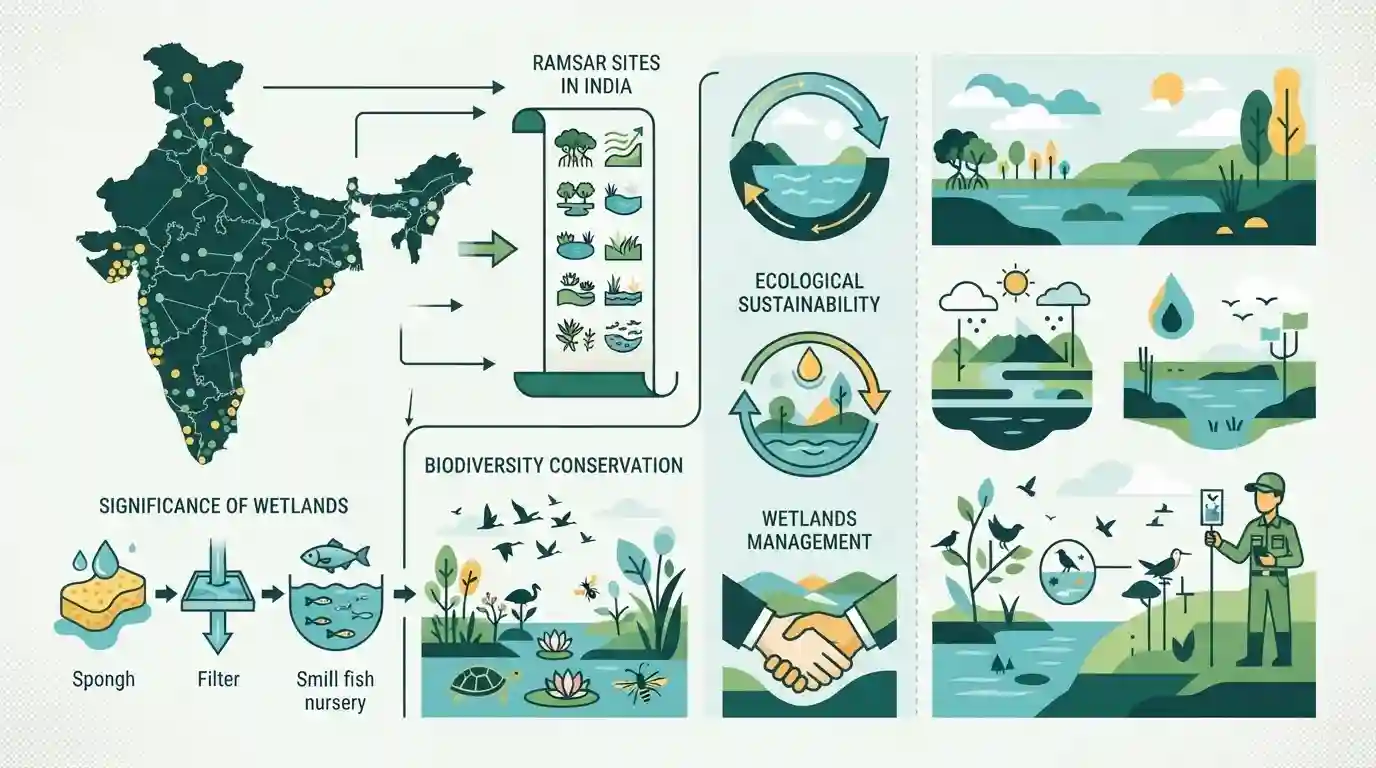
This PIB release focuses on Ramsar Sites in India, detailing the significance of wetlands, their designation under the Ramsar Convention, and India's growing network of wetlands of international importance aimed at biodiversity conservation and ecological sustainability.
मुख्य मुद्दे
- India has a significant network of Ramsar sites (Wetlands of International Importance) designated under the Ramsar Convention.
- The Ramsar Convention promotes the conservation and wise use of all wetlands through local and national actions and international cooperation.
- Wetlands provide critical ecological services, including flood control, groundwater recharge, water purification, and biodiversity support.
- Government initiatives like the National Wetland Conservation Programme play a crucial role in protecting these fragile ecosystems.
महत्त्वाच्या संज्ञा
Ramsar Convention

An intergovernmental treaty signed in 1971 in Ramsar, Iran, providing the framework for national action and international cooperation for the conservation and wise use of wetlands and their resources.
UPSC context
GS Paper III (Environment & Ecology); tests knowledge of international environmental conventions, biodiversity conservation, and global ecological commitments.
Wetlands (Conservation and Management) Rules
Regulatory framework notified under the Environment (Protection) Act, 1986, establishing State Wetland Authorities and decentralized guidelines for identifying, managing, and protecting wetlands in India.
UPSC context
GS Paper III (Environment & Ecology); tests domestic environmental laws, statutory bodies, and wetland regulatory frameworks.
Ministry of Environment, Forest and Climate Change
Central government ministry responsible for planning, promoting, coordinating, and overseeing environmental and forestry policies, including wildlife conservation and wetland management programs across India.
UPSC context
GS Paper II / III (Governance & Environment); tests understanding of nodal central ministries implementing environmental legislation and treaties.
पूर्वपरीक्षा सापळा
The Ramsar Convention is a specialized UN body administered directly under the United Nations Environment Programme (UNEP).
Aspirants often assume the Ramsar Convention is an agency or part of the United Nations Environment Programme (UNEP) or UNESCO, when it is an independent intergovernmental treaty with its own administrative machinery.
संबंधित स्थिर संकल्पना
What are the key mechanisms and administrative bodies of the Ramsar Convention?
- Founding Treaty: Intergovernmental treaty signed in 1971 in Ramsar, Iran, focused on the conservation and wise use of wetlands.
- Montreux Record: The Montreux Record is a register of wetland sites on the List of Wetlands of International Importance where changes in ecological character have occurred or are occurring.
- Partner Organizations: WWF, IUCN, Wetlands International, and BirdLife International act as official International Organization Partners (IOPs) to the Convention.
आंतर-विषय नमुने
Wetlands and Climate Change Mitigation (SDG Linkages)
Wetland conservation overlaps directly with climate mitigation targets (blue carbon sinks like mangroves and salt marshes) and SDG 13 (Climate Action) and SDG 15 (Life on Land).
Ramsar Designations in International Climate Diplomacy
Designation under international treaties like Ramsar strengthens India's negotiating positions in biodiversity COPs and climate COPs regarding financial transfers for ecosystem services.

Ramsar criteria, legal definition of wetlands, and institutional mandates under the Wetlands Rules frequently appear in Prelims matching lists.
संबंधित PYQ · 3
संबंधित PYQ · 3
- 2019PrelimsGS1
Consider the following statements: 1. Under Ramsar Convention, it is mandatory on the part of the Government of India to protect and conserve all the wetlands in the territory of India. 2. The Wetlands (Conservation and Management) Rules, 2010 were framed by the Government of India based on the recommendations of Ramsar Convention. 3. The Wetlands (Conservation and Management) Rules, 2010 also encompass the drainage area or catchment regions of the wetlands as determined by the authority. Which of the statements given above is/are correct?
- 2023MainsGS3
Comment on the National Wetland Conservation Programme initiated by the Government of India and name a few India's wetlands of international importance included in the Ramsar Sites.
- 2018MainsGS3
What is wetland? Explain the Ramsar concept of 'wise use' in the context of wetland conservation. Cite two examples of Ramsar sites from India.
