Access and Benefit Sharing Mechanisms in Biodiversity Conservation
Source:PIB ↗
কেন এটি গুরুত্বপূর্ণ
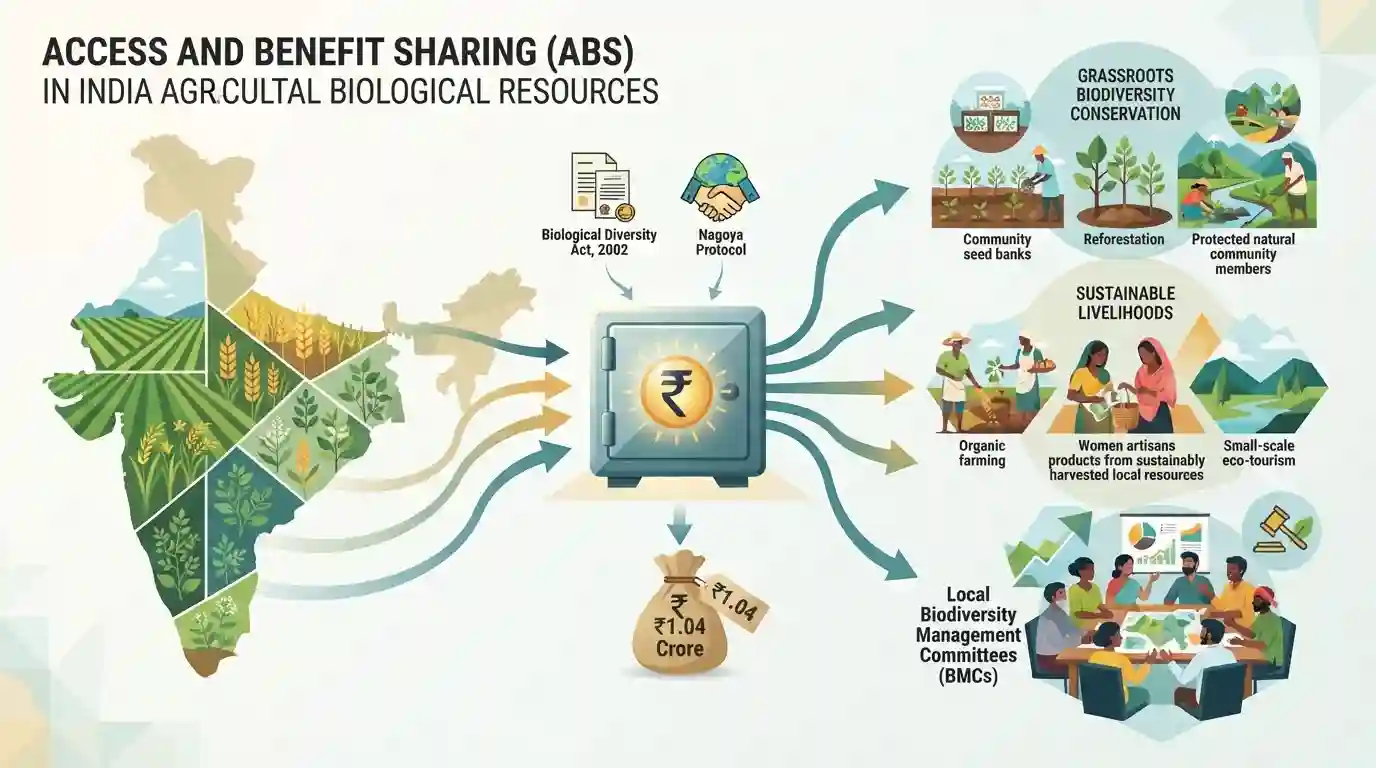
It demonstrates the functional implementation of Access and Benefit Sharing (ABS) provisions under the Biological Diversity Act and Nagoya Protocol, bridging commercial agricultural biotechnology with local community development and wildlife/habitat conservation.
সারসংক্ষেপ
Agricultural biological resources in India have generated approximately ₹1.04 crore under Access and Benefit Sharing (ABS) mechanisms, highlighting the practical enforcement of the Biological Diversity Act, 2002 and the Nagoya Protocol. These funds support grassroots biodiversity conservation, sustainable livelihoods, and local Biodiversity Management Committees (BMCs).
মূল বিষয়
- Agricultural biological resources generated around ₹1.04 crore in Access and Benefit Sharing (ABS) benefits.
- Funds are utilized for biodiversity conservation, sustainable management, and supporting local Biodiversity Management Committees (BMCs).
- ABS mechanisms operationalize the Nagoya Protocol's third objective of fair and equitable sharing of benefits arising from genetic resources.
- Highlights the growing convergence between commercial utilization of bio-resources and grassroots environmental stewardship.
গুরুত্বপূর্ণ শব্দ
Biological Diversity Act, 2002

India's primary legislative framework enacted in 2002 to fulfill Convention on Biological Diversity obligations, focusing on biodiversity conservation, sustainable use, and fair Access and Benefit Sharing (ABS) through a three-tier institutional mechanism.
UPSC context
GS Paper III (Environment & Ecology). Frequently tested for statutory bodies, biodiversity laws, and decentralized conservation mechanisms like BMCs.
Nagoya Protocol
An international supplementary agreement to the CBD adopted in 2010 that provides a transparent legal framework for the fair and equitable sharing of benefits arising from genetic resources.
UPSC context
GS Paper III (Environment & Biodiversity). Important for international environmental conventions, protocols, and India's compliance frameworks.
National Biodiversity Authority (NBA)
A statutory autonomous body established in 2003 under the Ministry of Environment, Forest and Climate Change to implement the Biological Diversity Act, 2002 and regulate ABS mechanisms.
UPSC context
GS Paper II/III (Governance and Environment). Tested for statutory bodies, their composition, and functions in environmental regulation.
সংযুক্ত স্থির ধারণা
What is the three-tier institutional structure under India's Biological Diversity Act, 2002?
- National Biodiversity Authority: National level body regulating bio-resource access and intellectual property matters.
- State Biodiversity Boards: State level bodies advising governments and regulating commercial utilization by Indians.
- Biodiversity Management Committees: Grassroots bodies mandated to prepare People's Biodiversity Registers (PBRs) and conserve local resources.
আন্তঃবিষয় প্যাটার্ন
ABS Mechanisms & Grassroots Environmental Governance
ABS mechanisms operationalize the Nagoya Protocol, linking international biodiversity law to decentralized Panchayati Raj institutions and local governance under the Biological Diversity Act.

Nagoya Protocol ABS mechanisms + BMC functions under Biological Diversity Act likely to be tested via statement-based MCQs.
সংযুক্ত PYQ · 2
সংযুক্ত PYQ · 2
- 2023PrelimsGS1
Consider the following statements: 1. In India, the Biodiversity Management Committees are key to the realization of the objectives of the Nagoya Protocol. 2. The Biodiversity Management Committees have important functions in determining access and benefit sharing, including the power to levy collection fees on the access of biological resources within its jurisdiction. Which of the statements given above is/are correct?
- 2024MainsGS3
What is the present world scenario of intellectual property rights with respect to life materials? Although, India is second in the world to file patents, still only a few have been commercialized. Explain the reasons behind this less commercialization.
