Agricultural Biological Resources Generate ABS Benefits Fund
Source:PIB ↗
Why It Matters
It highlights India's operationalization of Access and Benefit-Sharing (ABS) mechanisms under the Biological Diversity Act and international treaties like the Nagoya Protocol, balancing agricultural commercialization with local biodiversity conservation funding.
Summary
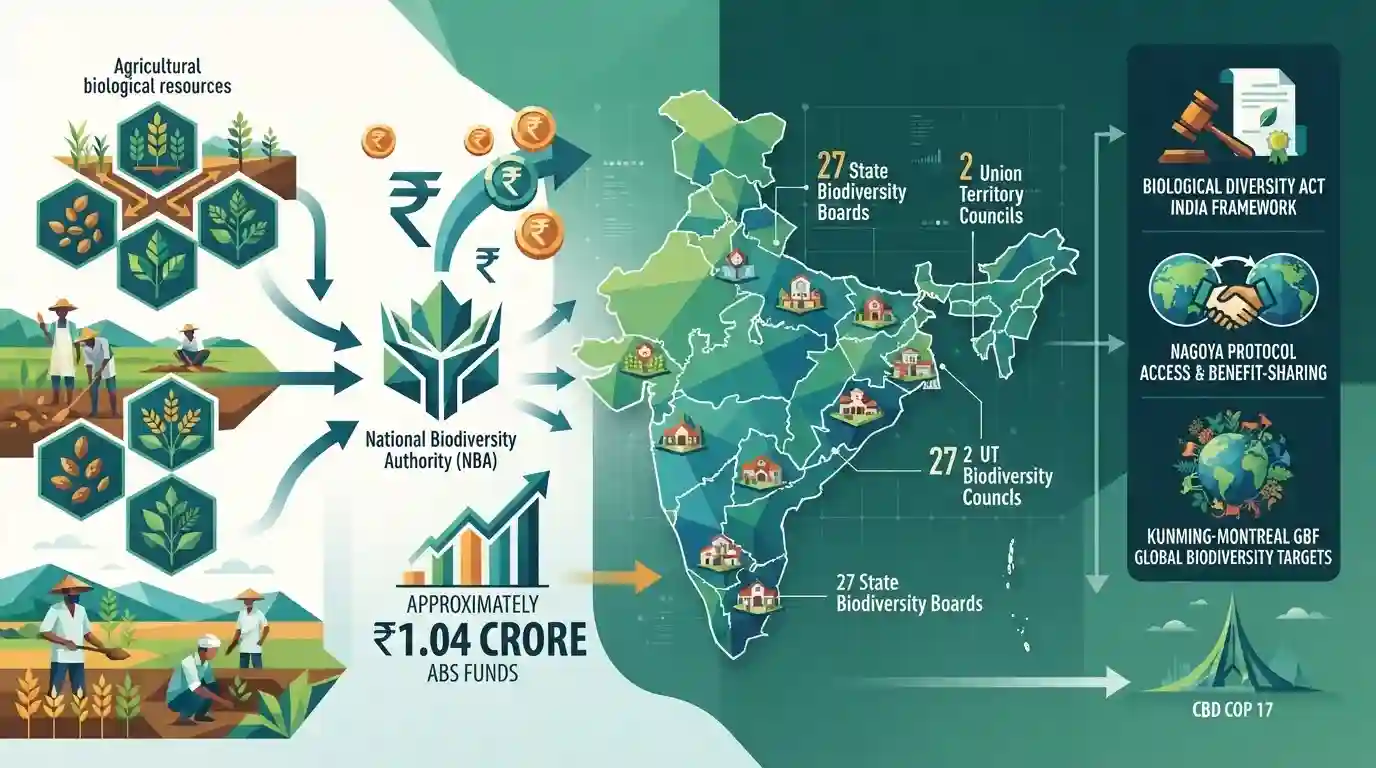
The National Biodiversity Authority (NBA) has disbursed approximately ₹1.04 crore in Access and Benefit-Sharing (ABS) funds from agricultural biological resource utilization across 27 State Biodiversity Boards and 2 UT Biodiversity Councils using an area-based methodology. This underlines India's robust framework under the Biological Diversity Act, Nagoya Protocol, and Kunming-Montreal Global Biodiversity Framework, ahead of CBD COP 17.
Key Points
- The National Biodiversity Authority (NBA) disbursed around ₹1.04 crore of Access and Benefit-Sharing (ABS) funds to 27 State Biodiversity Boards and 2 Union Territory Biodiversity Councils.
- Contributions came from companies like Crystal Crop Protection, Savannah Seeds, and Nunhems India for commercial and research utilization of agricultural resources like pearl millet, jowar, maize, rice, and bottle gourd.
- An area-based distribution approach is utilized where individual benefit claimers cannot be identified, allocating funds based on crop cultivation statistics from the Ministry of Agriculture.
- India's agriculture sector has generated roughly ₹87 crore in total ABS contributions, contributing significantly to a cumulative national total of over ₹204 crore released by the NBA.
- The framework aligns with Nagoya Protocol and Target 13 of the Kunming-Montreal Global Biodiversity Framework, with implementation highlights slated for CBD COP 17 in Yerevan, Armenia.
Important Terms
National Biodiversity Authority (NBA)

A statutory body established under India's Biological Diversity Act 2002 to regulate access to biological resources and facilitate the fair and equitable sharing of benefits arising from their commercial use.
UPSC context
UPSC Prelims/Mains (Environment & Ecology): Important statutory bodies, wildlife and biodiversity administration, and implementation of national environmental laws.
Kunming-Montreal Global Biodiversity Framework
A comprehensive global roadmap adopted under the UN Convention on Biological Diversity to halt and reverse biodiversity loss by 2030, featuring targets such as the '30x30' conservation goal.
UPSC context
UPSC Prelims/Mains (Environment & Biodiversity): International environmental conventions, global biodiversity targets, and sustainable development goals.
Biological Diversity Act 2002
Landmark Indian legislation enacted in 2002 to conserve biodiversity, ensure sustainable use of its components, and establish a decentralized three-tiered regulatory framework for equitable benefit-sharing.
UPSC context
UPSC Prelims/Mains (Environment & Ecology): Core national environment legislation, conservation frameworks, and statutory bodies.
Nagoya Protocol
A supplementary international agreement to the Convention on Biological Diversity that provides a transparent legal framework for the fair and equitable sharing of benefits arising from genetic resources.
UPSC context
UPSC Prelims/Mains (Environment & Ecology): International biodiversity protocols, biopiracy regulations, and India's international commitments.
State Biodiversity Boards (SBBs)
Decentralized bodies established at the state level in India to regulate the commercial utilization of local biological resources and manage state-level biodiversity funds under the national legal framework.
UPSC context
UPSC Prelims/Mains (Polity/Environment): Decentralized environmental governance, federal implementation of central environment laws, and local conservation initiatives.
Static Concepts Connected
What are the core institutional tiers under India's Biological Diversity Act, 2002?
- National Biodiversity Authority:: National level body regulating access, approving foreign collaborations, and advising central government.
- State Biodiversity Boards:: State level bodies regulating intra-state commercial utilization and coordinating with local authorities.
- Biodiversity Management Committees:: Grassroots level bodies mandated to prepare People's Biodiversity Registers (PBRs) and promote conservation.
Cross-Topic Patterns
Agriculture commercialization meets biodiversity conservation funds
ABS fund disbursement bridges agricultural commercialization under patent/plant variety laws with grassroots ecological restoration via Biodiversity Management Committees.

Nagoya Protocol ABS mechanisms, NBA's statutory powers, and Kunming-Montreal Target 13 are high-yield for environment MCQs.
Linked PYQs · 1
Linked PYQs · 1
- 2023PrelimsGS1
Consider the following statements: 1. In India, the Biodiversity Management Committees are key to the realization of the objectives of the Nagoya Protocol. 2. The Biodiversity Management Committees have important functions in determining access and benefit sharing, including the power to levy collection fees on the access of biological resources within its jurisdiction. Which of the statements given above is/are correct?
