Urban Mobility India Conference Concludes in Bhubaneswar
Source:PIB ↗
Why It Matters
Urban mobility is a critical component of India's rapid urbanization and sustainable development goals, highlighting strategies to reduce congestion, lower emissions, and prioritize public mass transport systems over private vehicles.
Summary
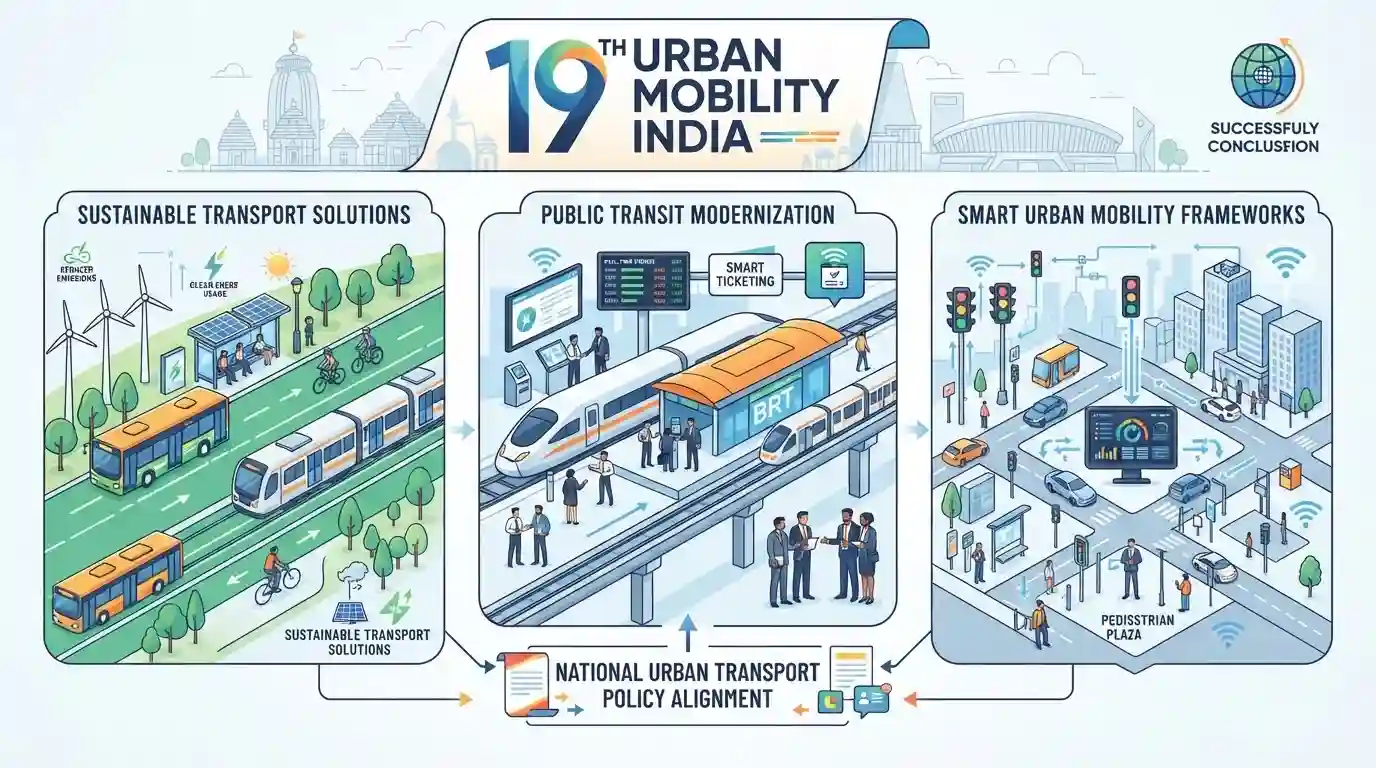
The 19th Urban Mobility India (UMI) Conference and Exhibition successfully concluded in Bhubaneswar, focusing on sustainable transport solutions, public transit modernization, and smart urban mobility frameworks aligned with the National Urban Transport Policy.
Key Points
- The 19th Urban Mobility India (UMI) Conference and Exhibition concluded in Bhubaneswar, Odisha, drawing around 1,500 delegates and experts.
- The conference focused on sustainable urban transport solutions, moving people rather than vehicles, and modernizing public transport infrastructure.
- It provided a platform for policymakers, urban planners, and transport experts to share best practices, technologies, and innovative financing mechanisms for urban mobility.
Important Terms
National Urban Transport Policy

A central policy framework established by the Ministry of Housing and Urban Affairs to prioritize people-centric sustainable urban transport, public transit modernization, and integrated land-use planning over vehicle-centric growth.
UPSC context
GS Paper III (Infrastructure, Urbanization) and GS Paper I (Urbanization issues); tests knowledge of sustainable urban planning and mobility policies.
Urban Mobility India Conference and Exhibition
An annual flagship event organized by the Ministry of Housing and Urban Affairs to share best practices, discuss smart urban mobility frameworks, and showcase sustainable transport solutions.
UPSC context
GS Paper III (Infrastructure, Sustainable Transport); tests awareness of government initiatives and institutional forums addressing urban traffic and transit modernization.
Static Concepts Connected
What are the key objectives and guiding principles of the National Urban Transport Policy (NUTP)?
- People-Centric Approach: NUTP shifts the focus of urban transport planning from vehicle-centric movement to people-centric movement, prioritizing walking, cycling, and public transport.
- Land-Use Integration: It integrates land use and transport planning in all urban areas to reduce travel demand and optimize commuter efficiency.
- Dedicated Funding: It encourages the establishment of dedicated urban transport funds at city and state levels to ensure sustainable financial support.
Cross-Topic Patterns
Urban Transit Finance & Fiscal Federalism
Urban transit projects depend heavily on land value capture and municipal green bonds, linking urban infrastructure finance to fiscal federalism and RBI municipal bond guidelines.

NUTP core philosophy ('moving people not vehicles') and innovative urban financing mechanisms are high-yield for mains and prelims.
Linked PYQs · 3
Linked PYQs · 3
- 2014MainsGS3
National Urban Transport Policy emphasises on 'moving people' instead of 'moving vehicles'. Discuss critically the success of the various strategies of the Government in this regard.
- 2016MainsGS3
What are 'Smart Cities'? Examine their relevance for urban development in India. Will it increase rural-urban differences? Give arguments for 'Smart Villages' in the light of PURA and RURBAN Mission.
- 2022MainsGS3
Why is Public Private Partnership (PPP) required in infrastructural projects ? Examine the role of PPP model in the redevelopment of Railway Stations in India.
