Air Pollution Analysis Facility Inaugurated for Delhi NCR
Source:PIB ↗
हे का महत्त्वाचे आहे
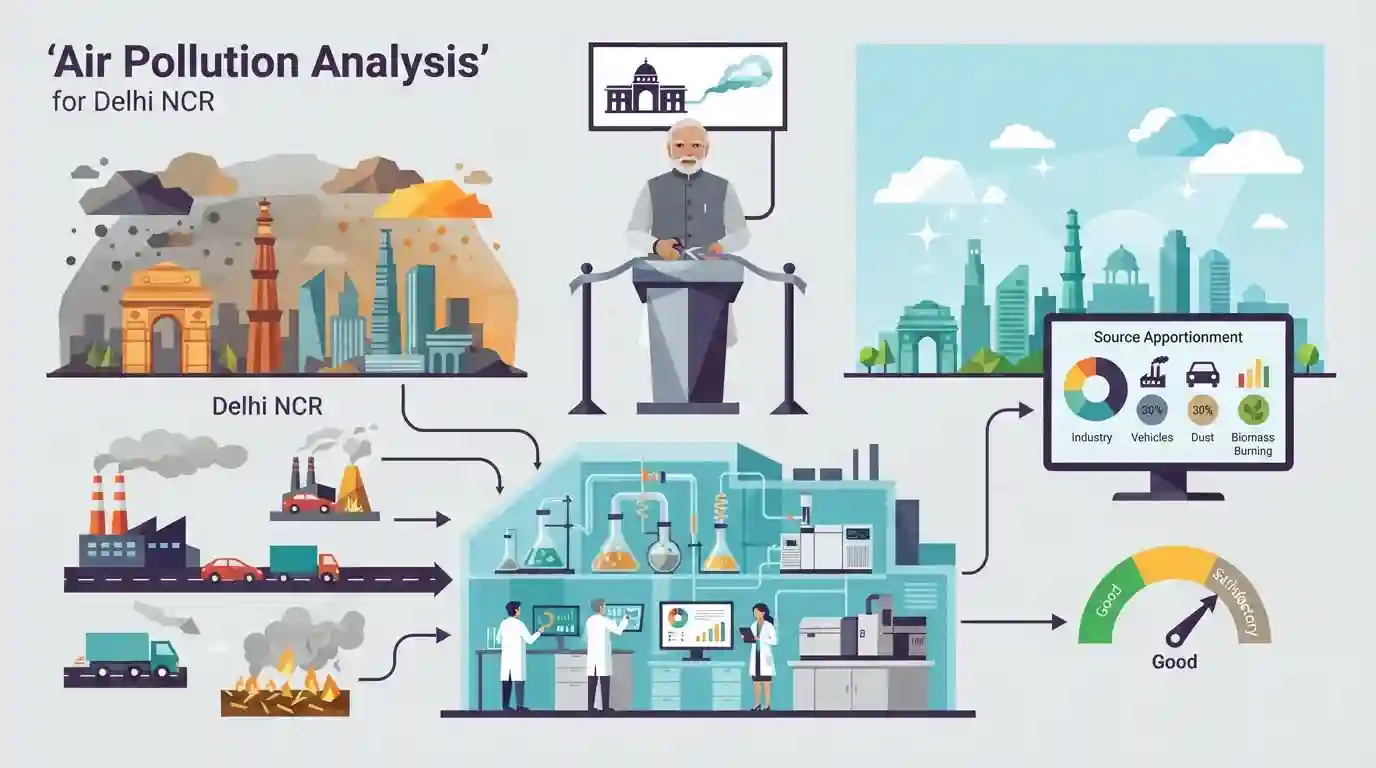
This initiative marks a novel technological milestone in addressing Delhi-NCR's chronic air pollution crisis, tying directly into government frameworks like the National Clean Air Programme (NCAP) and science-backed environmental management.
सारांश
Union Minister Dr Jitendra Singh inaugurated the world's first-of-its-kind 'Air Pollution Analysis' facility designed specifically for Delhi NCR to tackle air quality degradation through advanced scientific analysis and source apportionment.
मुख्य मुद्दे
- Union Minister Dr Jitendra Singh inaugurated the world's first-of-its-kind 'Air Pollution Analysis' facility for Delhi NCR.
- The advanced facility aims to provide real-time air pollution analysis and source apportionment to tackle the severe air quality issues in the National Capital Region (NCR).
- Emphasizes the role of indigenous technology, scientific research, and technological interventions in mitigating environmental challenges.
महत्त्वाच्या संज्ञा
National Clean Air Programme

India's comprehensive national strategy launched to tackle air pollution across major cities by aiming for targeted reductions in particulate matter concentrations through city-specific clean air action plans.
UPSC context
UPSC Prelims/Mains (GS Paper III: Environment & Pollution Control). Tests knowledge of government environmental initiatives, targets, and pollution management strategies.
Ministry of Science and Technology
The Union Government ministry responsible for formulating and promoting scientific research, technological innovation, and institutional capacity building across India through its specialized departments like DST, DBT, and DSIR.
UPSC context
UPSC Prelims/Mains (GS Paper III: Science & Technology). Tests awareness of key scientific governance structures, research bodies, and policy frameworks in India.
संबंधित स्थिर संकल्पना
What is the difference between Air Quality Index (AQI) and Source Apportionment in air pollution management?
- AQI Function:: Measures concentration of major pollutants (PM2.5, PM10, NO2, etc.) and translates them into a single color-coded index representing health severity.
- Source Apportionment:: Identifies and quantifies the specific contribution of various pollution sources (vehicular, industrial, stubble burning) to aid targeted policy interventions.
- Policy Value:: Enables dynamic, evidence-based mitigation strategies rather than blanket emergency responses across the Delhi-NCR airshed.
आंतर-विषय नमुने
NCR Air Quality & Federal Governance Coordination
Delhi-NCR's air quality crisis links environmental pollution management (GS-III) with federal governance challenges (GS-II) involving inter-state coordination across Punjab, Haryana, and UP via statutory bodies like CAQM.
Indigenous S&T and Strategic Self-Reliance
The integration of indigenous scientific infrastructure under 'Mission Mausam' highlights domestic R&D self-reliance, connecting science and tech policy (GS-III) with Atmanirbhar Bharat trade strategies.

Source apportionment + toxicity analysis labs (like AATAL) will likely be tested against standard AQI indexes in a 3-statement prelims Q.
संबंधित PYQ · 2
संबंधित PYQ · 2
- 2020MainsGS3
What are the key features of the National Clean Air Programme (NCAP) initiated by the Government of India?
- 2021MainsGS3
Describe the key points of the revised Global Air Quality Guidelines (AQGs) recently released by the World Health Organisation (WHO). How are these different from its last update in 2005? What changes in India's National Clean Air Programme are required to achieve these revised standards?
