Labour Codes and Social Protection Dialogue Begins in Lucknow
Source:PIB ↗
આ શા માટે મહત્વનું છે
The event directly relates to India's major ongoing economic reform—the consolidation of 29 central labour laws into four simplified Labour Codes—making it essential for understanding labour market flexibility, worker protection, and ease of doing business.
સારાંશ
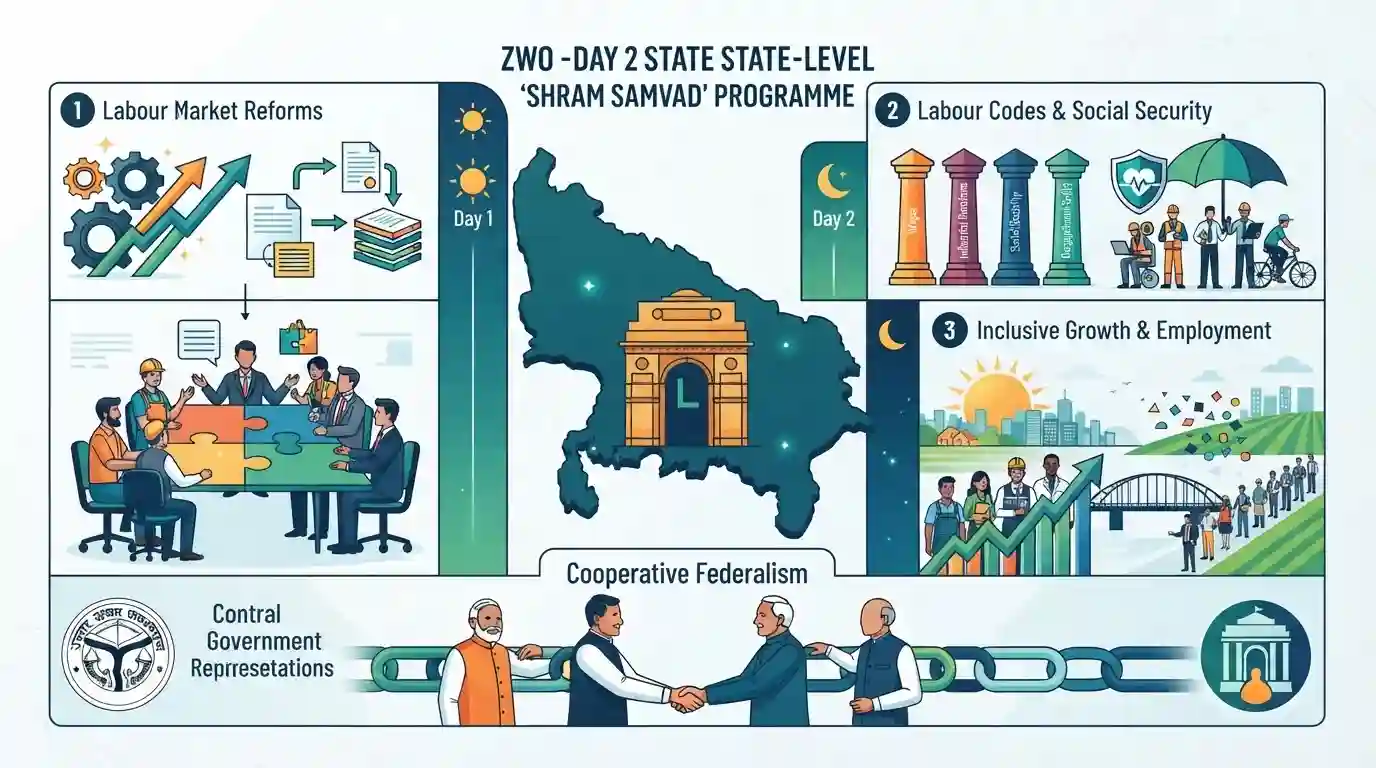
A two-day state-level 'Shram Samvad' programme is scheduled in Lucknow to discuss the implementation of the new Labour Codes, labour welfare measures, and social protection frameworks. The dialogue brings together key stakeholders to deliberate on streamlined labour regulations, formalization of the workforce, and security provisions for unorganized and gig workers, promoting cooperative federalism in labour administration.
મુખ્ય મુદ્દા
- A two-day state-level 'Shram Samvad' programme is being organized in Lucknow to deliberate on the new Labour Codes, labour welfare, and social protection.
- The programme aims to build consensus, discuss effective implementation strategies, and address challenges related to labour market reforms.
- It focuses on social security expansion for both organized and unorganized sector workers, including gig and platform workers.
- Highlights the importance of cooperative federalism and stakeholder consultations (employers, employees, and state officials) in shaping modern labour laws.
મહત્વપૂર્ણ શબ્દો
Four Labour Codes

A comprehensive legislative overhaul consolidating 29 central labour laws into four distinct codes: Code on Wages, Industrial Relations Code, Social Security Code, and Occupational Safety, Health and Working Conditions Code.
UPSC context
GS Paper III (Economy - Labour Reforms, Employment, Inclusive Growth). Important for questions on ease of doing business and worker welfare.
Shram Samvad Programme
A nationwide 90-day outreach and capacity-building campaign launched by the Ministry of Labour and Employment across hundreds of districts to create awareness regarding the new labour codes and social security provisions.
UPSC context
GS Paper II/III (Governance/Economy). Tests implementation of governance initiatives, cooperative federalism, and grassroots administrative outreach.
પ્રિલિમ્સ ટ્રેપ
The Union Ministry of Labour unilaterally notified all provisions of the four Labour Codes without requiring state-level rule-making or consensus building.
Aspirants often assume the Central Government alone enforces the Labour Codes, ignoring that states must frame corresponding rules under the Concurrent List.
સંલગ્ન સ્થિર ખ્યાલો
What are the four consolidated Labour Codes and their primary objectives in India?
- Consolidation: Code on Wages, Industrial Relations Code, Occupational Safety, Health and Working Conditions Code, and Code on Social Security subsume 29 central labour laws.
- Objectives: Simplifies compliance, removes archaic definitions, expands minimum wage coverage, and introduces statutory recognition for gig and platform workers.
- Constitutional Basis: Labour is in the Concurrent List (Entry 22, List III), requiring both central enactments and state-level rules for full operationalization.
આંતર-વિષય પેટર્ન
Labour Codes + Digital Economy Regulations
Gig and platform worker definitions in the Code on Social Security intersect with digital economy taxation and antitrust oversight of aggregators by the Competition Commission of India.
Labour Administration + Cooperative Federalism
The consultative framework of Shram Samvad exemplifies cooperative federalism in concurrent-list subjects, mirroring GST Council deliberative structures.

Expect a statement-based prelims question on whether gig workers are covered under statutory social security funds or central-state concurrent rules.
સંલગ્ન PYQ · 2
સંલગ્ન PYQ · 2
- 2024MainsGS3
Discuss the merits and demerits of the four 'Labour Codes' in the context of labour market reforms in India. What has been the progress so far in this regard?
- 2024MainsGS2
What changes has the Union Government recently introduced in the domain of Centre-State relations ? Suggest measures to be adopted to build the trust between the Centre and the States and for strengthening federalism.
