Broadband Public Protection and Disaster Relief System
Source:PIB ↗
Why It Matters
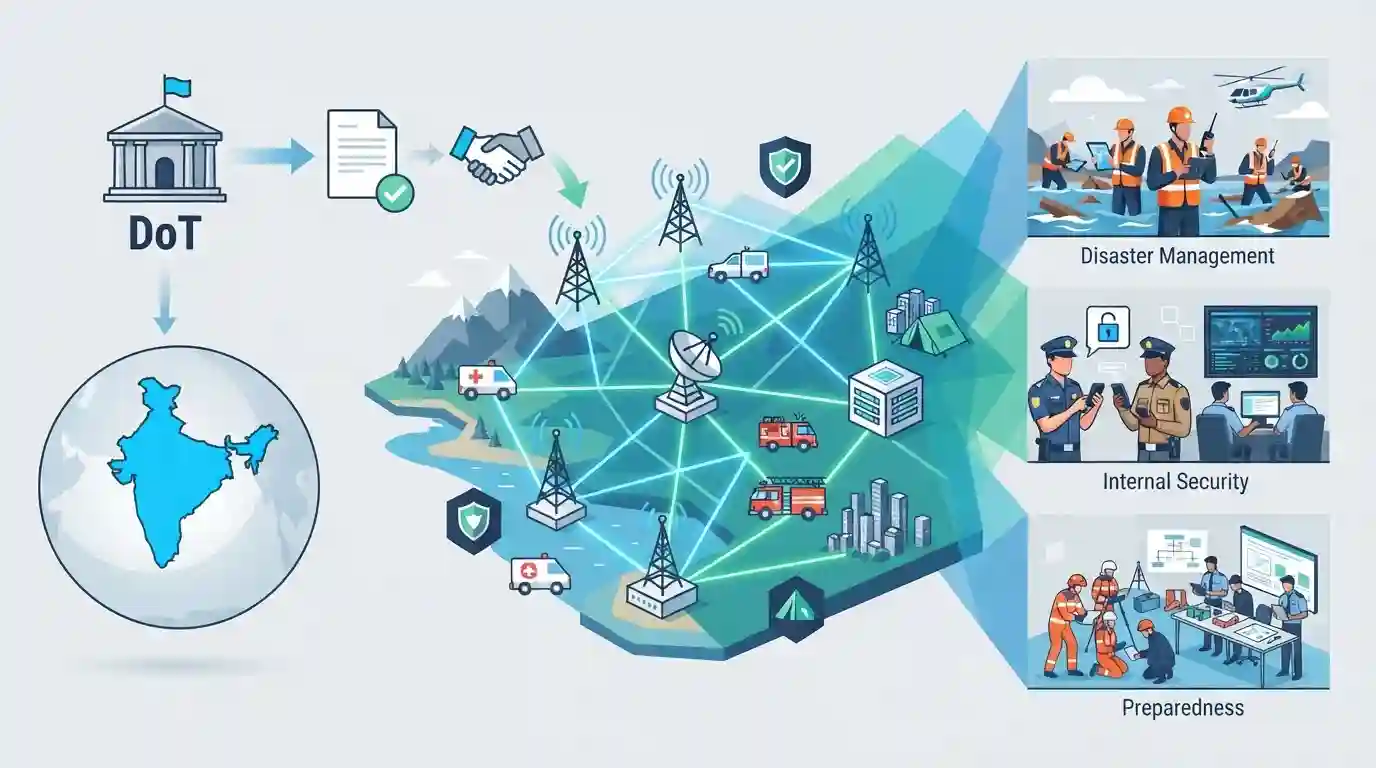
Robust communication networks are the backbone of effective disaster management and emergency response. Evaluating the network architecture for a dedicated public safety broadband system highlights India's policy shift toward enhanced disaster preparedness and resilient technological infrastructure.
Summary
The Department of Telecommunications (DoT), India, has solicited public and stakeholder feedback regarding the network architecture design of the proposed Broadband Public Protection and Disaster Relief (BB-PPDR) system. This critical communication infrastructure aims to bolster disaster management, emergency response, and public safety operations across the country by providing high-speed, reliable, and secure broadband connectivity.
Key Points
- The Department of Telecommunications (DoT) has invited public opinion and stakeholder inputs on the network architecture design for a proposed Broadband Public Protection and Disaster Relief (BB-PPDR) system.
- The BB-PPDR system aims to provide robust, secure, and high-speed broadband communication infrastructure specifically dedicated to public safety agencies, emergency responders, and disaster management authorities.
- Effective critical communication infrastructure is vital for transitioning from a reactive disaster management approach to a proactive, preparedness-focused framework.
- Stakeholder consultations ensure that the technological design accommodates interoperability, resilience, and security requirements under extreme emergency scenarios.
Important Terms
Broadband Public Protection and Disaster Relief (BB-PPDR) System

A dedicated, high-speed, and secure mission-critical communication infrastructure proposed for India to bolster disaster management, emergency response, and public safety operations across agencies using modern wireless technologies.
UPSC context
UPSC GS Paper III (Disaster Management & Internal Security): Tests preparedness, critical infrastructure resilience, and coordination during emergencies.
Department of Telecommunications (DoT)
The central government department under the Ministry of Communications responsible for formulating telecom policies, licensing, and spectrum management in India.
UPSC context
UPSC GS Paper III (Infrastructure & Science and Technology): Tests governance of critical communication spectrum and telecom policy frameworks.
Ministry of Communications
The nodal union ministry in India charged with formulating and administering policies, regulations, and institutional frameworks relating to telecommunications and postal services.
UPSC context
UPSC GS Paper II/III: Tests administrative structure, governance, and institutional oversight of telecom infrastructure and connectivity initiatives.
Static Concepts Connected
What are the core pillars of India's institutional framework for disaster management under the DM Act, 2005?
- Apex Body: National Disaster Management Authority (NDMA) chaired by the Prime Minister acts as the apex policy-making body.
- Executive Body: National Executive Committee (NEC) assists the NDMA and is responsible for preparing the National Disaster Management Plan.
- Tiered Structure: State (SDMA) and District (DDMA) authorities cascade implementation and localized preparedness down to the grassroots level.
Cross-Topic Patterns
Telecom Regulation Meets Internal Security Preparedness
Public safety communications infrastructure relies on dedicated spectrum allocation through the National Frequency Allocation Plan (NFAP), intersecting telecom regulation with internal security preparedness.
3GPP Standards in Sovereign Disaster Governance
Transitioning from narrow-band voice to 3GPP PS-LTE standards highlights how commercial cellular standards are adapted for sovereign disaster management frameworks.

BB-PPDR hybrid deployment model and 3GPP PS-LTE standards are prime candidates for a multi-statement Prelims tech application question.
Linked PYQs · 3
Linked PYQs · 3
- 2024MainsGS3
What is disaster resilience? How is it determined? Describe various elements of a resilience framework. Also mention the global targets of Sendai Framework for Disaster Risk Reduction (2015–2030).
- 2020MainsGS3
Discuss the recent measures initiated in disaster management by the Government of India departing from the earlier reactive approach.
- 2019MainsGS3
Disaster preparedness is the first step in any disaster management process. Explain how hazard zonation mapping will help disaster mitigation in the case of landslides.
