Regional Review Conference on Forest Rights Act
Source:PIB ↗
આ શા માટે મહત્વનું છે
The Forest Rights Act, 2006 is a landmark legislation aimed at redressing historical injustices faced by forest-dwelling communities. Regional review conferences are crucial governance mechanisms to track implementation gaps, ensure administrative accountability, and protect the rights of tribal and vulnerable populations.
સારાંશ
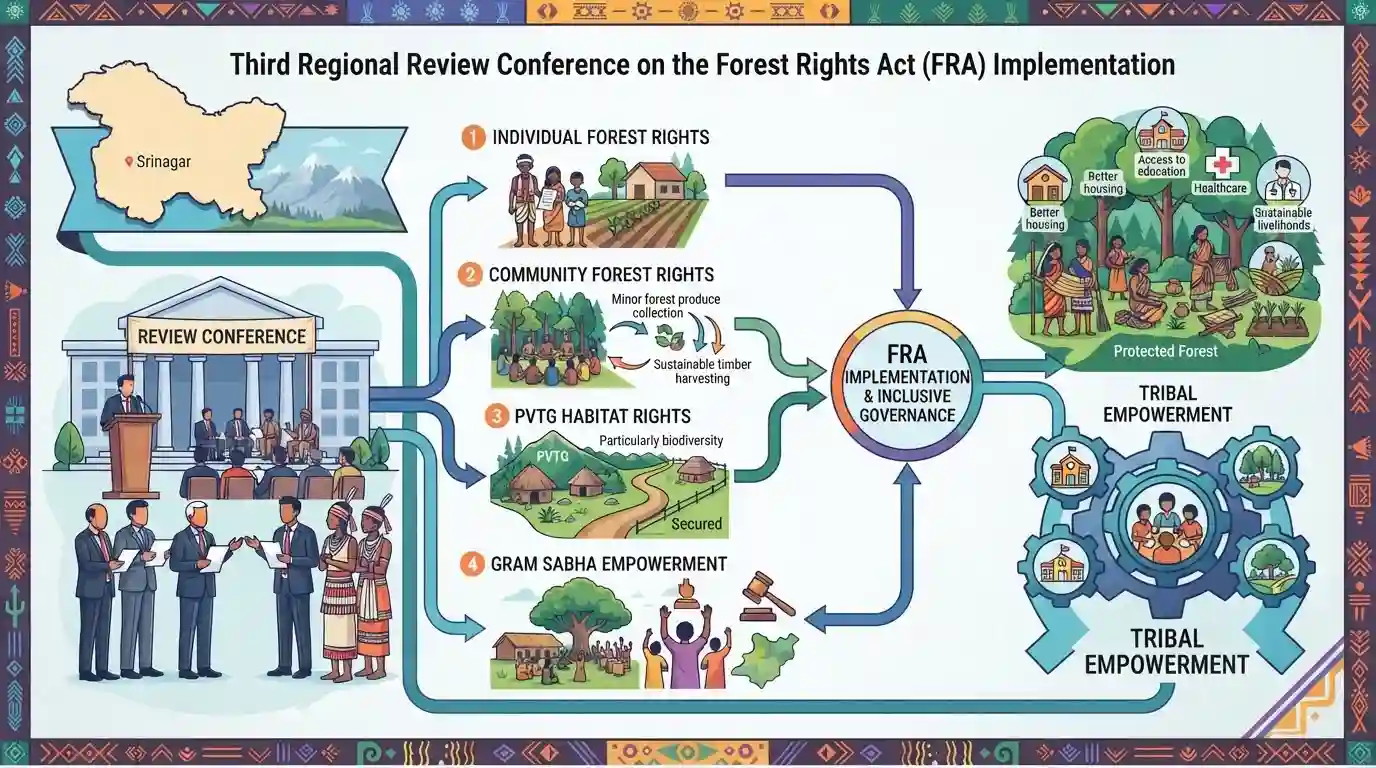
The Third Regional Review Conference on the Forest Rights Act (FRA) Implementation was held in Srinagar, Jammu and Kashmir, hosted by the Ministry of Tribal Affairs. The conference brought together administrators, policymakers, and stakeholders to evaluate the status of FRA implementation, address bottlenecks in recognizing individual and community forest rights, secure habitat rights for PVTGs, and empower Gram Sabhas for grassroots governance and inclusive tribal development.
મુખ્ય મુદ્દા
- The Ministry of Tribal Affairs organized the Third Regional Review Conference on the implementation of the Forest Rights Act (FRA) in Srinagar.
- The conference focused on reviewing the progress of individual and community forest rights recognition, habitat rights for Particularly Vulnerable Tribal Groups (PVTGs), and leveraging technology like web portals for transparent tracking.
- Emphasized strengthening grassroots institutions such as Gram Sabhas and Forest Rights Committees (FRCs) to ensure effective decentralization and social justice.
- Addressed regional bottlenecks and shared best practices among various states and UTs to accelerate inclusive growth and tribal welfare.
મહત્વપૂર્ણ શબ્દો
Scheduled Tribes and Other Traditional Forest Dwellers (Recognition of Forest Rights) Act, 2006 (FRA)

A landmark 2006 Indian legislation recognizing and vesting forest rights in forest-dwelling Scheduled Tribes and other traditional forest dwellers to redress historical injustices.
UPSC context
GS Paper II & III (Government Policies, Environment, Social Justice). Tests understanding of tribal rights, conservation laws, and grassroots governance.
Ministry of Tribal Affairs
The apex central ministry responsible for the overall policy, planning, and coordination of socio-economic development programs for Scheduled Tribes in India.
UPSC context
GS Paper II (Governance, Welfare Schemes for Vulnerable Sections). Tests institutional mechanisms for tribal welfare and policy execution.
Gram Sabha
The grassroots statutory village assembly comprising all adult members, which serves as the foundational authority under the FRA for initiating, verifying, and deciding forest rights claims.
UPSC context
GS Paper II (Polity and Governance - Grassroots Democracy) and GS Paper III (Environment). Evaluates decentralized resource governance and local bodies' empowerment.
પ્રિલિમ્સ ટ્રેપ
The Gram Sabha is the final authority for approving and granting individual and community forest rights under the FRA.
The Gram Sabha only initiates and verifies claims at the grassroots level, but the final authority for approving forest rights vests with the Sub-Divisional and District Level Committees, not the Gram Sabha itself.
સંલગ્ન સ્થિર ખ્યાલો
What are the key authorities and stages involved in the claim-processing mechanism under the Forest Rights Act, 2006?
- Gram Sabha Role: Gram Sabha initiates claims, verifies them through Forest Rights Committees (FRCs), and passes resolutions.
- SDLC Review: Sub-Divisional Level Committee (SDLC) examines and approves/rejects claims forwarded by the Gram Sabha.
- DLC Final Authority: District Level Committee (DLC) considers appeals against SDLC and gives final approval for forest rights titles.
આંતર-વિષય પેટર્ન
Forest Rights Act meets PESA 1996
FRA implementation intersects with PESA 1996 as both empower Gram Sabhas with decentralized resource governance in scheduled and forest areas.
PVTG Habitat Rights + PM-JANAKAN
Habitat rights for PVTGs under FRA link directly to welfare schemes like PM-JANAKAN for tribal development.

Expect a statement-based prelims question on Gram Sabha's statutory role vs. district-level committees under FRA 2006.
સંલગ્ન PYQ · 3
સંલગ્ન PYQ · 3
- 2021PrelimsGS1
At the national level, which ministry is the nodal agency to ensure effective implementation of the Scheduled Tribes and Other Traditional Forest Dwellers (Recognition of Forest Rights) Act, 2006?
- 2019PrelimsGS1
Consider the following statements about Particularly Vulnerable Tribal Groups (PVTGs) in India : 1. PVTGs reside in 18 States and one Union Territory. 2. A stagnant or declining population is one of the criteria for determining PVTG status. 3. There are 95 PVTGS officially notified in the country so far. 4. Irular and Konda Reddi tribes are included in the list of PVTGs. Which of the statements given above are correct?
- 2018PrelimsGS1
Consider the following statements: 1. The definition of "Critical Wildlife Habitat" is incorporated in the Forest Rights Act, 2006. 2. For the first time in India, Baigas have been given Habitat Rights. 3. Union Ministry of Environment, Forest and Climate Change officially decides and declares Habitat Rights for Primitive and Vulnerable Tribal Groups in any part of India. Which of the statements given above is/are correct?
