AgriVoltaics Integration for Solar and Agriculture
Source:PIB ↗
ఇది ఎందుకు ముఖ్యం
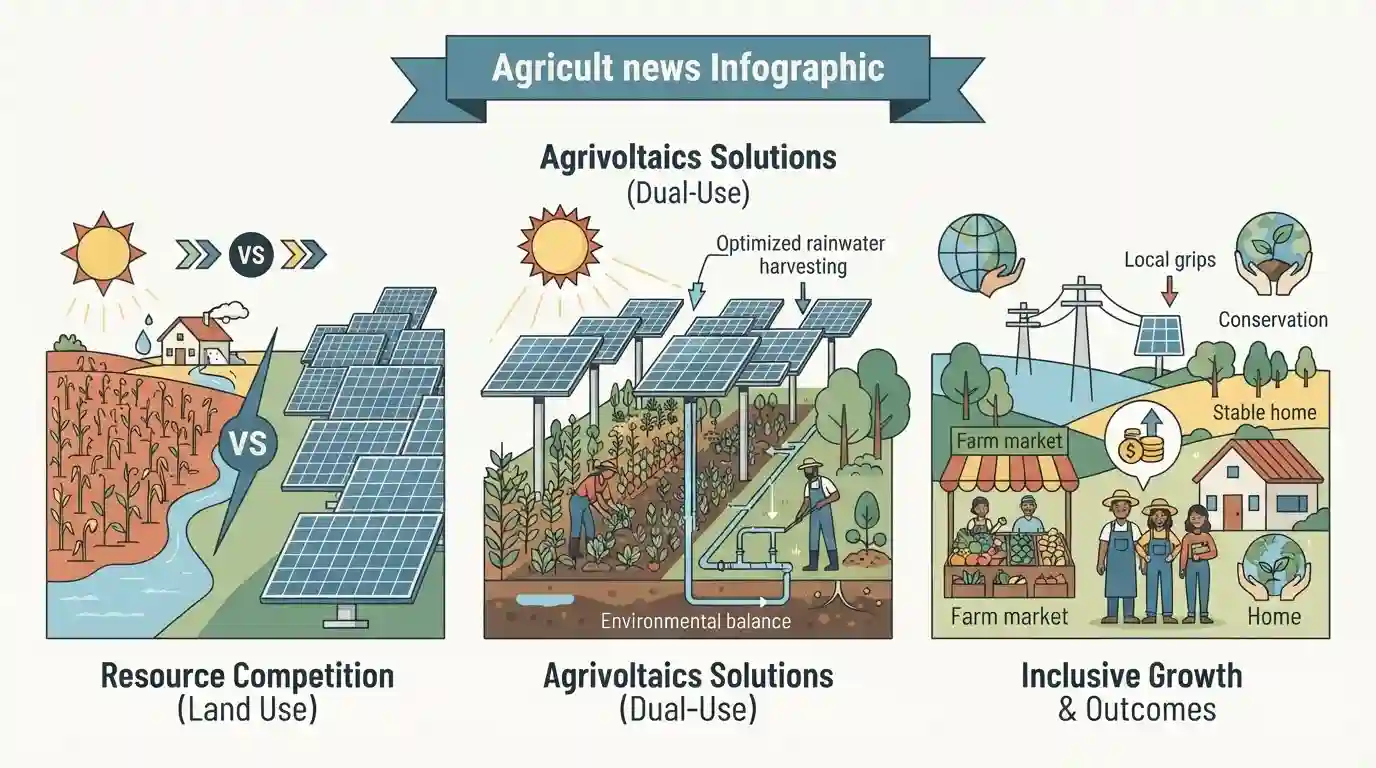
Agrivoltaics is an emerging technological paradigm that solves the food-energy-land nexus challenge, crucial for India's sustainable agriculture and renewable energy targets.
సారాంశం
The AgriVoltaics World Conference highlights the significance of integrating solar energy production with agriculture (agrivoltaics), addressing land-use competition, optimizing water conservation, and enhancing farmers' income through dual-use land infrastructure.
ముఖ్య అంశాలు
- AgriVoltaics represents a dual-use technology combining agricultural production and solar photovoltaic electricity generation on the same land.
- It helps optimize land use efficiency, particularly vital for a land-scarce, densely populated country like India.
- Provides dual income streams for farmers through crop yields and clean energy generation, boosting rural livelihoods and climate resilience.
ముఖ్యమైన పదాలు
AgriVoltaics World Conference

An international conference focusing on the dual-use integration of solar photovoltaic energy generation and agricultural crop production on the same land to optimize land use, water conservation, and farm income.
UPSC context
Important for GS Paper III (Infrastructure, Energy, and Agriculture), testing innovative solutions for land-use competition and sustainable rural development.
Ministry of New and Renewable Energy
The nodal ministry of the Government of India tasked with formulating policies, promoting research, and executing programs for the development and deployment of renewable energy sources.
UPSC context
Important for GS Paper III (Environment, Energy, and Infrastructure), testing institutional frameworks driving India's green transition and climate goals.
ప్రిలిమ్స్ ఉచ్చు
Agrivoltaics is solely a land-efficient method for commercial solar power generation without direct agricultural microclimate benefits.
Aspirants often assume agrivoltaics is purely a power-generation asset; however, it provides specific agronomic advantages like microclimate modification and reduced water evaporation.
అనుసంధానమైన స్థిర భావనలు
What are the key objectives and components of the PM-KUSUM scheme in India?
- Component A: Component A focuses on setting up 10,000 MW of decentralized grid-connected renewable power plants on barren or agricultural land.
- Component B: Component B supports installation of 17.5 lakh standalone solar agriculture pumps for irrigation security.
- Component C: Component C aids solarisation of 10 lakh grid-connected agriculture pumps for surplus power sale.
అంతర-అంశ నమూనాలు
Agrivoltaics + Land Use Conflict + PM-KUSUM
Agrivoltaics links renewable energy expansion under PM-KUSUM with rural livelihood security, balancing food security and net-zero targets in land-scarce economies.

Agrivoltaics microclimatic benefits + PM-KUSUM integration likely to feature in a statement-based prelims question.
అనుసంధాన PYQలు · 2
అనుసంధాన PYQలు · 2
- 2020MainsGS3
Describe the benefits of deriving electric energy from sunlight in contrast to the conventional energy generation. What are the initiatives offered by our Government for this purpose?
- 2025PrelimsGS1
Consider the following statements about 'PM Surya Ghar Muft Bijli Yojana': I. It targets installation of one crore solar rooftop panels in the residential sector. II. The Ministry of New and Renewable Energy aims to impart training on installation, operation, maintenance and repairs of solar rooftop systems at grassroot levels. III. It aims to create more than three lakhs skilled manpower through fresh skilling, and up-skilling, under scheme component of capacity building. Which of the statements given above are correct?
