India Global South Leadership and Economic Resilience Vision
Source:PIB ↗
Why It Matters
The speech outlines India's strategic foreign policy posture, its leadership role for the Global South, and domestic economic milestones, which are core themes for GS-2 (International Relations/Global Groupings) and GS-3 (Economic Development).
Summary
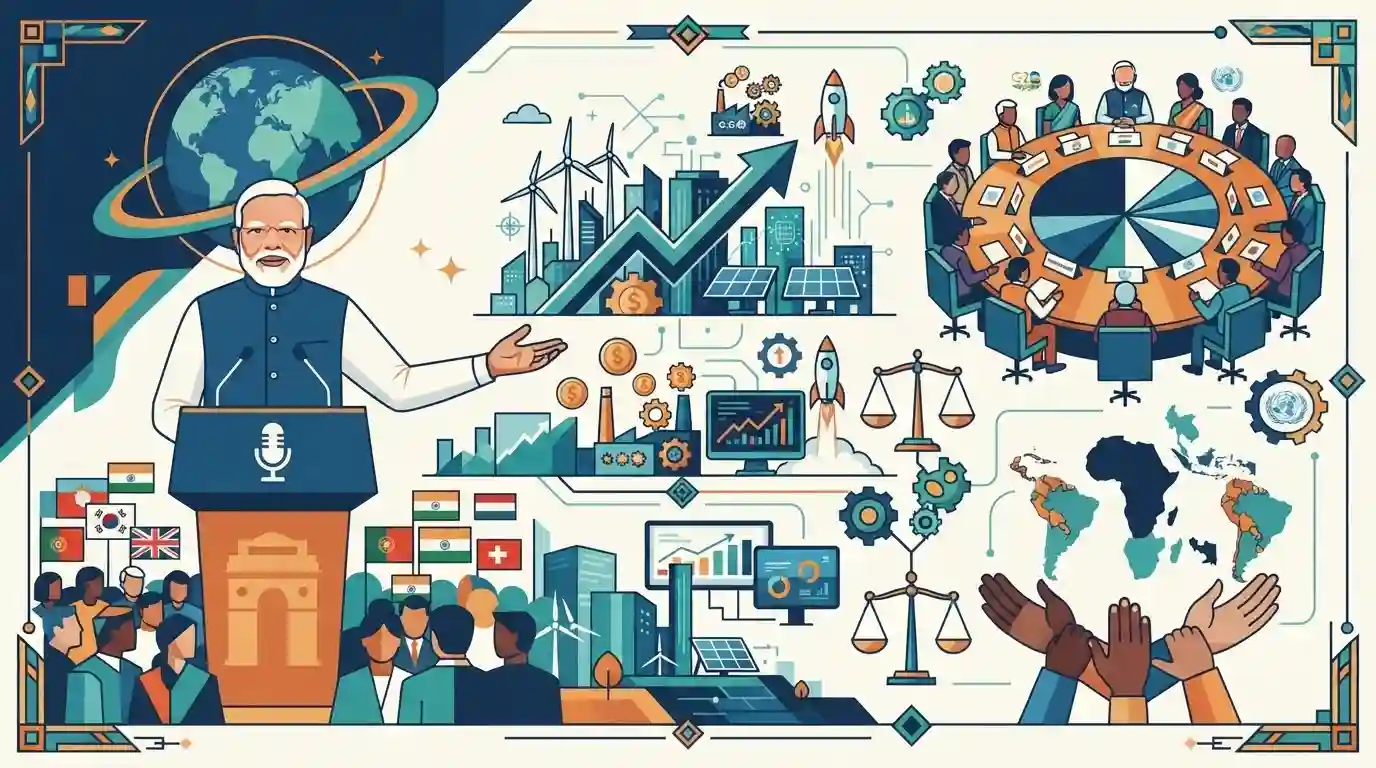
Prime Minister Narendra Modi's address at the NDTV World Summit outlines India's vision for global leadership, economic resilience, technological advancement, and the necessity for comprehensive multilateral reforms to support the Global South.
Key Points
- PM Modi highlighted India's journey of rapid growth, stability, and democratic resilience at the NDTV World Summit.
- Emphasized India's transformation into a pillar of global economic growth and a champion of the Global South.
- Highlighted the role of technology, digital public infrastructure (DPI), and reforms in shaping a futuristic India.
- Stressed the necessity of multilateral reforms to address contemporary global challenges like conflicts, supply chain resilience, and climate change.
Important Terms
NDTV World Summit

A high-level international forum serving as a platform for global leaders and policymakers to debate geopolitics, economic trends, technological progress, and India's strategic vision on the world stage.
UPSC context
GS Paper II / International Relations: Useful for tracking India's soft power outreach, diplomatic messaging, and discourse on contemporary global issues.
United Nations
An international organization founded in 1945 to promote global peace, security, and cooperation, currently facing widespread calls from India and the Global South for comprehensive structural reforms.
UPSC context
GS Paper II / International Relations & Global Governance: Essential for questions on multilateralism, UN reforms, and India's multilateral diplomacy.
Static Concepts Connected
What are the core pillars of India's Digital Public Infrastructure (DPI) architecture?
- Identity Layer: Aadhaar-based biometric verification enabling unique digital identity and targeted direct benefit transfers nationwide.
- Payment Layer: Unified Payments Interface (UPI) facilitating instant, interoperable retail digital payments across financial institutions.
- Consent Layer: Data Empowerment and Protection Architecture (DEPA) empowering citizens to securely share personal data with consent.
What structural reforms are frequently demanded by India regarding the United Nations Security Council (UNSC)?
- Equitable Representation: Expansion in both permanent and non-permanent membership categories to reflect contemporary geopolitical realities.
- Global South Voice: Inclusion of developing nations from Asia, Africa, and Latin America to properly represent the Global South.
- Historic Correction: Correction of historical injustices in global governance structures established post-WWII.
Cross-Topic Patterns
Multilateral Reforms & UNSC G4 Bids
India's advocacy for UN/Multilateral reform intersects directly with the G4 nations' bid for permanent UNSC seats and North-South governance debates.
Digital Public Infrastructure & Tech Diplomacy
DPI export strategies (India Stack) function simultaneously as domestic financial inclusion tools and instruments of techno-economic diplomacy across the Global South.

India's evolution from 'rule-taker' to 'rule-shaper' via DPI and Global South leadership will feature in IR or Governance mains.
Linked PYQs · 2
Linked PYQs · 2
- 2025MainsGS2
"The reform process in the United Nations remains unresolved, because of the delicate imbalance of East and West and entanglement of the USA vs. Russo-Chinese alliance.” Examine and critically evaluate the East-West policy confrontations in this regard.
- 2023MainsGS3
What is the status of digitalization in the Indian economy? Examine the problems faced in this regard and suggest improvements.
