Jammu and Kashmir Governance Approach Against Drug Abuse and Welfare
Source:PIB ↗
આ શા માટે મહત્વનું છે
The article highlights governance strategies for grassroots implementation of welfare schemes and multi-agency approaches to curb drug abuse, which are critical themes for GS2 (Social Justice/Governance) and GS3 (Internal Security).
સારાંશ
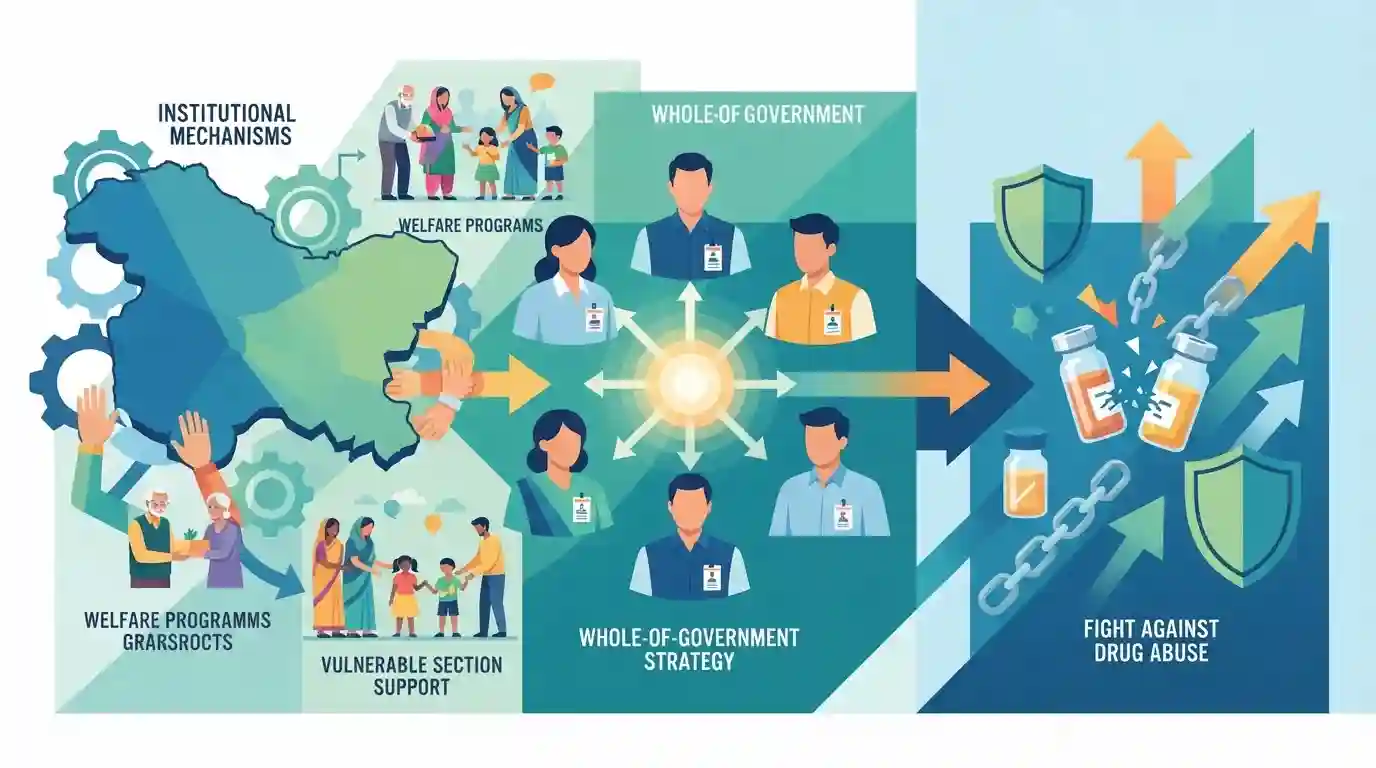
Union Secretary for Social Justice and Empowerment Shri Sudhansh Pant lauded Jammu and Kashmir's implementation of grassroots welfare programs and its whole-of-government strategy to tackle drug abuse, emphasizing convergence, institutional mechanisms, and vulnerable section support.
મુખ્ય મુદ્દા
- Union Secretary for MoSJ&E Shri Sudhansh Pant praised Jammu and Kashmir's grassroots welfare outreach and whole-of-government approach.
- The focus was placed on combating drug abuse through coordinated administrative, preventive, and rehabilitative measures.
- Emphasized the convergence of various central and UT-level social security and welfare schemes to target vulnerable sections effectively.
- Highlighted the importance of community participation and institutional frameworks in grassroots delivery.
મહત્વપૂર્ણ શબ્દો
Ministry of Social Justice and Empowerment (MoSJ&E)

The Union ministry responsible for policy formulation, welfare, social justice, and empowerment of marginalized groups, including Scheduled Castes, Other Backward Classes, senior citizens, persons with disabilities, and victims of substance abuse.
UPSC context
UPSC GS Paper II (Social Justice / Vulnerable Sections) – examines welfare schemes, institutional frameworks, and policies for marginalized populations.
Whole-of-Government Approach
An integrated governance strategy involving multiple ministries, security agencies, and administrative tiers acting in tandem to tackle complex, cross-cutting challenges like narcotics trafficking and substance abuse.
UPSC context
UPSC GS Paper II (Governance) & GS Paper III (Internal Security) – tests administrative coordination and anti-drug strategies.
Nasha Mukt Bharat Abhiyaan (NMBA)
A nationwide campaign launched by the Ministry of Social Justice and Empowerment focused on community outreach, mass awareness, and rehabilitation to combat substance abuse across vulnerable districts in India.
UPSC context
UPSC GS Paper III (Internal Security / Social Issues) – tests government initiatives and demand-reduction strategies against drug abuse.
સંલગ્ન સ્થિર ખ્યાલો
What are the key institutional components and schemes under India's national strategy against drug abuse?
- NMBA Focus: Nashamukt Bharat Abhiyaan (NMBA) focuses on vulnerable districts through mass awareness and community outreach.
- NAPDDR Mandate: NAPDDR is an umbrella scheme providing financial assistance for preventive education, awareness, and de-addiction facilities.
- De-addiction Tiers: Tiered de-addiction infrastructure includes IRCAs, ODICs, and Addiction Treatment Facilities (ATFs) in government hospitals.
આંતર-વિષય પેટર્ન
Narco-Terrorism & Internal Security Links
Drug trafficking routes like the Golden Crescent directly intersect with internal security, cross-border infiltration, and narco-terrorism in border regions like Jammu & Kashmir.
Welfare Convergence & District Administration
The convergence model under MoSJ&E mirrors rural development frameworks like aspirational districts, linking welfare delivery to administrative accountability at the grassroots.

NAPDDR, NMBA, and tiered de-addiction infrastructure (IRCAs, ATFs) are high-yield static areas frequently tested in Prelims.
સંલગ્ન PYQ · 2
સંલગ્ન PYQ · 2
- 2019MainsGS2
Performance of welfare schemes that are implemented for vulnerable sections is not so effective due to absence of their awareness and active involvement at all stages of policy process. Discuss.
- 2024MainsGS3
Explain how narco-terrorism has emerged as a serious threat across the country. Suggest suitable measures to counter narco-terrorism.
