Tripartite MoU for Livelihood Skill Development of Tribal Youth
Source:PIB ↗
Why It Matters
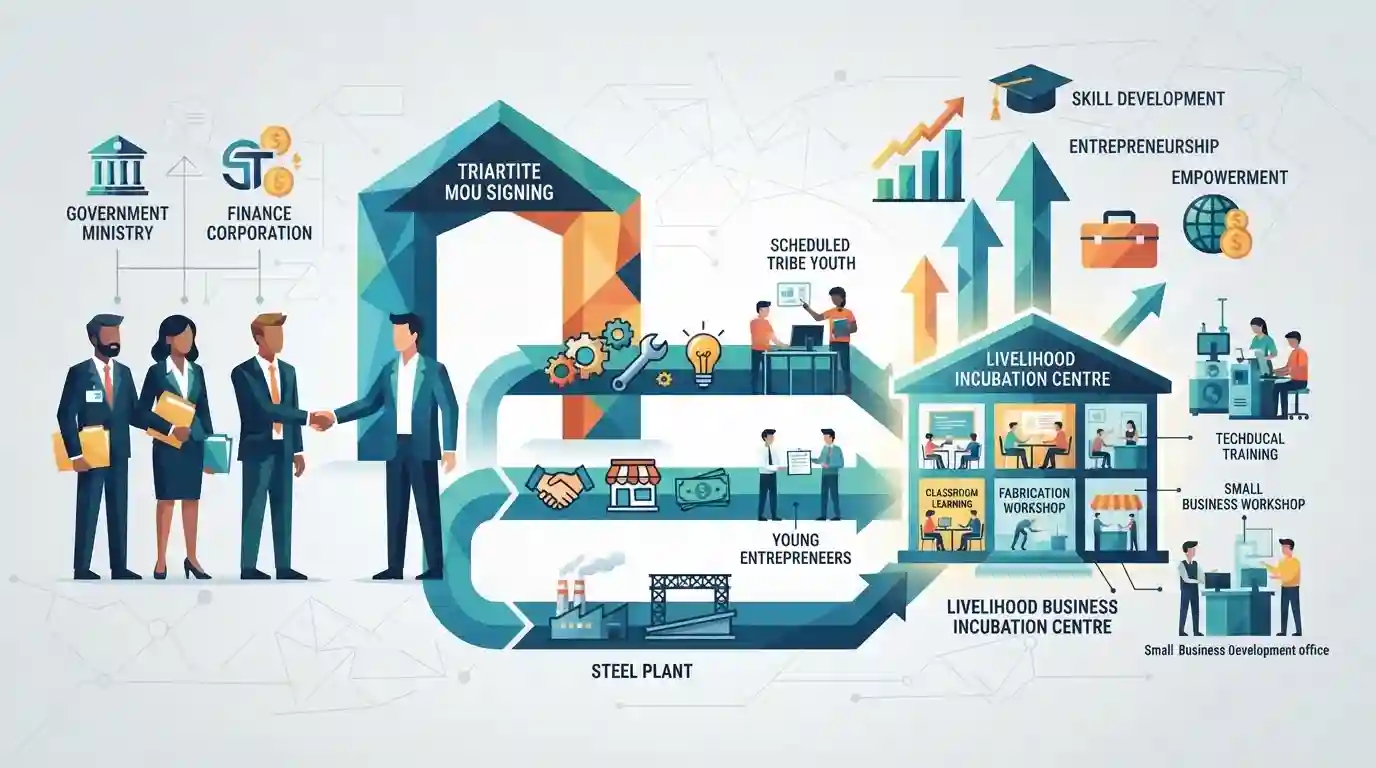
This initiative exemplifies cooperative governance and inter-ministerial synergy (Tribal Affairs, MSME, and Steel) aimed at grassroots economic empowerment, skill-based capacity building, and entrepreneurship promotion among vulnerable tribal youth.
Summary
The Ministry of Tribal Affairs, via NSTFDC, signed a tripartite MoU with NSIC and Rourkela Steel Plant to boost livelihood opportunities, skill development, and entrepreneurship among Scheduled Tribe youth through the Rourkela Livelihood Business Incubation Centre.
Key Points
- A tripartite MoU was signed between NSTFDC (Ministry of Tribal Affairs), NSIC (Ministry of MSME), and Rourkela Steel Plant (Ministry of Steel) to strengthen livelihood opportunities for Scheduled Tribe (ST) youth.
- The Livelihood Business Incubation Centre at Rourkela, established in 2018, is recognized as a Centre of Excellence by the Ministry of Tribal Affairs and has benefited over 600 students.
- The center provides vocational training, skill development, and entrepreneurship programs (such as tailoring, electrical work, accounting, bakery, and mushroom farming) with machinery funded under the MSME ASPIRE scheme and recurring expenses borne by NSTFDC grants.
Important Terms
National Scheduled Tribes Finance and Development Corporation (NSTFDC)

Apex public sector corporation under the Ministry of Tribal Affairs providing financial assistance, concession loans, and skill training for income generation and economic development of Scheduled Tribes.
UPSC context
UPSC GS Paper II (Vulnerable Sections & Government Schemes): Evaluates institutional mechanisms and financial inclusion schemes for Scheduled Tribes development.
Ministry of Tribal Affairs
The central government nodal ministry responsible for policy planning, coordination, and implementation of welfare, educational, and socio-economic programs for Scheduled Tribes in India.
UPSC context
UPSC GS Paper II (Governance & Social Justice): Important for schemes, welfare policies, and institutional mandates concerning tribal populations.
National Small Industries Corporation (NSIC)
A Mini Ratna PSU under the Ministry of MSME that aids, fosters, and promotes the growth of micro, small, and enterprises via marketing, technology, and incubation support.
UPSC context
UPSC GS Paper III (Inclusive Growth & Industrial Policy): Tests knowledge of public sector interventions for small businesses and skill development.
Prelims Trap
NSTFDC functions under the Ministry of Finance as a specialized banking institution.
NSTFDC functions under the Ministry of Tribal Affairs, not the Ministry of Finance or Ministry of Social Justice and Empowerment, which aspirants often confuse with other corporation mandates.
Static Concepts Connected
What are the mandate and institutional framework of the National Scheduled Tribes Finance and Development Corporation (NSTFDC)?
- Apex Body: Established in 2001 under the Ministry of Tribal Affairs as an apex organization for economic upliftment of STs.
- Concessional Loans: Provides concessional financial assistance, term loans, and microcredit for income-generating ventures and skill training grants.
Cross-Topic Patterns
Tribal Welfare + MSME Convergence Models
The convergence between tribal welfare finance (NSTFDC) and MSME infrastructure schemes (ASPIRE) illustrates whole-of-government execution targeted at vulnerable demographics.

Expect match-the-following questions linking specialized corporations like NSTFDC or NSFDC to their respective administrative ministries.
Linked PYQs · 3
Linked PYQs · 3
- 2023MainsGS2
Skill development programmes have succeeded in increasing human resources supply to various sectors. In the context of the statement analyse the linkages between education, skill and employment.
- 2021MainsGS2
“Earn while you learn' scheme needs to be strengthened to make vocational education and skill training meaningful.” Comment.
- 2014MainsGS2
Do government's schemes for up-lifting vulnerable and backward communities by protecting required social resources for them, lead to their exclusion in establishing businesses in urban economies ?
