PM-DAKSH Scheme Performance in Training and Placement
Source:PIB ↗
কেন এটি গুরুত্বপূর্ণ
Crucial for analyzing targeted welfare measures, skill development initiatives for marginalized communities (SCs, OBCs, sanitation workers), and evaluating public policy outcomes in inclusive growth.
সারসংক্ষেপ
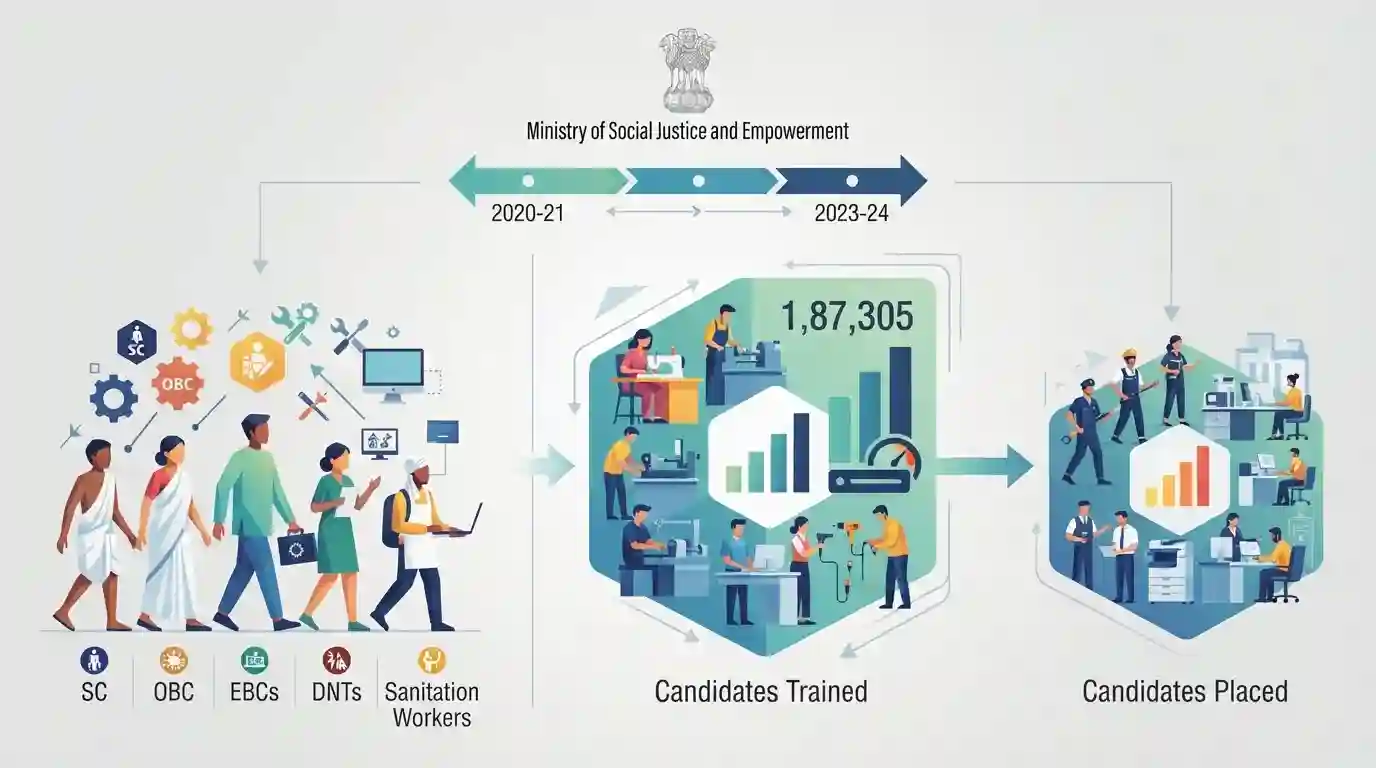
The Ministry of Social Justice and Empowerment reported that under the PM-DAKSH (Pradhan Mantri Dakshta Aur Kushalta Sampann Hitgrahi) scheme, 1,87,305 candidates were trained and 96,162 were placed between 2020-21 and 2023-24. The scheme focuses on upskilling/reskilling and short-term/long-term training programs for marginalized groups like SCs, OBCs, EBCs, DNTs, and sanitation workers to enhance employability.
মূল বিষয়
- During the period from 2020-21 to 2023-24, a total of 1,87,305 candidates were trained, and 96,162 candidates were placed under the PM-DAKSH scheme.
- PM-DAKSH (Pradhan Mantri Dakshta Aur Kushalta Sampann Hitgrahi) Yojana is implemented by the Ministry of Social Justice and Empowerment.
- The scheme targets target groups including Scheduled Castes (SCs), Other Backward Classes (OBCs), Economically Backward Classes (EBCs), Denotified Tribes (DNTs), and sanitation workers including waste pickers.
- The objective is to enhance the competencies of the target groups and make them employable either through wage employment or self-employment, thereby fostering social inclusion and economic empowerment.
গুরুত্বপূর্ণ শব্দ
PM-DAKSH Scheme

A central sector scheme by the Ministry of Social Justice and Empowerment aimed at upskilling and reskilling marginalized groups like SCs, OBCs, EBCs, DNTs, and sanitation workers to enhance employability and wage/self-employment.
UPSC context
Mains GS Paper II (Social Justice - Welfare Schemes for Vulnerable Sections). Tests knowledge of targeted skill development initiatives for marginalized communities.
Pradhan Mantri Dakshta Aur Kushalta Sampann Hitgrahi (PM-DAKSH) Yojana
The full form of the PM-DAKSH Yojana, a national initiative focusing on short-term/long-term training, upskilling, and entrepreneurship development programs for vulnerable sections of society.
UPSC context
Mains GS Paper II (Welfare Schemes & Social Justice). Important for evaluating government efforts towards social empowerment and inclusive growth.
Ministry of Social Justice and Empowerment
The nodal union ministry responsible for formulating and administering policies, welfare schemes, and legislation for the empowerment of marginalized groups, including SCs, OBCs, senior citizens, and differently-abled persons.
UPSC context
Prelims/Mains GS Paper II. Tests governance structures and the institutional framework behind social welfare implementation.
সংযুক্ত স্থির ধারণা
What are the key implementing agencies and target groups under the PM-DAKSH Scheme?
- Implementing Agencies: Implemented by the Ministry of Social Justice and Empowerment through three PSUs: NSFDC, NBCFDC, and NSKFDC.
- Target Beneficiaries: Targets marginalized sections including Scheduled Castes, Other Backward Classes, Economically Backward Classes, De-notified Tribes, and sanitation workers.
- Training Components: Offers upskilling, short-term, long-term training, and Recognition of Prior Learning (RPL) to boost wage or self-employment.
আন্তঃবিষয় প্যাটার্ন
Targeted Skill Schemes vs Universal Skilling
Skill development initiatives under MSDE are frequently confused with targeted social justice welfare schemes managed by MoSJE such as PM-DAKSH.

Expect a statement-based prelims question distinguishing MoSJE's PM-DAKSH target groups (SC/OBC/DNT/Sanitation workers) from MSDE schemes.
সংযুক্ত PYQ · 3
সংযুক্ত PYQ · 3
- 2023MainsGS2
“Development and welfare schemes for the vulnerable, by its nature, are discriminatory in approach.” Do you agree? Give reasons for your answer.
- 2021MainsGS2
“Earn while you learn' scheme needs to be strengthened to make vocational education and skill training meaningful.” Comment.
- 2018PrelimsGS1
With reference to Pradhan Mantri Kaushal Vikas Yojana, consider the following statements: 1. It is the flagship scheme of the Ministry of Labour and Employment. 2. It, among other things, will also impart training in soft skills, entrepreneurship, financial and digital literacy. 3. It aims to align the competencies of the unregulated workforce of the country to the National Skill Qualification Framework. Which of the statements given above is/are correct?
