Inauguration of AgriVoltaics Conference on Solar Agriculture
Source:PIB ↗
ఇది ఎందుకు ముఖ్యం
Agrivoltaics presents a dual-use land strategy that addresses India's twin challenges of expanding renewable energy capacity and ensuring food security while enhancing farmer incomes.
సారాంశం
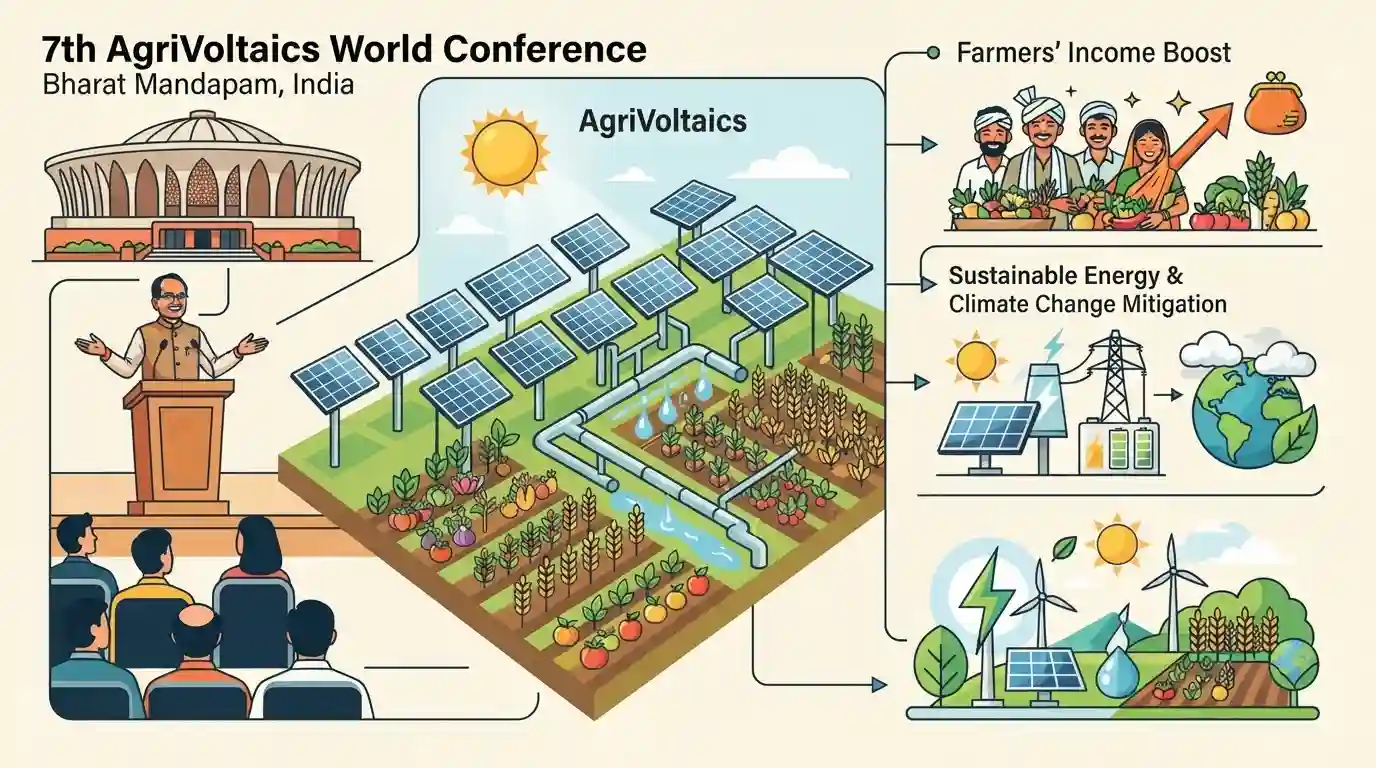
Union Minister Shri Shivraj Singh Chouhan inaugurated the 7th AgriVoltaics World Conference at Bharat Mandapam, highlighting the integration of solar power generation and agriculture (agrivoltaics) to boost farmers' incomes, conserve water, and advance sustainable clean energy solutions in India.
ముఖ్య అంశాలు
- Union Minister Shivraj Singh Chouhan inaugurated the 7th AgriVoltaics World Conference at Bharat Mandapam, New Delhi.
- AgriVoltaics integrates solar photovoltaic panels with agricultural crop production on the same piece of land, optimizing land use.
- The system provides dual benefits: generating clean renewable electricity while shielding sensitive crops from excessive heat and reducing water evaporation.
- Aims to augment farmers' incomes, support sustainable development, and tackle climate change challenges without compromising food security.
ముఖ్యమైన పదాలు
AgriVoltaics World Conference

An innovative dual-land-use system that combines agricultural production with photovoltaic solar energy generation on the same land area, helping conserve water and boost farmers' incomes.
UPSC context
UPSC Prelims/Mains (GS Paper III: Agriculture & Energy) – tests knowledge of sustainable farming innovations and renewable energy integration.
Ministry of Agriculture and Farmers Welfare
The apex central government ministry in India responsible for formulating policies, administering programs, and promoting sustainable growth in agriculture, allied sectors, and farmers' welfare.
UPSC context
UPSC Prelims/Mains (GS Paper II/III: Governance & Agriculture) – tests institutional frameworks for agrarian policy and farmer welfare schemes.
అనుసంధానమైన స్థిర భావనలు
What are the key climate targets committed by India at COP26 (Panchamrit) and their relevance to renewable integration?
- 500 GW Target: India aims to reach 500 GW of non-fossil energy capacity by 2030, making decentralized models like agrivoltaics vital to bypass land scarcity issues.
- 2030 Renewables: India pledged to meet 50% of its energy requirements from renewable energy by 2030, reducing carbon intensity of its economy by less than 45%.
- Net Zero 2070: Net-zero emissions target by 2050 or 2070? India committed to achieve net-zero carbon emissions by 2070 during COP26 in Glasgow.
అంతర-అంశ నమూనాలు
Agrivoltaics + National Action Plan on Climate Change
Agrivoltaics links renewable energy expansion (PM-KUSUM) with agrarian adaptation strategies, protecting food security while meeting COP targets.
Dual Land-Use + Farmers' Income Doubling
Dual land-use models directly impact land acquisition debates, agricultural productivity metrics, and farmers' income doubling targets.

Agrivoltaic dual-use metrics (shade, water savings, 500 GW target) will appear in a multi-statement environment/agriculture question.
అనుసంధాన PYQలు · 2
అనుసంధాన PYQలు · 2
- 2020MainsGS3
Describe the benefits of deriving electric energy from sunlight in contrast to the conventional energy generation. What are the initiatives offered by our Government for this purpose?
- 2025PrelimsGS1
Consider the following statements about 'PM Surya Ghar Muft Bijli Yojana': I. It targets installation of one crore solar rooftop panels in the residential sector. II. The Ministry of New and Renewable Energy aims to impart training on installation, operation, maintenance and repairs of solar rooftop systems at grassroot levels. III. It aims to create more than three lakhs skilled manpower through fresh skilling, and up-skilling, under scheme component of capacity building. Which of the statements given above are correct?
