CAQM Review Meeting on Dust Pollution Mitigation in Delhi NCR
Source:PIB ↗
Why It Matters
It highlights institutional governance and statutory interventions by bodies like CAQM to tackle severe air pollution and dust management in the National Capital Region.
Summary
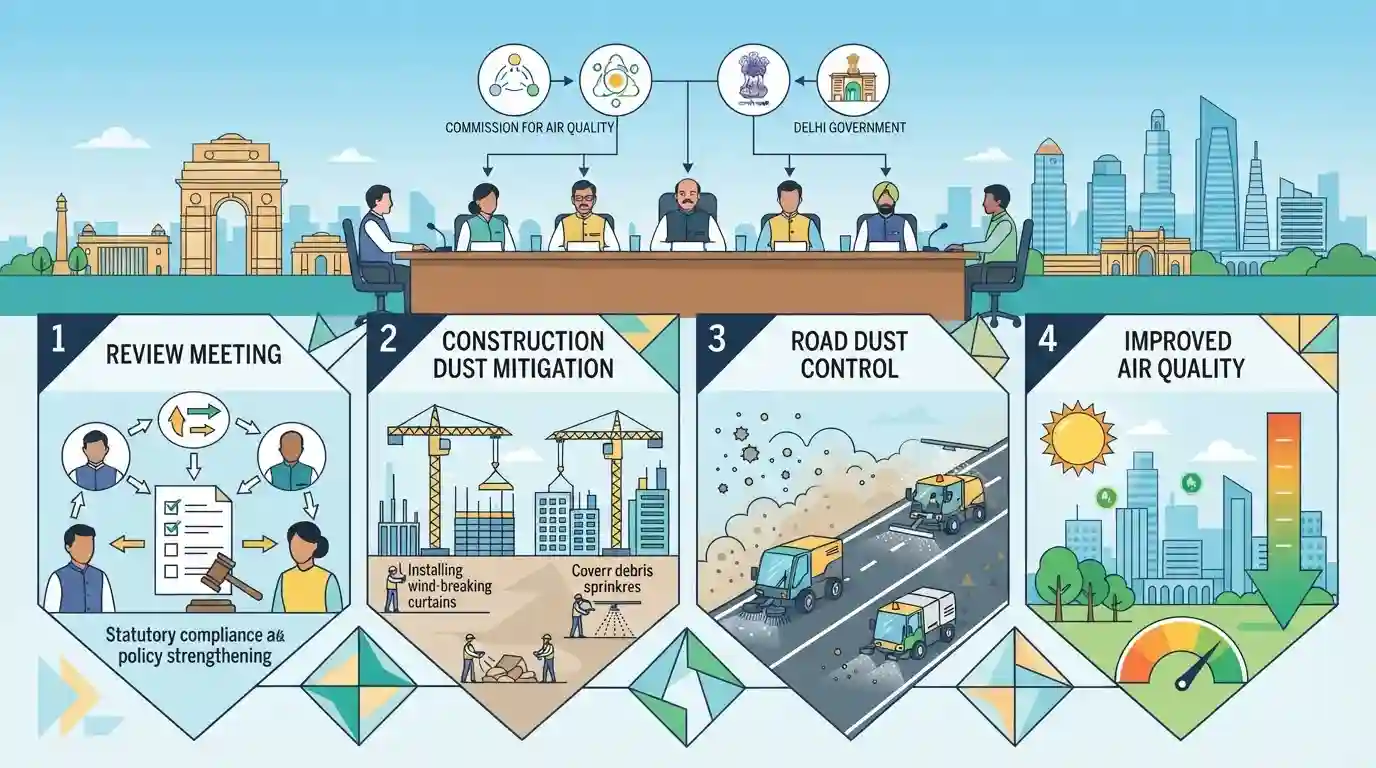
The Commission for Air Quality Management (CAQM) held a review meeting with Delhi Government agencies to strengthen air pollution mitigation strategies, specifically targeting dust pollution from construction and demolition activities and road dust, reinforcing statutory compliance for better air quality in the region.
Key Points
- CAQM reviewed dust pollution issues and air pollution mitigation measures with Delhi Government agencies.
- Focus areas included construction and demolition (C&D) waste management, road dust mitigation, and anti-smog measures.
- Emphasized strict compliance with statutory directions and guidelines to curb deteriorating air quality in the NCR.
Important Terms
Commission for Air Quality Management (CAQM)

A statutory body established under the Commission for Air Quality Management in National Capital Region and Adjoining Areas Act, 2021, to coordinate, monitor, and regulate air quality management in the NCR.
UPSC context
UPSC Paper III (Environment): Tests statutory bodies, environmental governance, and institutional mechanisms for pollution control in the National Capital Region.
Delhi Government agencies
Government bodies, municipal corporations, and administrative departments in Delhi tasked with implementing environmental regulations, infrastructure maintenance, and urban sanitation policies.
UPSC context
UPSC Paper III (Environment and Governance): Tests multi-agency coordination, urban governance challenges, and implementation gaps in combating urban air pollution.
Prelims Trap
CAQM is an advisory body whose directives are recommendations for state governments in the National Capital Region.
Aspirants often confuse CAQM with an advisory body or assume its jurisdiction is limited strictly to the NCT of Delhi, missing its statutory reach into adjoining states.
Static Concepts Connected
What are the statutory powers and composition of the Commission for Air Quality Management (CAQM)?
- Statutory Basis: Created under the CAQM Act 2021 as a statutory body replacing the judicial EPCA.
- Jurisdiction: Jurisdiction spans NCR and adjoining areas in Punjab, Haryana, Rajasthan, and UP.
- Enforcement Powers: Possesses powers to issue legally binding directions, impose environmental compensation, and penalize violators with up to 5 years imprisonment or fines.
Cross-Topic Patterns
Environmental Governance vs. Federal Polity
CAQM's legally binding directions over multiple states illustrate cooperative federalism overriding state boundaries for transboundary environmental challenges like stubble burning and dust.

CAQM statutory powers, jurisdiction over NCR/adjoining states, and supersession of EPCA make it a prime candidate for a UPSC prelims statement.
Linked PYQs · 2
Linked PYQs · 2
- 2020MainsGS3
What are the key features of the National Clean Air Programme (NCAP) initiated by the Government of India?
- 2021MainsGS3
Describe the key points of the revised Global Air Quality Guidelines (AQGs) recently released by the World Health Organisation (WHO). How are these different from its last update in 2005? What changes in India's National Clean Air Programme are required to achieve these revised standards?
