Ministry Drive on Cleanliness and Governance Efficiency
Source:PIB ↗
কেন এটি গুরুত্বপূর্ণ
It highlights administrative reforms, institutional accountability, and cleanliness drives in government machinery, which are core components of effective governance and bureaucratic efficiency evaluated under GS Paper II.
সারসংক্ষেপ
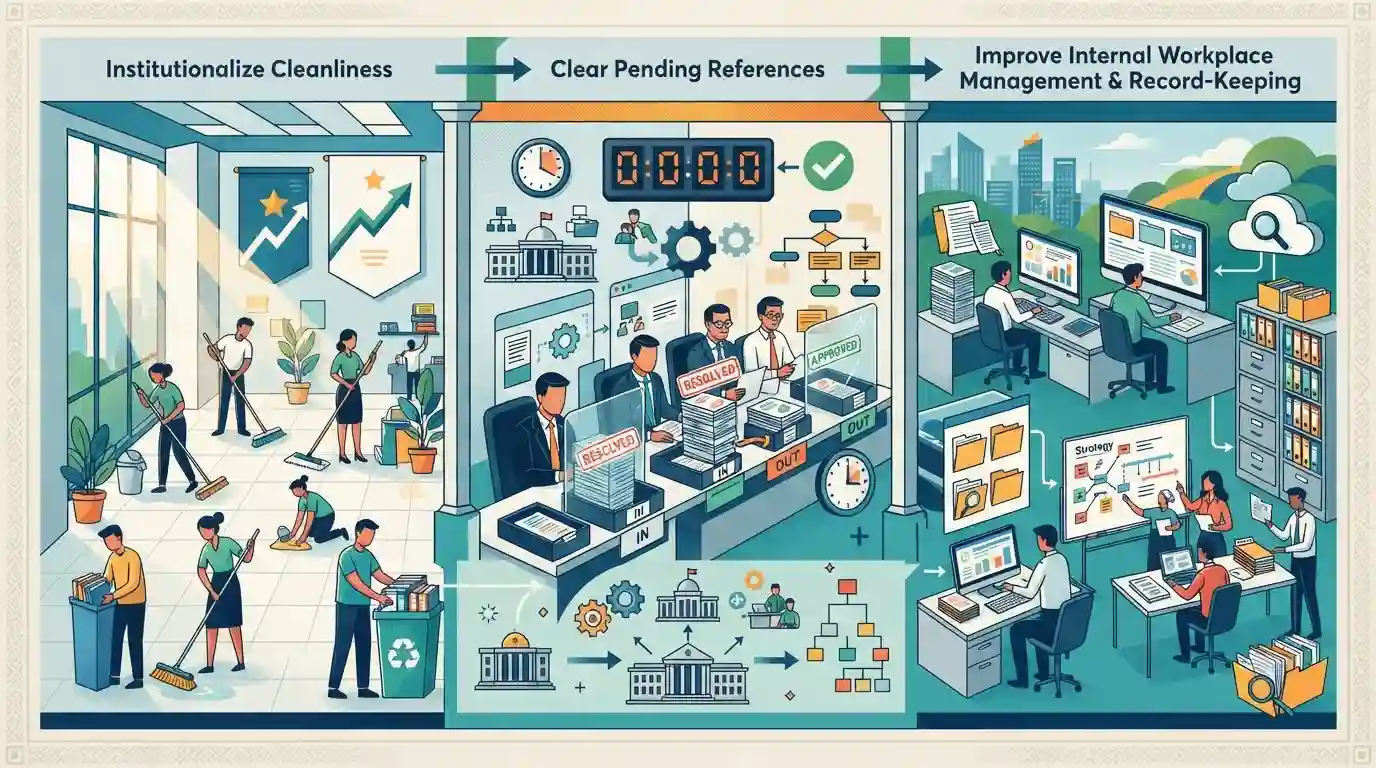
The Ministry of Women and Child Development is set to launch a dedicated nationwide drive under Special Campaign 6.0 to institutionalize cleanliness, clear pending references, and improve internal workplace management and record-keeping in governance institutions.
মূল বিষয়
- The Ministry of Women and Child Development is organizing a dedicated nationwide drive on 30th October under Special Campaign 6.0 focusing on institutional cleanliness, pendency reduction, and record management.
- The campaign emphasizes streamlining governance processes, enhancing office management efficiency, and promoting a citizen-centric approach in public service delivery.
- It builds on the successes of previous special campaigns aimed at institutionalizing Swachhata (cleanliness) and minimizing delays in public grievance redressal and inter-ministerial references.
গুরুত্বপূর্ণ শব্দ
Special Campaign 6.0

A government-wide initiative spearheaded by the DARPG to institutionalize cleanliness (Swachhata), clear pending references, and improve workplace management and record-keeping across central ministries and departments.
UPSC context
UPSC Mains GS Paper II: Governance, Transparency, and Accountability in Government administration and public grievance redressal mechanisms.
Ministry of Women and Child Development
The apex Union ministry in India responsible for formulating and administering policies, laws, and programs for the holistic development, welfare, and empowerment of women and children.
UPSC context
UPSC Mains GS Paper II: Governance and Social Justice; schemes and welfare interventions for vulnerable sections.
Special Campaign 4.0
A preceding nationwide government campaign led by DARPG focused on reducing pendency, promoting cleanliness, disposing of e-waste, and freeing up office spaces in public administration.
UPSC context
UPSC Mains GS Paper II: Governance, administrative reforms, and efficiency in public service delivery.
সংযুক্ত স্থির ধারণা
What are the primary institutional mechanisms for grievance redressal and pendency reduction in Indian governance?
- CPGRAMS Portal: CPGRAMS (Centralized Public Grievance Redress and Monitoring System) is the single portal for citizens to lodge grievances across ministries and departments.
- Special Campaigns: Special Campaigns for Disposal of Pendency systematically target MP references, Parliamentary Assurances, inter-ministerial notes, and public grievances during designated windows.
- Nodal Agency DARPG: The Department of Administrative Reforms and Public Grievances (DARPG) acts as the nodal agency coordinating administrative reforms and monitoring pendency metrics across all central ministries.
আন্তঃবিষয় প্যাটার্ন
Administrative Reforms and Bureaucratic Accountability
Special campaigns targeting inter-ministerial references and MP letters directly impact administrative efficiency, feeding into debates on bureaucratic accountability, red tape, and the Second ARC recommendations on civil service reforms.
Swachhata Campaigns and Circular Economy in Governance
The institutionalization of Swachhata drives in government offices connects public administration waste management with larger national urban-rural sanitation targets and circular economy models.

Special Campaigns for pendency reduction (like Campaign 3.0-6.0) often appear in matching or multi-statement prelims questions on governance.
সংযুক্ত PYQ · 3
সংযুক্ত PYQ · 3
- 2024MainsGS2
e-governance is not just about the routine application of digital technology in service delivery process. It is as much about multifarious interactions for ensuring transparency and accountability. In this context evaluate the role of the 'Interactive Service Model' of e-governance.
- 2023MainsGS2
e-governance, as a critical tool of governance, has ushered in effectiveness, transparency and accountability in governments. What inadequacies hamper the enhancement of these features ?
- 2025MainsGS2
e-governance projects have a built-in bias towards technology and back-end integration than user-centric designs. Examine.
