India National Vision for Prosperity Peace and Global Welfare
Source:PIB ↗
हे का महत्त्वाचे आहे
This statement reflects India's official strategic narrative regarding its national growth model—balancing domestic economic and military strength with multilateral diplomacy and global peace, important for understanding India's foreign and domestic policy stance.
सारांश
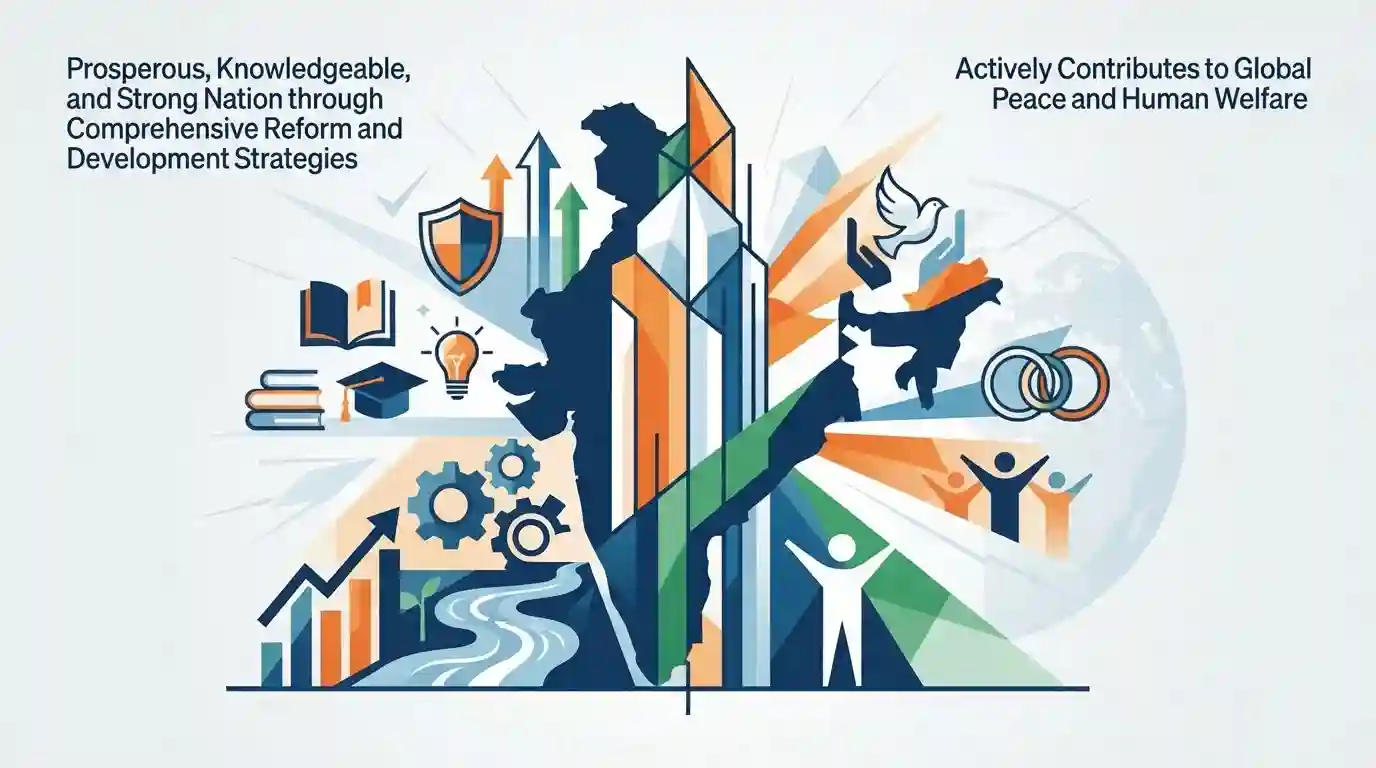
The Raksha Mantri highlighted the government's vision of shaping India into a prosperous, knowledgeable, and strong nation that actively contributes to global peace and human welfare through comprehensive reform and development strategies.
मुख्य मुद्दे
- The government under PM Modi is striving to transform India into a nation combining prosperity, knowledge, and strength with a commitment to global peace and humanity.
- Focus on blending economic growth with technological and knowledge advancement, alongside strategic capabilities.
- Emphasis on welfare, global well-being, and peaceful international cooperation.
महत्त्वाच्या संज्ञा
Government of India

The central executive organ of the Union of India, responsible for governance, policy formulation, administration, and implementation of laws across the country.
UPSC context
UPSC GS Paper II (Polity & Governance) – Tests understanding of executive organs, governance structures, and constitutional functioning.
Ministry of Defence
The union government department charged with coordinating and supervising all agencies and functions of the government relating directly to national security and the Indian Armed Forces.
UPSC context
UPSC GS Paper II/III (Security & Governance) – Tests the institutional framework governing national security and defence policy.
संबंधित स्थिर संकल्पना
What are the core principles guiding India's foreign policy and global peace commitments?
- Non-Alignment:: Historical stance formulated by Jawaharlal Nehru, emphasizing strategic autonomy and avoiding Cold War bloc politics.
- Panchsheel:: Five principles of peaceful co-existence signed with China in 1954, forming the bedrock of Indian bilateral diplomacy.
- Vasudhaiva Kutumbakam:: India's philosophy of viewing the entire world as a single family, guiding humanitarian aid and global south leadership.
आंतर-विषय नमुने
Defence Modernisation meets Global South Diplomacy
India's pursuit of indigenous defence capabilities combined with soft power diplomacy reflects a strategic blend of hard power deterrence and 'Vasudhaiva Kutumbakam' (One Earth, One Family, One Future).

Questions linking India's strategic self-reliance (Atmanirbhar Bharat) with its multilateral peace commitments frequently appear in Mains GS-II.
संबंधित PYQ · 2
संबंधित PYQ · 2
- 2024MainsGS2
Critically analyse India's evolving diplomatic, economic and strategic relations with the Central Asian Republics (CARs) highlighting their increasing significance in regional and global geopolitics.
- 2019MainsGS3
Do you agree with the view that steady GDP growth and low inflation have left the Indian economy in good shape? Give reasons in support of your arguments.
