Social Justice Ministry Welfare Scheme Implementation Review
Source:PIB ↗
આ શા માટે મહત્વનું છે
Reviews of ministerial functioning and welfare schemes by leadership highlight the governance, transparency, and implementation challenges associated with social justice policies in India.
સારાંશ
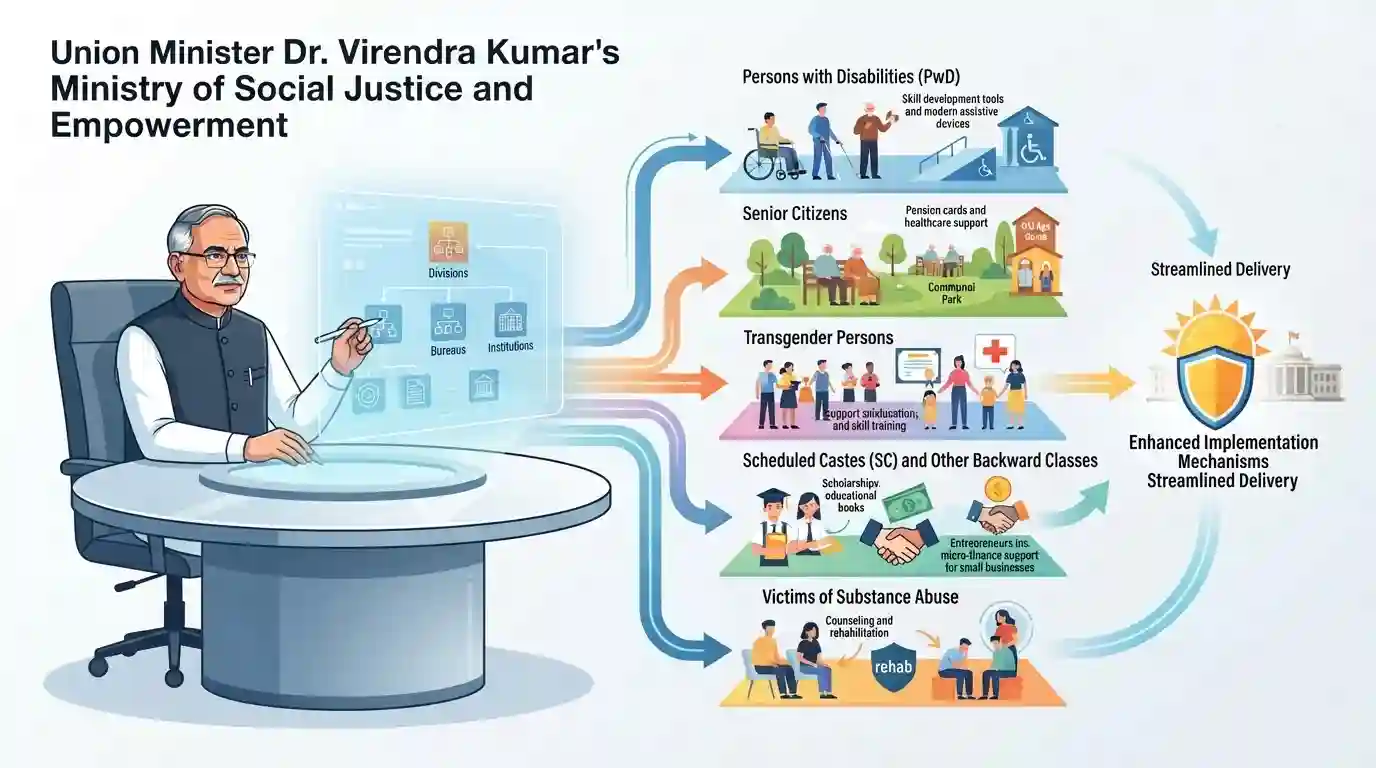
Union Minister Dr. Virendra Kumar conducted a comprehensive review of the divisions, bureaus, and institutions under the Ministry of Social Justice and Empowerment, focusing on streamlining welfare delivery and enhancing implementation mechanisms for vulnerable populations.
મુખ્ય મુદ્દા
- Union Minister Dr. Virendra Kumar reviewed the functioning of various divisions, bureaus, and institutions under the Ministry of Social Justice and Empowerment.
- The review focused on evaluating the progress of flagship welfare schemes aimed at marginalized and vulnerable communities, including Scheduled Castes (SCs), Other Backward Classes (OBCs), senior citizens, victims of substance abuse, and divyangjan (persons with disabilities).
- Emphasis was laid on administrative accountability, efficient fund utilization, and ensuring last-mile delivery of welfare measures.
મહત્વપૂર્ણ શબ્દો
Ministry of Social Justice and Empowerment

The nodal central ministry in India responsible for policy formulation, legislation, and welfare programs aimed at marginalized sections including SCs, OBCs, senior citizens, persons with disabilities, and victims of substance abuse.
UPSC context
GS Paper II (Social Justice / Governance). Tests knowledge of welfare schemes, institutional mechanisms, and governance for vulnerable populations.
પ્રિલિમ્સ ટ્રેપ
Ministry of Social Justice and Empowerment exclusively administers schemes for Persons with Disabilities, overlooking its mandate for SCs, OBCs, and senior citizens.
Aspirants often assume umbrella schemes like PM-AJAY or AVYAY are standalone ministries rather than being administered under the Ministry of Social Justice and Empowerment.
સંલગ્ન સ્થિર ખ્યાલો
What are the key constitutional provisions and institutional mechanisms for the welfare of vulnerable sections in India?
- Constitutional Basis: Constitutional Safeguards include Articles 15, 16, 17, 38, 39, and 46 which direct the state to promote educational and economic interests of weaker sections.
- PM-AJAY Scheme: Umbrella Schemes such as PM-AJAY (Pradhan Mantri Anusuchit Jati Abhyuday Yojana) combine earlier schemes for holistic development of Scheduled Castes.
- Senior Citizens: Senior Citizens are supported through schemes like Atal Vayo Abhyuday Yojana (AVYAY) focusing on financial security, healthcare, and shelter.
- Disability Sector: Divyangjan Empowerment is driven by the Rights of Persons with Disabilities Act, 2016 and the Accessible India Campaign (Sugamya Bharat Abhiyan).
આંતર-વિષય પેટર્ન
Welfare Administration vs Fiscal Accountability
Welfare administration reviews link administrative accountability with fiscal federalism and budgetary outcomes, a recurring theme in both GS-II governance and Public Administration optional questions on bureaucratic performance.
DPSP Mandates and Grassroots Welfare Delivery
Flagship initiatives for marginalized groups directly connect constitutional mandates under Part IV Directive Principles with grassroots execution challenges examined in GS-II.

Ministry-level structural reviews of welfare schemes often feature in matching columns or statement-based GS-II governance questions.
સંલગ્ન PYQ · 3
સંલગ્ન PYQ · 3
- 2019MainsGS2
Performance of welfare schemes that are implemented for vulnerable sections is not so effective due to absence of their awareness and active involvement at all stages of policy process. Discuss.
- 2023MainsGS2
“Development and welfare schemes for the vulnerable, by its nature, are discriminatory in approach.” Do you agree? Give reasons for your answer.
- 2017MainsGS2
To ensure effective implementation of policies addressing water, sanitation and hygiene needs the identification of the beneficiary segments is to be synchronized with the anticipated outcomes." Examine the statement in the context of the WASH scheme.
