India-New Zealand Free Trade Agreement and Export Boost
Source:PIB ↗
Why It Matters
This article is important for GS3 (Economy - International Trade, Exports, and Protectionism vs. Bilateralism) and GS2 (International Relations - India's bilateral ties with Oceania/New Zealand), illustrating India's proactive strategy of entering bilateral trade agreements to boost manufacturing and export competitiveness.
Summary
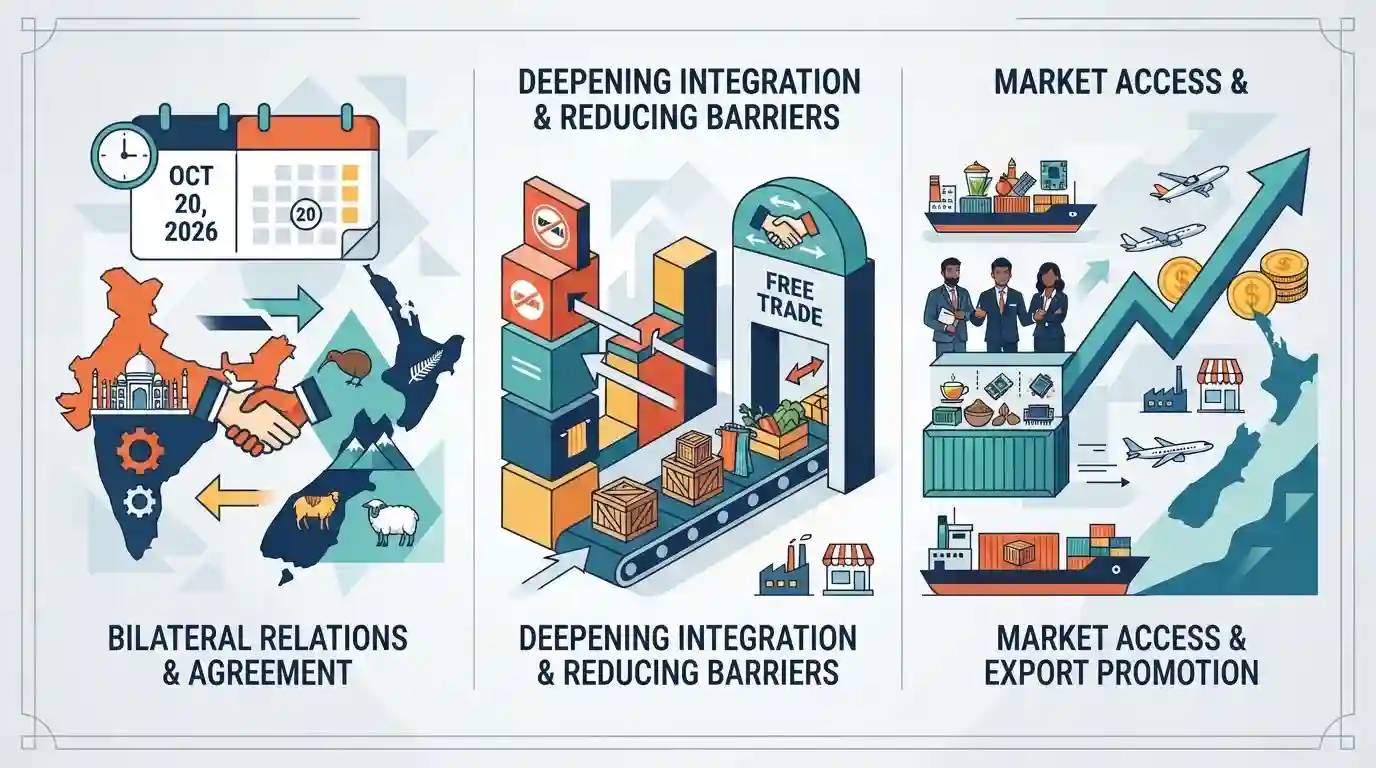
The India-New Zealand Free Trade Agreement (FTA) is set to come into force on October 20, 2026. The bilateral pact aims to deepen economic integration, reduce trade barriers, expand market access for Indian exporters and MSMEs, and strengthen strategic and commercial ties between India and New Zealand.
Key Points
- The India-New Zealand Free Trade Agreement (FTA) comes into force on October 20, 2026, coinciding with Vijay Dashmi.
- The trade pact is designed to open new market opportunities, boost Indian exports, and enhance bilateral economic cooperation.
- It encompasses provisions to ease market access for goods and services, benefiting key sectors like MSMEs, manufacturing, and agriculture.
- Strengthens diplomatic and economic engagement between India and New Zealand in the Indo-Pacific region.
Important Terms
India-New Zealand Free Trade Agreement (FTA)

A bilateral trade pact between India and New Zealand designed to reduce trade barriers, eliminate tariffs, and enhance economic cooperation and market access for exporters, MSMEs, and farmers.
UPSC context
GS Paper III (Indian Economy - Export Promotion & Foreign Trade); tests understanding of bilateral trade pacts and global economic integration.
Prelims Trap
The FTA grants 100% duty-free access to all Indian and New Zealand exports across every single agricultural and industrial sector.
Aspirants often assume comprehensive FTAs eliminate tariffs across all sectors equally, missing that sensitive agricultural items (dairy, sugar) are explicitly placed on exclusion lists.
Static Concepts Connected
What are the core instruments and distinctions in international trade agreements under WTO frameworks?
- FTA Definition: Free Trade Agreement (FTA) involves reciprocal elimination or reduction of tariffs on substantially all trade between partner countries.
- PTA vs FTA: Preferential Trade Agreement (PTA) offers reduced tariffs on a narrower, positive list of agreed goods rather than comprehensive elimination.
- Rules of Origin: Rules of Origin (RoO) prevent trade diversion by ensuring imported goods have undergone sufficient local transformation within the exporting partner nation.
Cross-Topic Patterns
FTA Negative Lists & Domestic Agrarian Safeguards
Bilateral trade pacts incorporate aggressive negative lists (dairy, agriculture) to insulate domestic livelihoods while pushing labor-intensive exports like textiles and leather.
Indo-Pacific Economic Architecture & Investment Pacts
Bilateral economic pacts increasingly serve as strategic anchors in the Indo-Pacific, balancing trade concessions with long-term investment commitments across manufacturing and infrastructure.

Expect a statement-based prelims question on FTA negative lists protecting sensitive domestic agriculture vs immediate tariff elimination for MSMEs.
Linked PYQs · 3
Linked PYQs · 3
- 2025MainsGS3
What are the challenges before the Indian economy when the world is moving away from free trade and multilateralism to protectionism and bilateralism? How can these challenges be met?
- 2023MainsGS3
Faster economic growth requires increased share of the manufacturing sector in GDP, particularly of MSMEs. Comment on the present policies of the Government in this regard.
- 2024MainsGS2
Critically analyse India's evolving diplomatic, economic and strategic relations with the Central Asian Republics (CARs) highlighting their increasing significance in regional and global geopolitics.
