Bureau of Indian Standards Quality Framework for AYUSH
Source:PIB ↗
Why It Matters
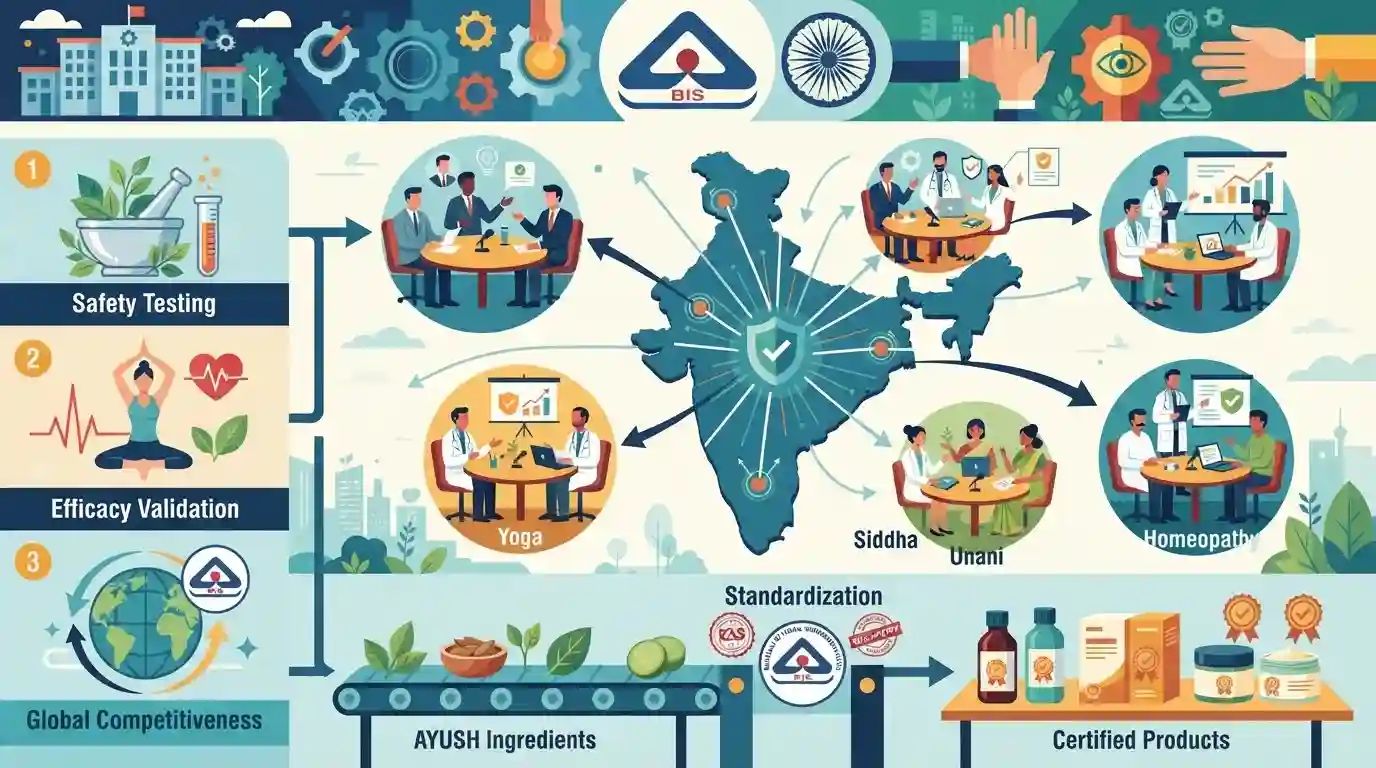
Standardization of AYUSH products is crucial for establishing India as a global hub for traditional medicine, boosting exports, and ensuring consumer safety.
Summary
The Bureau of Indian Standards (BIS), in collaboration with stakeholders, organized nationwide interactive sessions to promote quality standards for AYUSH products and practices. The focus is on standardizing traditional medical systems to ensure safety, efficacy, and enhanced global competitiveness.
Key Points
- The Bureau of Indian Standards (BIS) organised nationwide interactive sessions to promote quality standards in the AYUSH (Ayurveda, Yoga & Naturopathy, Unani, Siddha, and Homoeopathy) sector.
- The initiative aims to enhance the credibility, safety, and global market acceptance of traditional Indian medicines through rigorous standardization.
- Standardization helps bridge the gap between traditional wisdom and modern consumer expectations, fostering consumer trust and boost export potential.
Important Terms
Bureau of Indian Standards (BIS)

India's national standards body responsible for the harmonious development of standardization, marking, and quality certification of goods, including traditional AYUSH products and practices.
UPSC context
UPSC Prelims/Mains (GS Paper II/III): Important statutory bodies, consumer protection, and standardizing traditional medicine for global market access.
Ministry of Ayush
The nodal government ministry in India responsible for developing, promoting, and regulating traditional systems of healthcare, including Ayurveda, Yoga, Unani, Siddha, and Homeopathy.
UPSC context
UPSC Prelims/Mains (GS Paper II - Health & Governance): Tests policies, institutional frameworks, and public health interventions in traditional medicine.
Prelims Trap
AYUSH quality standards and certifications are formulated and monitored exclusively by the Ministry of Ayush without external statutory standard bodies.
Aspirants often assume AYUSH standardization is exclusively handled by the Ministry of Ayush internally, missing the statutory role of the Bureau of Indian Standards (BIS) in setting these benchmarks.
Static Concepts Connected
What is the statutory framework and functioning of the Bureau of Indian Standards (BIS)?
- Establishment: Statutory Body established under the Bureau of Indian Standards Act, 2016 (succeeding the erstwhile BIS Act, 1986).
- Parent Ministry: Functions under the administrative control of the Ministry of Consumer Affairs, Food and Public Distribution.
- Core Functions: Responsible for the development of Indian Standards, product certification, hallmarking, and laboratory testing.
Cross-Topic Patterns
AYUSH Standardization + Health Diplomacy & Medical Exports
Standardizing AYUSH herbs and equipment through BIS supports India's strategic push for Medical Value Travel and traditional medicine exports under bilateral trade agreements.
Traditional Knowledge Digital Library (TKDL) + BIS Standards
Bridging traditional knowledge with modern scientific validation through CCRAS and BIS mirrors similar IPR protection initiatives for traditional herbs via TKDL.

Expect statement-based questions pairing BIS's statutory mandate with institutional roles like CCRAS in validating traditional medicine.
Linked PYQs · 3
Linked PYQs · 3
- 2026PrelimsGS1
The Bureau of Indian Standard (BIS) recently introduced a national standard to test and assess bomb disposal system. Which of the following statements with regard to this system is/are correct? 1. The new standard is known as IS 19445 : 2025. 2. It will improve interoperability of equipment across agencies. 3. It was developed by TBRL, DRDO in collaboration with the 30th Central Scientific Research Institute, Russia. Select the answer using the code given below :
- 2017PrelimsGS1
Consider the following statements: 1. The Standard Mark of Bureau of Indian Standards (BIS) is mandatory for automotive tyres and tubes. 2. AGMARK is a quality Certification Mark issued by the Food and Agriculture Organisation (FAO). Which of the statements given above is/are correct?
- 2026PrelimsGS1
Which of the following is/are the most significant implication(s) of obtaining Oeko-Tex certification for Eri Silk in the global textile industry ? 1. It allows Indian exporters to compete in high-end markets that prioritise chemical-free products. 2. It confirms that Eri Silk meets international safety, environmental, and quality standards, enabling its entry into premium eco-conscious markets. Select the answer using the code given below :
