NAMASTE Scheme Impact on Sanitation Worker Rehabilitation
Source:PIB ↗
Why It Matters
The NAMASTE scheme is a crucial policy framework addressing the dignity, safety, and rehabilitation of sanitation workers, aligning with India's constitutional goals of social justice and eradication of manual scavenging.
Summary
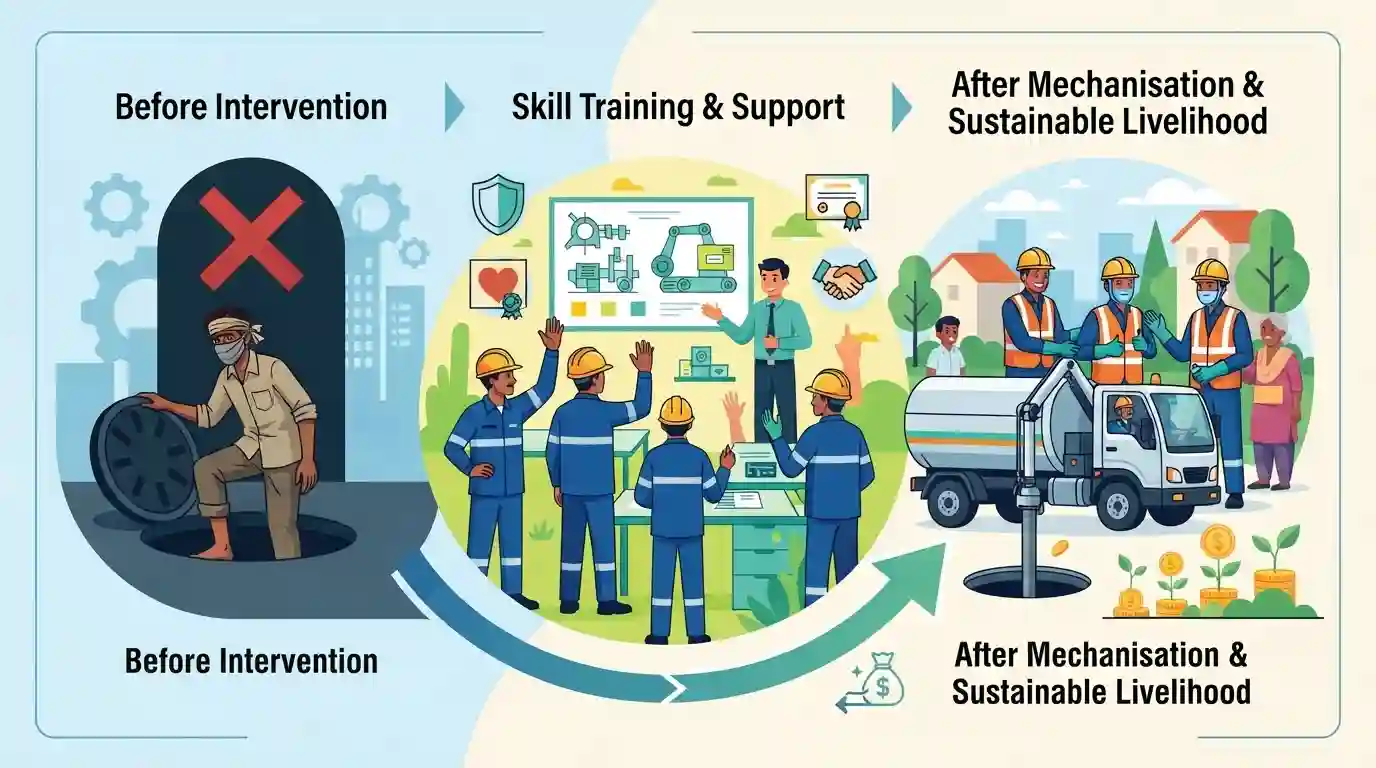
The article highlights a success story under the NAMASTE (National Action for Mechanised Sanitation Ecosystem) scheme, detailing how government interventions, skill training, and mechanization are transforming the lives of sanitation workers by ensuring safety, dignity, and sustainable livelihoods.
Key Points
- The NAMASTE scheme aims to eradicate manual scavenging and promote mechanised cleaning of sewers and septic tanks.
- It ensures occupational safety, provision of safety gear, and formalization of sanitation workers by mapping and skill development.
- Success stories highlight how financial assistance, dignity of labor, and skill training empower marginalized communities, transitioning them from hazardous manual work to safe livelihoods.
Important Terms
NAMASTE scheme (National Action for Mechanised Sanitation Ecosystem)

A joint central sector scheme of the Ministry of Social Justice and Empowerment and Ministry of Housing and Urban Affairs aimed at eradicating manual scavenging and achieving zero fatalities in sewer and septic tank cleaning through mechanization.
UPSC context
Crucial for UPSC GS Paper II (Social Justice, Welfare Schemes for Vulnerable Sections) and GS Paper III (Occupational Safety, Governance).
Ministry of Social Justice and Empowerment
The nodal central ministry responsible for welfare, social justice, and empowerment of marginalized groups, including Scheduled Castes, Other Backward Classes, senior citizens, and sanitation workers.
UPSC context
Essential for UPSC GS Paper II under Ministries, Institutional Frameworks, and implementation of government welfare policies.
Prelims Trap
The NAMASTE scheme is exclusively implemented by the Ministry of Social Justice and Empowerment.
Aspirants often assume NAMASTE is solely implemented by the Ministry of Social Justice and Empowerment, missing its joint execution with the Ministry of Housing and Urban Affairs.
Static Concepts Connected
What are the key constitutional and statutory mandates against manual scavenging in India?
- Constitutional Provisions: Constitutional safeguards include Article 17 (abolition of untouchability) and Article 21 (right to life and dignity).
- 1993 Act: The Employment of Manual Scavengers and Construction of Dry Latrines (Prohibition) Act, 1993 was the first comprehensive legislation banning dry latrines and manual scavenging.
- 2013 Act: The Prohibition of Employment as Manual Scavengers and their Rehabilitation Act, 2013 widened the definition, banned hazardous manual cleaning, and mandated surveys and rehabilitation.
- Judicial Mandates: Supreme Court rulings in the Dr. Balram Singh v. Union of India case mandated strict enforcement of safety measures and compensation for sewer deaths.
Cross-Topic Patterns
Welfare schemes + Financial inclusion entrepreneurship
NAMASTE's credit-linked capital subsidies intersect with financial inclusion priorities like Stand-Up India and PM SVANidhi, aiming to uplift historically marginalized caste groups into formal entrepreneurs.
Occupational safety + Labour code reforms
Transitioning manual scavengers into mechanized operators ties occupational safety standards to the wider debate on OSH Code compliance in the unorganized sector.

NAMASTE scheme objectives, convergence with AB-PMJAY, and institutional backing by MoSJE/MoHUA are prime targets for matching statements.
Linked PYQs · 2
Linked PYQs · 2
- 2017MainsGS2
To ensure effective implementation of policies addressing water, sanitation and hygiene needs the identification of the beneficiary segments is to be synchronized with the anticipated outcomes." Examine the statement in the context of the WASH scheme.
- 2023MainsGS2
“Development and welfare schemes for the vulnerable, by its nature, are discriminatory in approach.” Do you agree? Give reasons for your answer.
