Administrative Efficiency and E-Waste Management in Education
Source:PIB ↗
Why It Matters
The article highlights practical steps taken by a key government department to institutionalize cleanliness, improve administrative efficiency through reduced pendency, and tackle e-waste management, aligning with broader goals of good governance and sustainable environmental practices in public institutions.
Summary
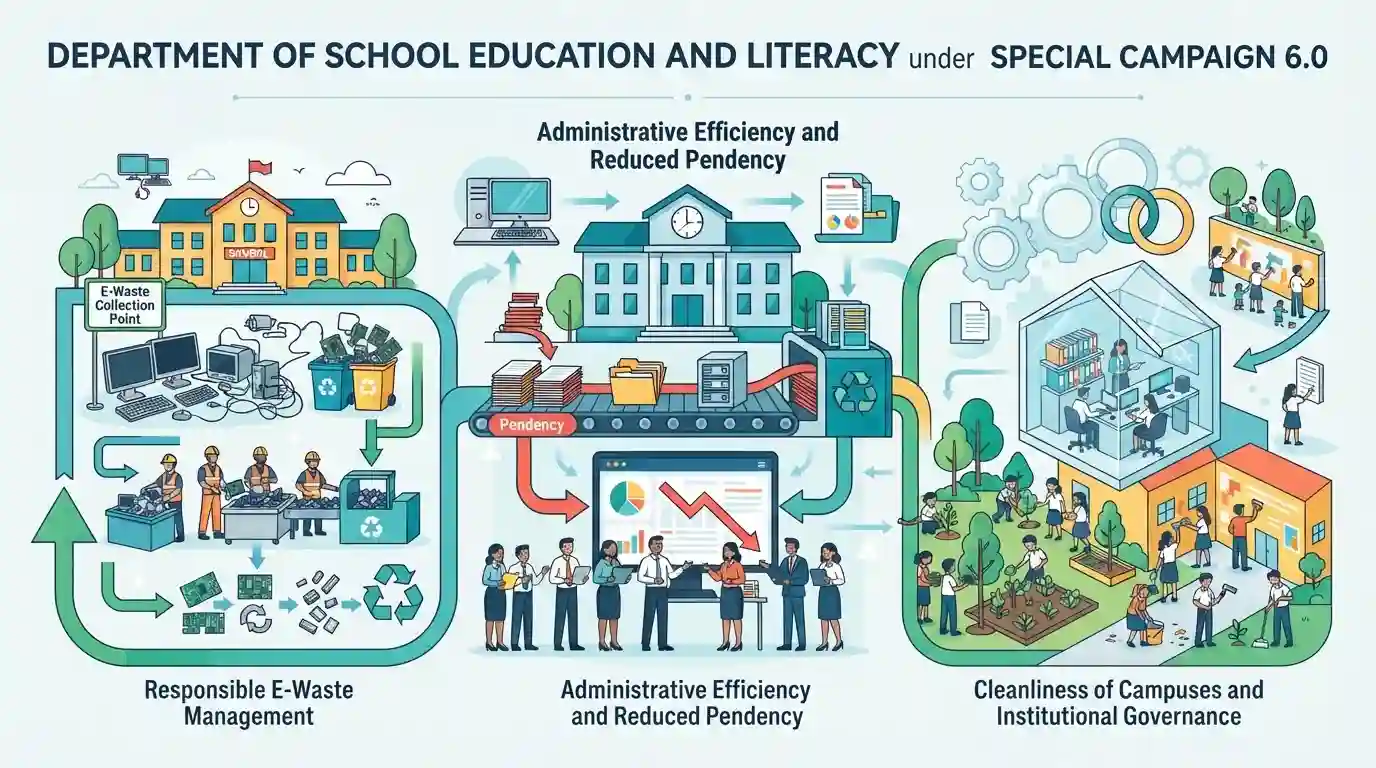
The Department of School Education and Literacy has launched initiatives under Special Campaign 6.0 focusing on administrative efficiency, cleanliness of campuses, and responsible e-waste management. The drive emphasizes reducing pendency, disposing of obsolete electronic waste safely, and enhancing institutional governance within the education sector.
Key Points
- The Department of School Education and Literacy is actively participating in Special Campaign 6.0, focusing on institutionalizing swachhata (cleanliness) and reducing pendency in government offices.
- Key areas of focus include administrative efficiency, maintaining cleaner school campuses, and ensuring responsible e-waste management.
- The campaign emphasizes proper disposal of obsolete electronic items (e-waste) to prevent environmental degradation and promote sustainable resource use in educational institutions.
- It also highlights digitization, file management optimization, and grievance redressal to streamline governance and public service delivery in the education sector.
Important Terms
Special Campaign 6.0

An annual nationwide government drive coordinated by the DARPG to promote administrative efficiency, reduce pendency, ensure cleanliness (Swachhata), and manage e-waste in public offices.
UPSC context
GS Paper II (Governance and Transparency): Tests administrative reforms, reduction of pendency, institutional cleanliness, and accountability in governance.
Department of School Education and Literacy
A department under the Ministry of Education responsible for formulating policies and nationwide programs for school-level education, elementary to higher secondary, across India.
UPSC context
GS Paper II (Social Sector - Education): Tests institutional frameworks, policy implementation, and governance in school education.
Ministry of Education
The central government ministry overseeing education policy, higher education, school education and literacy, and institutional development across the country.
UPSC context
GS Paper II (Governance and Social Development): Tests administrative structures and national policy execution in India's education sector.
Static Concepts Connected
What are the key provisions and targets under the E-Waste (Management) Rules in India?
- EPR Framework: Extended Producer Responsibility (EPR) mandates producers to collect and recycle electronic waste.
- Safe Disposal: Targeted collection goals and environmentally sound dismantling are legally enforced for registered recyclers.
- Institutional Compliance: Institutional generators of e-waste must maintain records and channel waste only through authorized recyclers.
Cross-Topic Patterns
Administrative Reforms + E-Waste Management + Digital India
Special Campaigns intersect with e-waste rules and Digital India initiatives, bridging administrative reform with sustainable governance in public institutions.

Special Campaign focus areas (pendency reduction, e-waste) tested via institutional governance statements in Prelims.
Linked PYQs · 2
Linked PYQs · 2
- 2024MainsGS3
Industrial pollution of river water is a significant environmental issue in India. Discuss the various mitigation measures to deal with this problem and also the government's initiatives in this regard.
- 2024MainsGS2
e-governance is not just about the routine application of digital technology in service delivery process. It is as much about multifarious interactions for ensuring transparency and accountability. In this context evaluate the role of the 'Interactive Service Model' of e-governance.
