Regional Rapid Transit System and Urban Commuter Mobility
Source:PIB ↗
આ શા માટે મહત્વનું છે
Understanding modern high-speed regional rail systems like RRTS is crucial for evaluating India's infrastructure development, sustainable urban transport policies, and regional economic integration.
સારાંશ
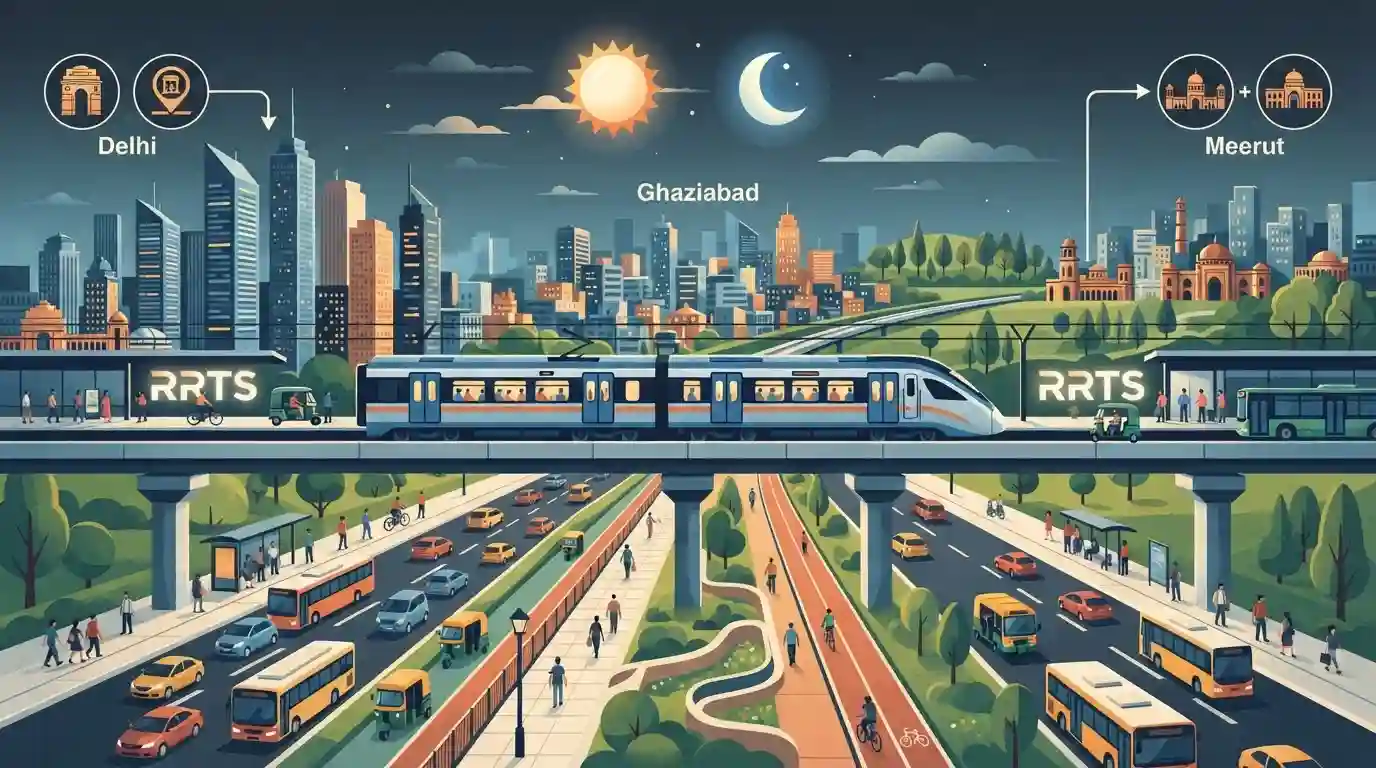
The article highlights the celebration of Namo Bharat Diwas 2026 by the National Capital Region Transport Corporation (NCRTC), marking three years of operational success for the Namo Bharat Regional Rapid Transit System (RRTS) on the Delhi-Ghaziabad-Meerut corridor. The project has transformed urban commuter mobility, promoted sustainable regional growth, and reduced dependence on road transport in the National Capital Region.
મુખ્ય મુદ્દા
- NCRTC celebrated Namo Bharat Diwas 2026, marking three successful years of Namo Bharat operations.
- The Regional Rapid Transit System (RRTS) focuses on high-speed, high-frequency regional transit to connect urban nodes like Delhi, Ghaziabad, and Meerut.
- RRTS project aims to transform regional mobility, reduce road congestion, and lower carbon emissions in the National Capital Region (NCR).
મહત્વપૂર્ણ શબ્દો
National Capital Region Transport Corporation (NCRTC)

A joint venture company of the Government of India and participating states mandated to implement the Regional Rapid Transit System (RRTS) projects across the National Capital Region to ensure balanced and sustainable economic development.
UPSC context
GS Paper III (Infrastructure - Transport & Urban Mobility); tests knowledge of special-purpose vehicles and bodies implementing mass rapid transit projects.
Regional Rapid Transit System (RRTS)
A dedicated high-speed, high-frequency rail-based transit system designed to connect regional urban nodes around the National Capital Region, offering faster and more reliable inter-city commuter mobility.
UPSC context
GS Paper III (Infrastructure & Urbanization); evaluates understanding of sustainable regional connectivity and modern mass transit solutions in India.
Namo Bharat
The brand name given by the Government of India to the high-speed regional trainsets operating on the RRTS corridors, symbolizing modern, comfortable, and efficient semi-high-speed commuter transit.
UPSC context
GS Paper III (Economy/Infrastructure); tests awareness of flagship public transport branding and regional rail corridor advancements.
પ્રિલિમ્સ ટ્રેપ
RRTS is functionally identical to high-capacity urban metro rail systems operating within metropolitan city limits.
Aspirants often confuse RRTS with urban metro systems. RRTS is designed for high-speed, inter-city regional transit between urban nodes (like Delhi-Meerut), whereas metros cater primarily to intra-city commuting with frequent stops.
સંલગ્ન સ્થિર ખ્યાલો
What is the difference between Metro Rail and Regional Rapid Transit System (RRTS) in India?
- Primary Objective: Designed for high-speed (160-180 km/h) inter-city regional transit connecting distant urban nodes across the NCR.
- Operational Design: Features longer distances between stations, higher acceleration, and dedicated rolling stock compared to intra-city metro networks.
- Institutional Setup: Executed through the NCRTC, a joint venture of the Central Government and states of Delhi, Haryana, Rajasthan, and UP.
આંતર-વિષય પેટર્ન
RRTS and Urban Governance (74th Amendment)
High-speed regional rail systems like RRTS are financed through multi-lateral development banks and central-state joint ventures, directly testing fiscal federalism and urban governance frameworks under the 74th Constitutional Amendment.
Urban Mobility and Climate Commitments
By shifting commuters from private road transport to electrified rail, Namo Bharat directly contributes to India's Nationally Determined Contributions (NDCs) under the Paris Agreement and National Electric Mobility goals.

NCRTC's RRTS operational model vs conventional metro systems (speed, distance, fare structure) is a prime candidate for an analytical prelims statement.
સંલગ્ન PYQ · 3
સંલગ્ન PYQ · 3
- 2021MainsGS3
“Investment in infrastructure is essential for more rapid and inclusive economic growth.” Discuss in the light of India's experience.
- 2024MainsGS3
What is the need for expanding the regional air connectivity in India? In this context, discuss the government's UDAN Scheme and its achievements.
- 2022MainsGS3
Why is Public Private Partnership (PPP) required in infrastructural projects ? Examine the role of PPP model in the redevelopment of Railway Stations in India.
