Ayurveda Paediatrics Centre of Excellence and Traditional Medicine
Source:PIB ↗
Why It Matters
It reflects India's strategic focus on institutionalizing and promoting traditional systems of medicine (AYUSH), particularly in specialized domains like paediatrics (Kaumarbhritya), which is crucial for inclusive healthcare delivery and evidence-based integration.
Summary
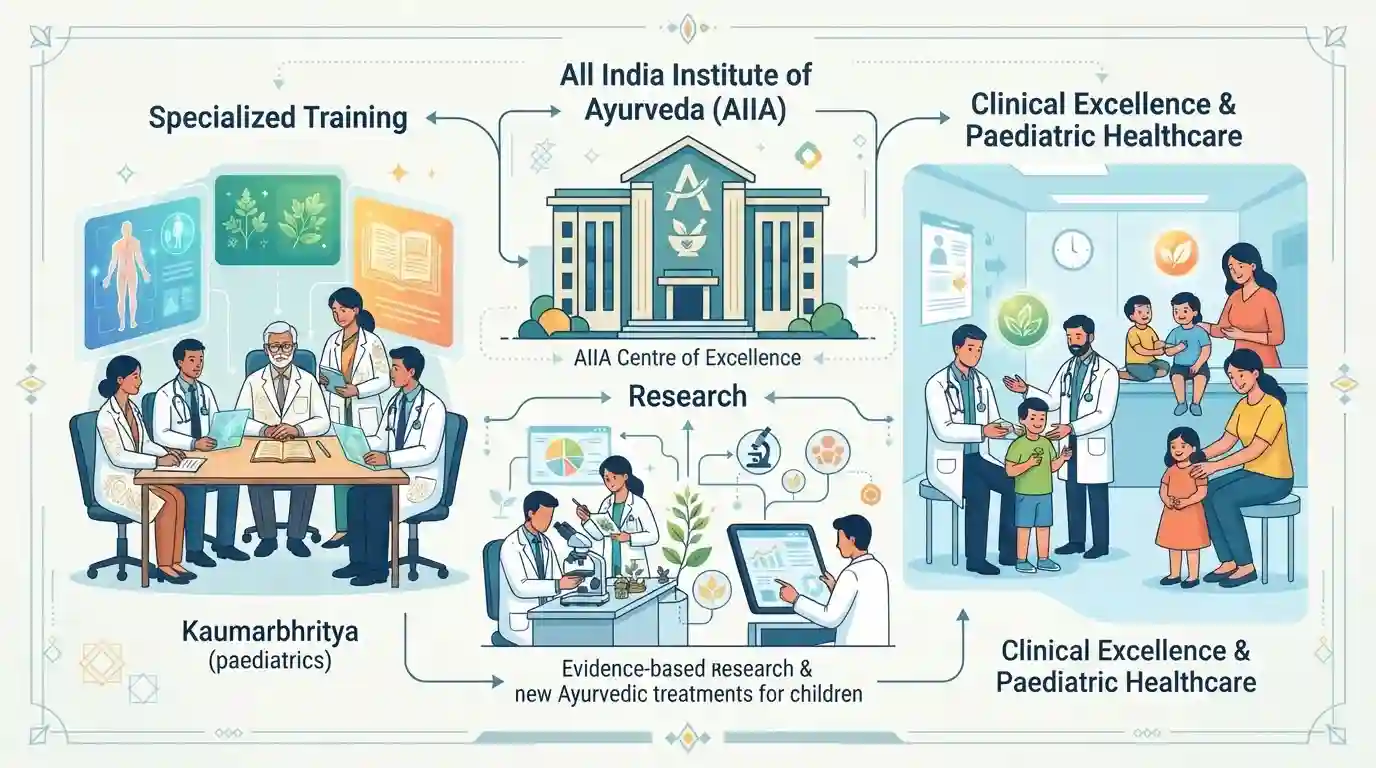
The All India Institute of Ayurveda (AIIA) has been designated as a Centre of Excellence for Rashtriya Ayurveda Vidyapeeth (RAV) in Kaumarbhritya (Ayurvedic paediatrics). This development underscores the growing institutional push to integrate traditional Ayurvedic practices into mainstream paediatric healthcare through specialized training, research, and high standards of clinical excellence.
Key Points
- The All India Institute of Ayurveda (AIIA) has been officially recognized as a Centre of Excellence for the Rashtriya Ayurveda Vidyapeeth (RAV) in Kaumarbhritya (Ayurvedic paediatrics).
- This recognition highlights AIIA's advanced specialized clinical training, research, and healthcare delivery in the field of children's health using traditional Ayurvedic methods.
- The initiative aims to bridge ancient wisdom with modern scientific validation to bolster maternal and child healthcare under the Ayush umbrella.
Important Terms
Rashtriya Ayurveda Vidyapeeth (RAV)

An autonomous organization under the Ministry of Ayush established to promote classical Ayurvedic education and research through the traditional Guru-Shishya Parampara (master-disciple tradition).
UPSC context
UPSC Prelims/Mains (GS Paper II/Health & Traditional Medicine). Tests institutional frameworks preserving indigenous knowledge systems.
All India Institute of Ayurveda (AIIA)
A premier apex institution under the Ministry of Ayush, New Delhi, patterned on AIIMS to integrate traditional Ayurvedic practices with modern scientific research, education, and healthcare delivery.
UPSC context
UPSC Prelims/Mains (GS Paper II - Health Infrastructure & Human Resources). Tests developments in premier public health institutions.
Ministry of Ayush
The nodal government ministry in India responsible for formulating policy, research, and propagation of traditional medicine systems including Ayurveda, Yoga & Naturopathy, Unani, Siddha, and Homoeopathy.
UPSC context
UPSC Prelims/Mains (GS Paper II - Government Policies & Interventions). Tests governance and institutional support for alternative healthcare systems.
Prelims Trap
All India Institute of Ayurveda is a statutory body established directly under an Act of Parliament.
AIIA is often mistaken for a statutory body, but it functions as an autonomous institute under the Ministry of Ayush. Similarly, RAV preserves knowledge via the Gurukula system, not modern university frameworks.
Static Concepts Connected
What are the key branches of Ashtanga Ayurveda, and what does Kaumarbhritya entail?
- Eight Branches: Ashtanga Ayurveda comprises eight branches: Kayachikitsa (Internal Medicine), Kaumarbhritya (Paediatrics), Shalya Tantra (Surgery), Shalakya Tantra (ENT/Ophthalmology), Agada Tantra (Toxicology), Bhutavidya (Psychiatry), Rasayana (Rejuvenation), and Vajikaran (Aphrodisiacs).
- Kaumarbhritya Focus: Kaumarbhritya specifically deals with child care, nursing of infants and mother, and management of pediatric disorders from birth to adolescence.
- RAV Mandate: Rashtriya Ayurveda Vidyapeeth (RAV) operates under the Ministry of Ayush to promote traditional Ayurvedic education through the traditional Guru-Shishya parampara (Gurukula system).
Cross-Topic Patterns
AYUSH integration in Public Health Infrastructure
Integration of ancient systems like Kaumarbhritya with National Health Mission (NHM) initiatives tests convergence between traditional medicine and modern public health delivery frameworks.
Traditional Knowledge and Cultural Diplomacy
Institutionalizing traditional knowledge through bodies like RAV reflects soft-power diplomacy and preservation of intangible cultural heritage under UNESCO guidelines.

UPSC frequently links autonomous bodies under Ministry of AYUSH with specific functional mandates (e.g., RAV vs AIIA). Watch out for mismatch traps.
Linked PYQs · 2
Linked PYQs · 2
- 2018MainsGS2
Appropriate local community-level healthcare intervention is a prerequisite to achieve 'Health for All' in India. Explain.
- 2024MainsGS2
In a crucial domain like the public healthcare system the Indian State should play a vital role to contain the adverse impact of marketisation of the system. Suggest some measures through which the State can enhance the reach of public healthcare at the grassroots level.
