CAQM Reviews Paddy Stubble Management in Punjab
Source:PIB ↗
ఇది ఎందుకు ముఖ్యం
Stubble burning in northwest India is a major recurrent contributor to severe winter air pollution in the National Capital Region (NCR). Reviewing ground-level implementation, machinery deployment, and administrative accountability by bodies like CAQM is critical for evaluating policy execution and environmental governance.
సారాంశం
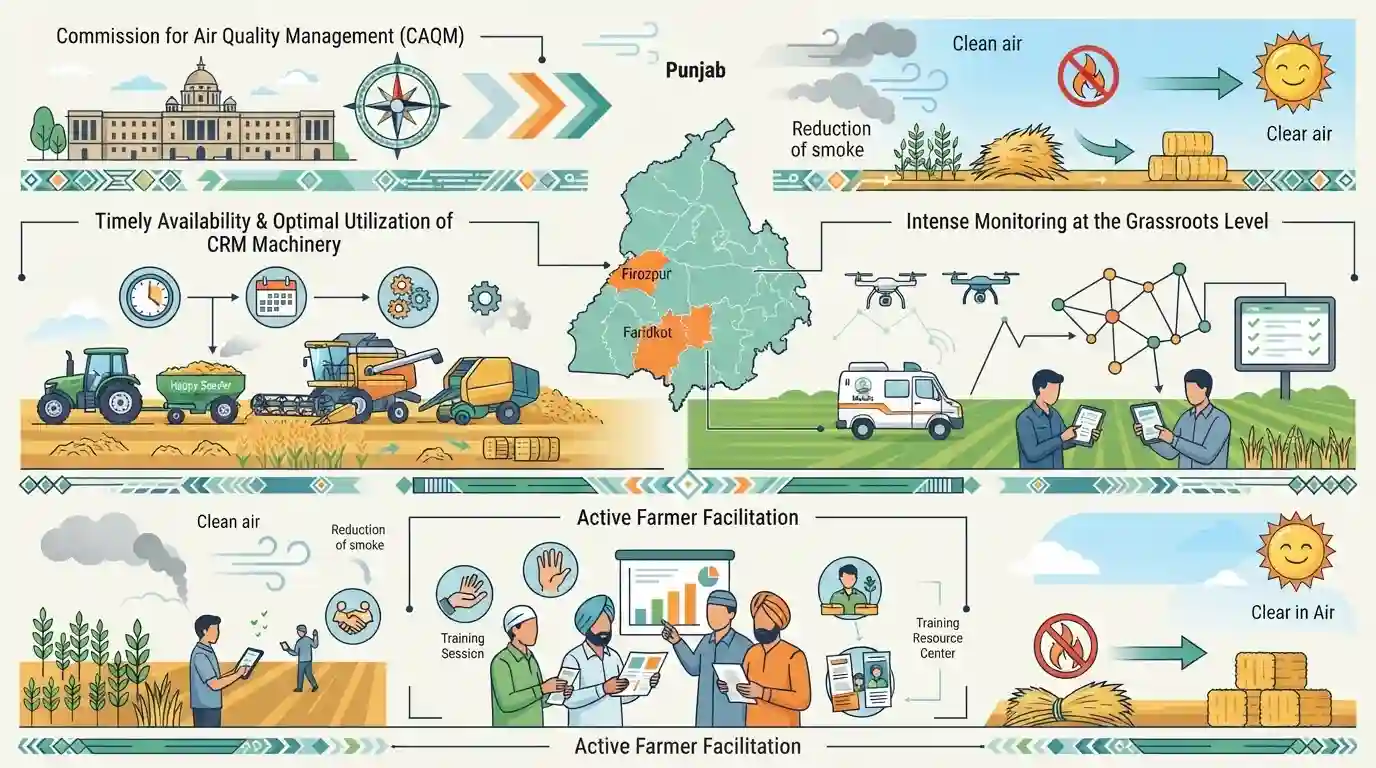
The Commission for Air Quality Management (CAQM) recently reviewed paddy stubble management measures in the Firozpur and Faridkot districts of Punjab, stressing the timely availability and optimal utilization of Crop Residue Management (CRM) machinery, intense monitoring at the grassroots level, and active farmer facilitation to minimize stubble burning incidents and combat regional air pollution.
ముఖ్య అంశాలు
- The Commission for Air Quality Management (CAQM) reviewed paddy stubble management (PSM) measures in the Firozpur and Faridkot districts of Punjab.
- Discussions focused on the effective implementation of the action plan for crop residue management (CRM), ensuring timely availability and utilization of CRM machinery, and addressing gaps.
- Emphasis was laid on farmer facilitation, optimal utilization of funds, and shifting towards sustainable agricultural practices to curb stubble burning and mitigate air pollution in the NCR.
- District administrations were urged to proactively monitor machinery distribution, logistics, and micro-level execution to achieve zero stubble burning targets.
ముఖ్యమైన పదాలు
Commission for Air Quality Management (CAQM)

A statutory body established under the Commission for Air Quality Management in National Capital Region and Adjoining Areas Act, 2021, responsible for coordinating, monitoring, and planning air quality management in the NCR and adjoining regions.
UPSC context
Important for GS Paper III (Environment, Pollution Control, Statutory Bodies); tests governance mechanisms for regional air pollution control.
ప్రిలిమ్స్ ఉచ్చు
Commission for Air Quality Management (CAQM) is a continuation of the erstwhile EPCA under executive notifications.
Aspirants often confuse EPCA (which was a Supreme Court-mandated body) with CAQM, which is a statutory body created by an Act of Parliament in 2021.
అనుసంధానమైన స్థిర భావనలు
What is the legal status and jurisdiction of the Commission for Air Quality Management (CAQM)?
- Statutory Origin: Statutory Body established under the Commission for Air Quality Management in National Capital Region and Adjoining Areas Act, 2021.
- Jurisdiction: Covers Delhi-NCR and adjoining areas in Haryana, Punjab, Rajasthan, and Uttar Pradesh where pollution sources impact regional air quality.
- Superseded EPCA: Replaced the Supreme Court-mandated Environment Pollution (Prevention and Control) Authority (EPCA) and holds superior penal and regulatory powers.
అంతర-అంశ నమూనాలు
Air Pollution vs. Agricultural Subsidies
CAQM orders connect federal air quality governance with agricultural subsidy utilization, echoing debates on incentivizing sustainable farming without worsening fiscal deficits.
Cooperative Federalism in NCR Air Governance
Punjab-Haryana stubble management directly influences the Air Quality Index (AQI) of the National Capital Region, merging federal environmental mandates with centre-state cooperative federalism.

Expect a statement-based question on CAQM's statutory status, jurisdiction breadth beyond Delhi, and its powers under the 2021 Act.
అనుసంధాన PYQలు · 1
అనుసంధాన PYQలు · 1
- 2024MainsGS3
Industrial pollution of river water is a significant environmental issue in India. Discuss the various mitigation measures to deal with this problem and also the government's initiatives in this regard.
