Supreme Court Forms Enquiry Committee for Violence
Source:PIB ↗
ఇది ఎందుకు ముఖ్యం
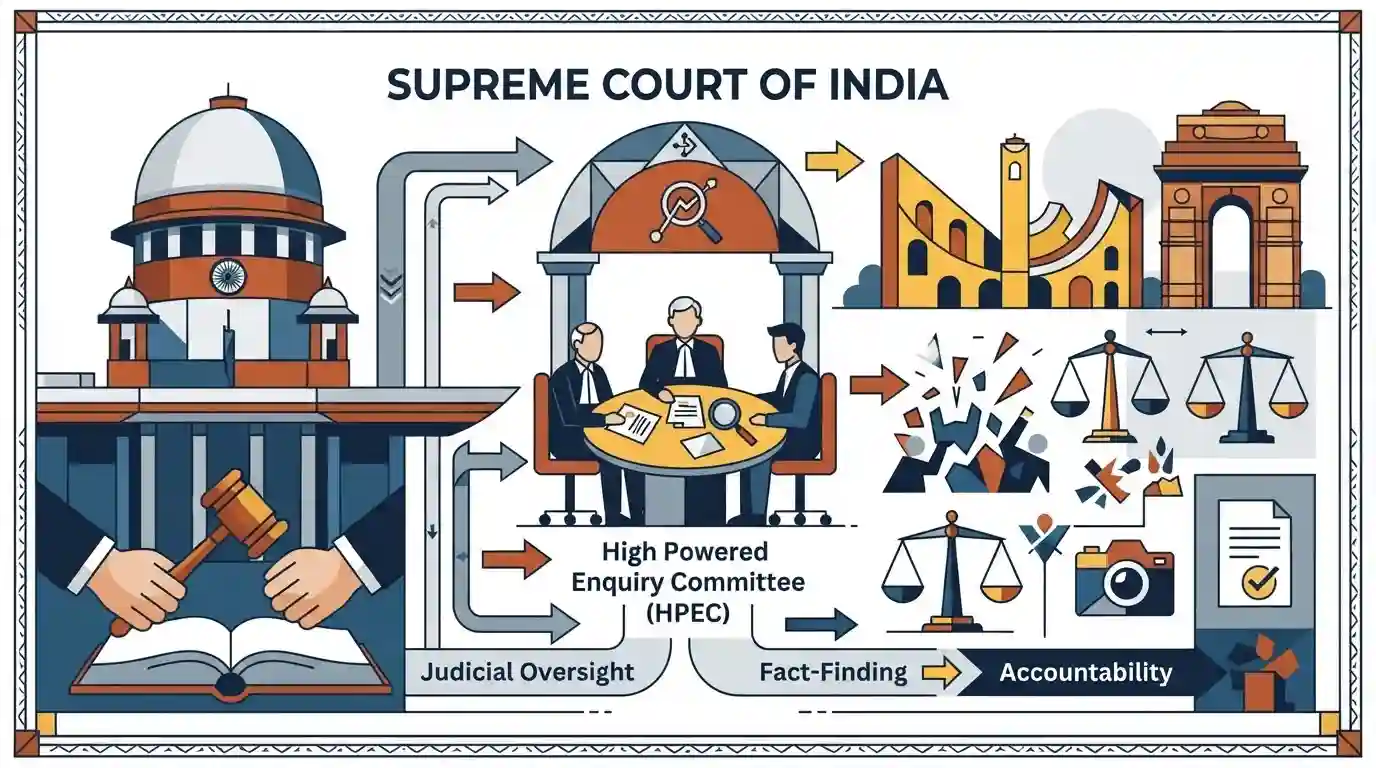
It illustrates the evolving role of the Supreme Court in instituting independent High Powered Enquiry Committees to investigate incidents of civil unrest or public violence, intersecting with the debate on judicial activism, separation of powers, and maintenance of public order.
సారాంశం
The article notes the formation of a High Powered Enquiry Committee (HPEC) by the Supreme Court of India to probe the aspects and incidents of violence that occurred at Jantar Mantar and other places during July 2026, pointing towards judicial mechanisms for fact-finding and accountability.
ముఖ్య అంశాలు
- The Supreme Court of India constituted a High Powered Enquiry Committee (HPEC) to investigate incidents of violence at Jantar Mantar, Delhi, and other locations in July 2026.
- Highlights judicial intervention and the appointment of specialized committees by the Supreme Court to probe public disturbances, communal tensions, or civil unrest issues.
- Reflects on the balance of powers, judicial oversight, and institutional mechanisms used to address law and order situations involving public demonstrations.
ముఖ్యమైన పదాలు
Supreme Court of India

The apex court of India established under Article 124 of the Constitution, functioning as the ultimate guardian of fundamental rights and the final court of appeal.
UPSC context
GS Paper II (Polity and Governance - Structure, Organization, and Functioning of the Judiciary). Tests understanding of judicial review, judicial activism, and constitutional remedies.
High Powered Enquiry Committee (HPEC)
A five-member judicial committee appointed by the Supreme Court to investigate incidents of violence during protests, ensuring independent fact-finding, accountability, and protection of witness identities.
UPSC context
GS Paper II (Judiciary and Separation of Powers). Tests the Supreme Court's powers under Article 142 to set up expert/enquiry panels for public accountability.
ప్రిలిమ్స్ ఉచ్చు
Only the central or state government has the statutory authority to constitute an enquiry committee or commission for investigating public violence.
Aspirants often assume only the Executive can set up Enquiry Commissions under the Commission of Inquiry Act, 1952, overlooking the Supreme Court's inherent and Article 142 powers to appoint committees.
అనుసంధానమైన స్థిర భావనలు
What are the constitutional provisions regarding the Supreme Court's investigative and enquiry powers in India?
- Article 142: The Supreme Court exercises plenary powers under Article 142 to pass any decree or order necessary for doing complete justice in any cause or matter pending before it.
- Article 32 Limits: Unlike High Courts under Article 226, the Supreme Court's writ jurisdiction under Article 32 is strictly confined to the enforcement of Fundamental Rights.
- Expert Committees: The Supreme Court may appoint expert committees or commissions of inquiry for impartial fact-finding in matters of grave public importance.
అంతర-అంశ నమూనాలు
Judicial Activism vs. Executive Domain
Judicial appointment of enquiry committees intersects with Article 142 powers, testing the limits of judicial oversight over the executive's law and order domain.

Supreme Court-appointed committees and Article 142 powers often appear in Polity MCQs testing institutional boundaries.
అనుసంధాన PYQలు · 2
అనుసంధాన PYQలు · 2
- 2024MainsGS2
Explain the reasons for the growth of public interest litigation in India. As a result of it, has the Indian Supreme Court emerged as the world's most powerful judiciary ?
- 2020MainsGS2
Judicial Legislation is antithetical to the doctrine of separation of powers as envisaged in the Indian Constitution. In this context justify the filing of large number of public interest petitions praying for issuing guidelines to executive authorities.
