CAQM expands PTZ camera remote monitoring for NCR industries
Source:PIB ↗
কেন এটি গুরুত্বপূর্ণ
It highlights the deployment of advanced surveillance technology (AI/IoT/PTZ monitoring) by statutory environmental bodies like CAQM to tackle industrial air pollution in the NCR, aligning with the broader objective of strengthening enforcement mechanisms for clean air.
সারসংক্ষেপ
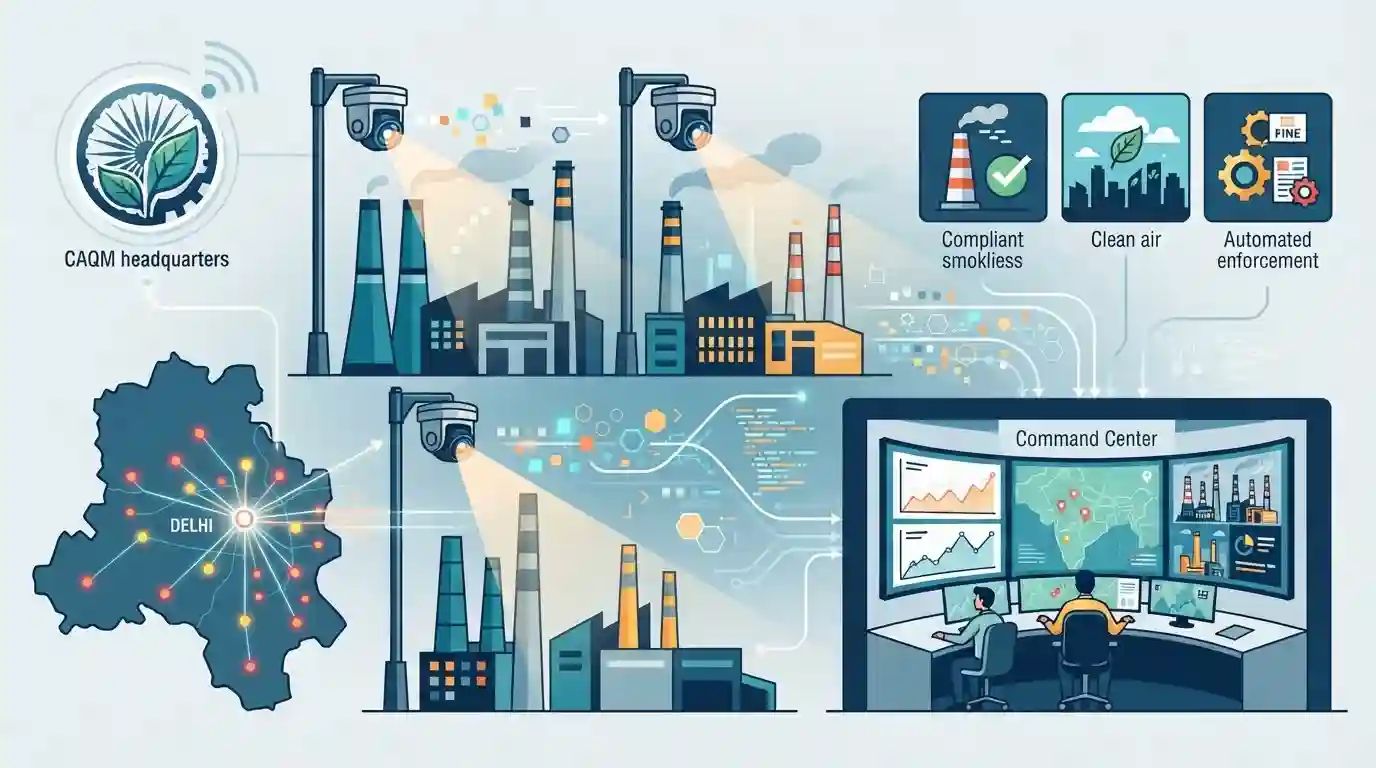
The Commission for Air Quality Management (CAQM) has expanded its Pan-Tilt-Zoom (PTZ) camera-based remote monitoring network to cover all industries under Direction No. 98 across the National Capital Region (NCR). This technological intervention seeks to enforce strict environmental compliance, track industrial emissions dynamically, and curb air pollution in the region with minimal manual intervention.
মূল বিষয়
- CAQM has expanded PTZ Camera-based Remote Monitoring to cover all categories of industries listed under Direction No. 98 across the National Capital Region (NCR).
- The initiative aims to curb air pollution, ensure strict compliance with environmental standards, and minimize manual intervention through real-time surveillance.
- PTZ (Pan-Tilt-Zoom) cameras enable remote monitoring of industrial stacks, emissions, and general plant operations to deter non-compliance and illegal polluting activities.
গুরুত্বপূর্ণ শব্দ
Direction No. 98

An administrative and regulatory order issued by the CAQM mandating the installation of PTZ cameras across industries in the NCR to track real-time fuel consumption and emissions.
UPSC context
UPSC Prelims/Mains: Tests governance mechanisms, regulatory enforcement, and anti-pollution measures by statutory bodies like the CAQM in the National Capital Region.
Commission for Air Quality Management (CAQM)
A statutory body established under the CAQM Act, 2021, tasked with coordinating, planning, and monitoring air quality management across the National Capital Region and adjoining areas.
UPSC context
UPSC Prelims/Mains: Important for statutory bodies, environmental governance, and institutional mechanisms to tackle regional air pollution issues.
Environment (Protection) Act, 1986
The overarching umbrella legislation enacted in 1986 empowering the central government to coordinate state-level activities, set emission standards, and protect and improve environmental quality.
UPSC context
UPSC Prelims/Mains: Core environmental law forming the legal bedrock for pollution control, statutory rules, and environmental protection agencies in India.
প্রিলিমস ফাঁদ
CAQM is an advisory executive body created under the Environment (Protection) Act, 1986.
Aspirants often assume CAQM is an executive body under the Ministry of Environment or a tribunal like the NGT. It is a specialized statutory regulatory body established by a specific Act of Parliament in 2021.
সংযুক্ত স্থির ধারণা
What are the statutory genesis and jurisdictional mandate of the Commission for Air Quality Management (CAQM)?
- Creation: Statutory Body created under the CAQM Act, 2021, replacing the earlier Environment Pollution (Prevention and Control) Authority (EPCA).
- Jurisdiction: Covers NCR and adjoining areas in Punjab, Haryana, Rajasthan, and Uttar Pradesh where sources of pollution impact NCR air quality.
- Powers: Empowered to issue legally binding directions, entertain appeals against state pollution boards, and penalize violators with heavy environmental compensation.
আন্তঃবিষয় প্যাটার্ন
CAQM vs State Pollution Control Boards
CAQM's statutory directions supersede state pollution control boards within its jurisdiction, creating a unique federal-environmental governance friction point in the NCR.

CAQM statutory powers, jurisdiction limits over Punjab/Haryana stubble, and binding nature of directions are high-yield prelims traps.
সংযুক্ত PYQ · 2
সংযুক্ত PYQ · 2
- 2024MainsGS3
Industrial pollution of river water is a significant environmental issue in India. Discuss the various mitigation measures to deal with this problem and also the government's initiatives in this regard.
- 2020MainsGS3
What are the key features of the National Clean Air Programme (NCAP) initiated by the Government of India?
