CAQM reviews enforcement measures to curb paddy stubble burning
Source:PIB ↗
Why It Matters
Stubble burning is a recurring environmental crisis triggering acute air pollution in Northern India. Understanding the role, regulatory powers, and enforcement mechanisms of statutory bodies like CAQM is essential for aspirants preparing for questions on environmental governance and pollution mitigation.
Summary
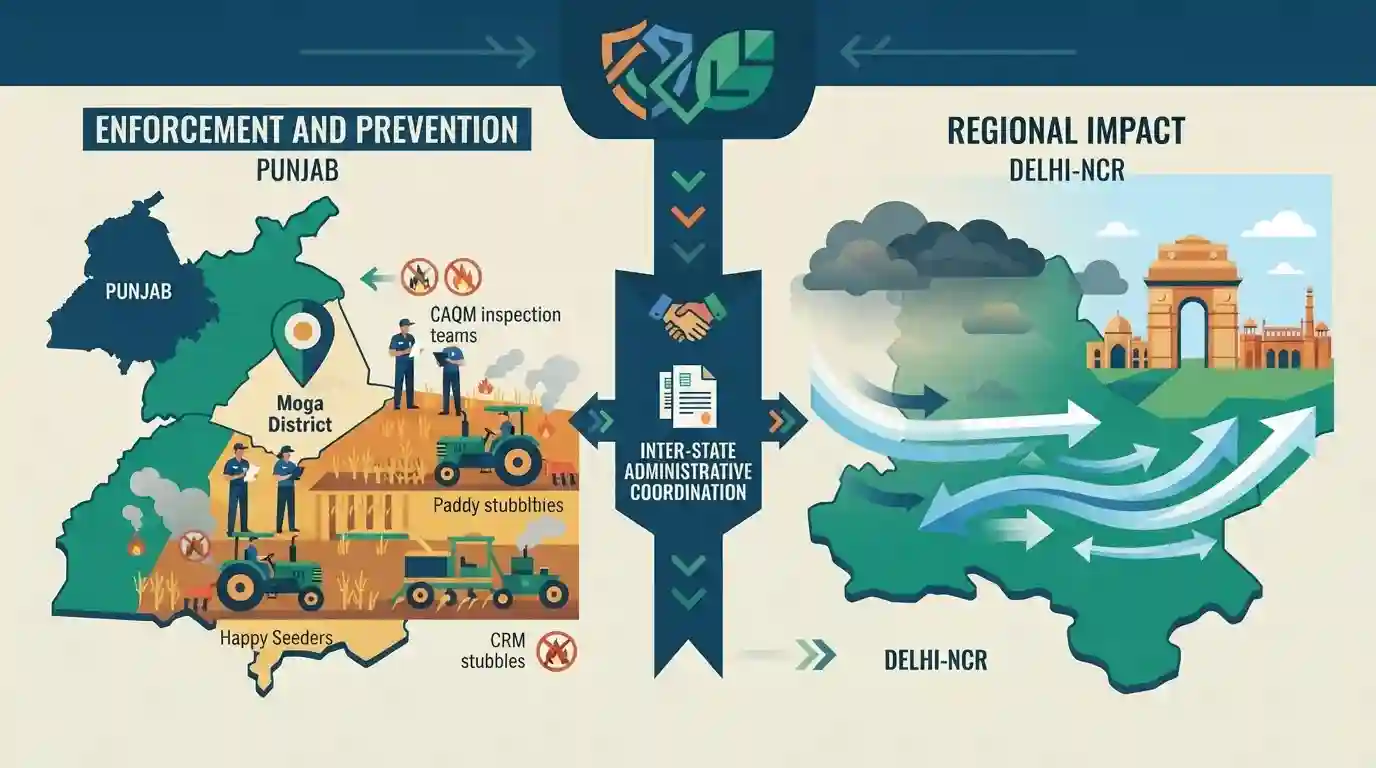
The Commission for Air Quality Management (CAQM) dispatched inspection teams to Moga District in Punjab to oversee enforcement and preventive measures against paddy stubble burning during the 2026 harvesting season. The initiative targets mitigating seasonal air pollution in Delhi-NCR by ensuring effective ground-level execution of Crop Residue Management (CRM) plans and inter-state administrative coordination.
Key Points
- The Commission for Air Quality Management (CAQM) deployed flying squads and inspection teams to Moga District, Punjab, to review ground-level enforcement measures during the 2026 paddy harvesting season.
- The primary focus of the visits is to curb stubble burning (paddy residue burning), a major contributor to severe winter air pollution spikes across the Delhi-NCR region.
- The review emphasizes strict adherence to action plans, monitoring crop residue management (CRM) machinery deployment, and active engagement with local administrative machinery and farmers.
- Institutional coordination between central agencies and state authorities (Punjab and Haryana) is critical for addressing transboundary environmental issues like seasonal air pollution.
Important Terms
Commission for Air Quality Management (CAQM)

A statutory body established to coordinate, monitor, and plan for air quality management in Delhi-NCR and adjoining areas, replacing fragmented bodies like EPCA with binding executive powers.
UPSC context
UPSC Prelims/Mains (GS Paper III - Environment Conservation & Pollution Control): tests institutional frameworks for tackling regional air pollution and stubble burning.
Commission for Air Quality Management in National Capital Region and Adjoining Areas Act, 2021
The legislation enacted in 2021 giving statutory backing and overriding administrative powers to the CAQM to tackle air pollution across northern states.
UPSC context
UPSC Prelims (Polity & Environment): tests statutory acts, institutional mandates, and cooperative federalism in resolving trans-boundary environmental challenges.
Prelims Trap
The Commission for Air Quality Management (CAQM) replaced EPCA, continuing its status as a judicial/executive authority set up by Supreme Court orders.
Aspirants often assume EPCA is a statutory body. EPCA was a Supreme Court-mandated body, whereas CAQM is a statutory body created by an Act of Parliament in 2021.
Static Concepts Connected
What are the key powers, jurisdiction, and statutory backing of the CAQM?
- Statutory Basis: Statutory origin established under the CAQM Act of 2021, replacing the EPCA.
- Jurisdiction: Jurisdiction covers Delhi-NCR and adjoining areas in Punjab, Haryana, Rajasthan, and UP.
- Binding Powers: Issues legally binding directions and can supersede state pollution control board orders on air quality.
Cross-Topic Patterns
CAQM vs. Cooperative Federalism in Air Pollution
Stubble burning enforcement links environmental jurisprudence under Article 21 with cooperative federalism challenges between central statutory bodies like CAQM and state agrarian administrations.

Expect a statement-based question testing CAQM's statutory powers under its 2021 Act vs EPCA, particularly its binding directives.
Linked PYQs · 3
Linked PYQs · 3
- 2024MainsGS3
Industrial pollution of river water is a significant environmental issue in India. Discuss the various mitigation measures to deal with this problem and also the government's initiatives in this regard.
- 2022PrelimsGS1
In the context of WHO Air Quality Guidelines, consider the following statements: 1. The 24-hour mean of PM2.5 should not exceed 15 µg/m³ and annual mean of PM2.5 should not exceed 5 µg/m³. 2. In a year, the highest levels of ozone pollution occur during the periods of inclement weather. 3. PM10 can penetrate the lung barrier and enter the bloodstream. 4. Excessive ozone in the air can trigger asthma. Which of the statements given above are correct?
- 2022PrelimsGS1
Which one of the following has been constituted under the Environment (Protection) Act, 1986?
