PM-AJAY drives inclusive development and socio-economic projects
Source:PIB ↗
কেন এটি গুরুত্বপূর্ণ
PM-AJAY represents a vital policy instrument for the upliftment of Scheduled Castes, aligning with India's constitutional mandates for social justice, inclusive growth, and poverty reduction. Understanding its architecture and components is crucial for GS2 questions on vulnerable sections and governance.
সারসংক্ষেপ
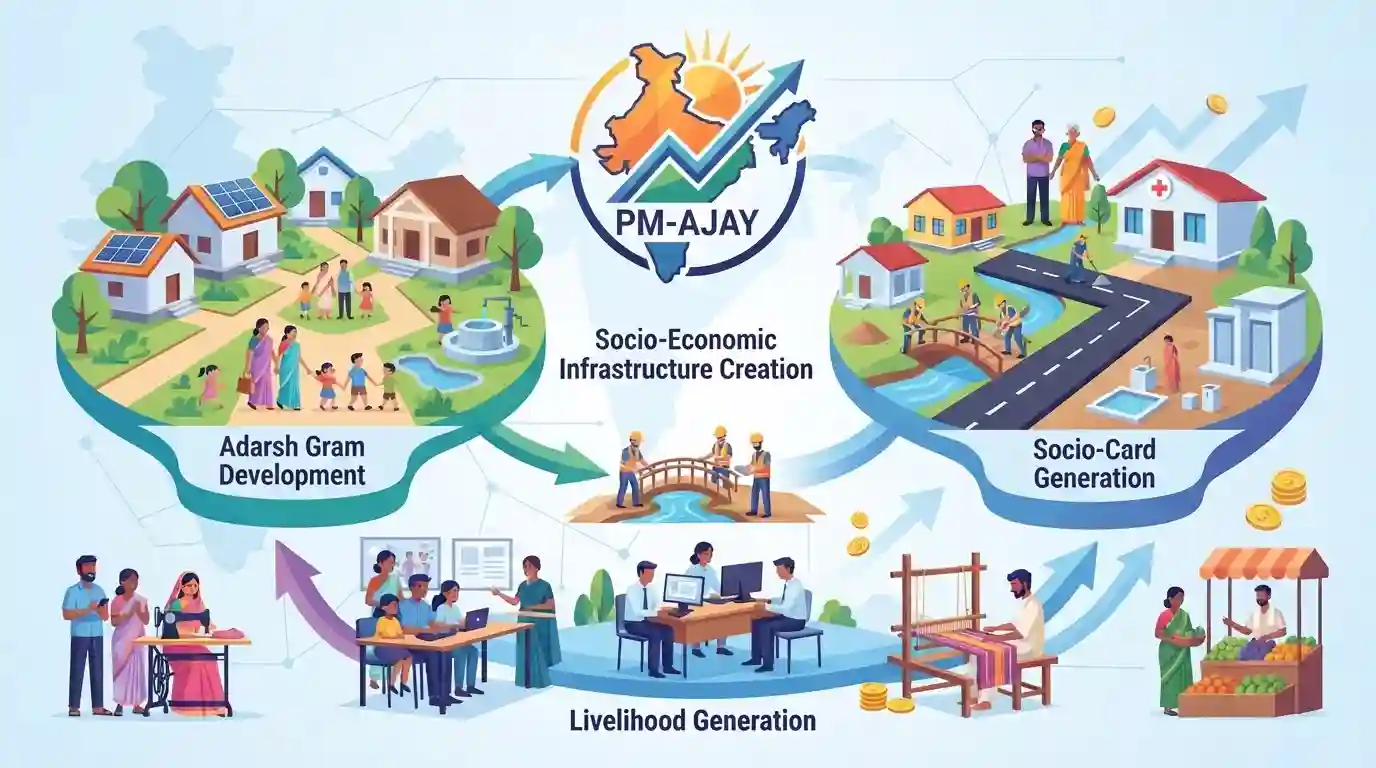
The article details the performance and impact of the Pradhan Mantri Anusuchit Jaati Abhyuday Yojana (PM-AJAY), a flagship central scheme aimed at inclusive development of Scheduled Castes (SCs). By focusing on Adarsh Gram development, socio-economic infrastructure creation, and livelihood generation, PM-AJAY strives to bridge developmental deficits, empower marginalized communities, and foster holistic socio-economic growth across India.
মূল বিষয়
- PM-AJAY is a Centrally Sponsored Scheme aimed at reducing poverty and socio-economic gaps among Scheduled Castes (SCs) by merging three erstwhile schemes: SCA to SCSP, PM-ADAG, and PCR Act.
- The scheme focuses on three major verticals: development of Adarsh Grams into model villages, grants-in-aid for socio-economic infrastructure projects, and livelihood generation/skill development.
- It promotes inclusive development by improving educational infrastructure, hostel facilities, and income-generating opportunities in SC-majority habitations.
- The initiative emphasizes convergence of central and state resources to maximize impact at the grassroots level.
গুরুত্বপূর্ণ শব্দ
Pradhan Mantri Anusuchit Jaati Abhyuday Yojana (PM-AJAY)

A flagship 100% centrally sponsored scheme launched by merging three earlier initiatives to foster the socio-economic and educational empowerment of Scheduled Castes through Adarsh Grams, livelihood projects, and hostels.
UPSC context
Important for GS Paper II (Welfare Schemes for Vulnerable Sections, Social Justice) and GS Paper III (Inclusive Growth and Development Issues).
Ministry of Social Justice and Empowerment
The nodal Union ministry responsible for welfare, social justice, and empowerment of disadvantaged and marginalized sections of society, including Scheduled Castes and Other Backward Classes.
UPSC context
Relevant for GS Paper II under Government Policies and Interventions for the welfare of vulnerable sections and institutional frameworks for social justice.
প্রিলিমস ফাঁদ
PM-AJAY is a newly introduced standalone scheme without any predecessor schemes or legacy components.
Aspirants often assume PM-AJAY is entirely a new standalone creation, missing that it is a rationalized merger of three pre-existing schemes (SCA to SCSP, PMAGY, and BJRCY).
সংযুক্ত স্থির ধারণা
What are the constitutional safeguards and developmental mechanisms for Scheduled Castes in India?
- Directive Principles: Article 46 mandates the State to promote with special care the educational and economic interests of the weaker sections, and particularly of the Scheduled Castes and Scheduled Tribes.
- Plan Allocations: Special Central Assistance (SCA) to Scheduled Castes Sub Plan (SCSP) was designed to channelize additional central assistance to state plans for SC development.
- Constitutional Body: Constitutional bodies like the National Commission for Scheduled Castes (Article 338) monitor safeguards and investigate deprivation of socio-economic rights.
আন্তঃবিষয় প্যাটার্ন
Welfare Convergence & Decentralized District Planning
PM-AJAY's convergence model and infrastructure grants in SC-dominated habitations connect directly to participatory district-level planning under the Aspirational Districts Programme and inclusive federalism.

PM-AJAY component merger (SCA to SCSP, PMAGY, BJRCY) and Adarsh Gram criteria make prime targets for a statement-based prelims question.
সংযুক্ত PYQ · 2
সংযুক্ত PYQ · 2
- 2024MainsGS2
Public charitable trusts have the potential to make India's development more inclusive as they relate to certain vital public issues. Comment.
- 2026PrelimsGS1
Consider the following statements about the provisions pertaining to the Scheduled Castes and the Scheduled Tribes in India : 1. Provisions regarding the administration of the Tribal Areas in the States of Assam, Meghalaya, Tripura and Mizoram are given in the Fifth Schedule of the Constitution of India. 2. Some tribes of India are entitled to exemption from paying Income Tax on certain incomes. 3. The Constitution of India provides for reservation of seats in Panchayats for women belonging to the Scheduled Castes and the Scheduled Tribes. Which one of the following conclusions based on the above statements is correct ?
