NHRC issues notice over school ceiling collapse and student injuries
Source:PIB ↗
हे का महत्त्वाचे आहे
This case highlights the active role of the National Human Rights Commission (NHRC) in protecting child rights and flagging administrative apathy regarding public school infrastructure, directly tying into governance accountability and the right to education.
सारांश
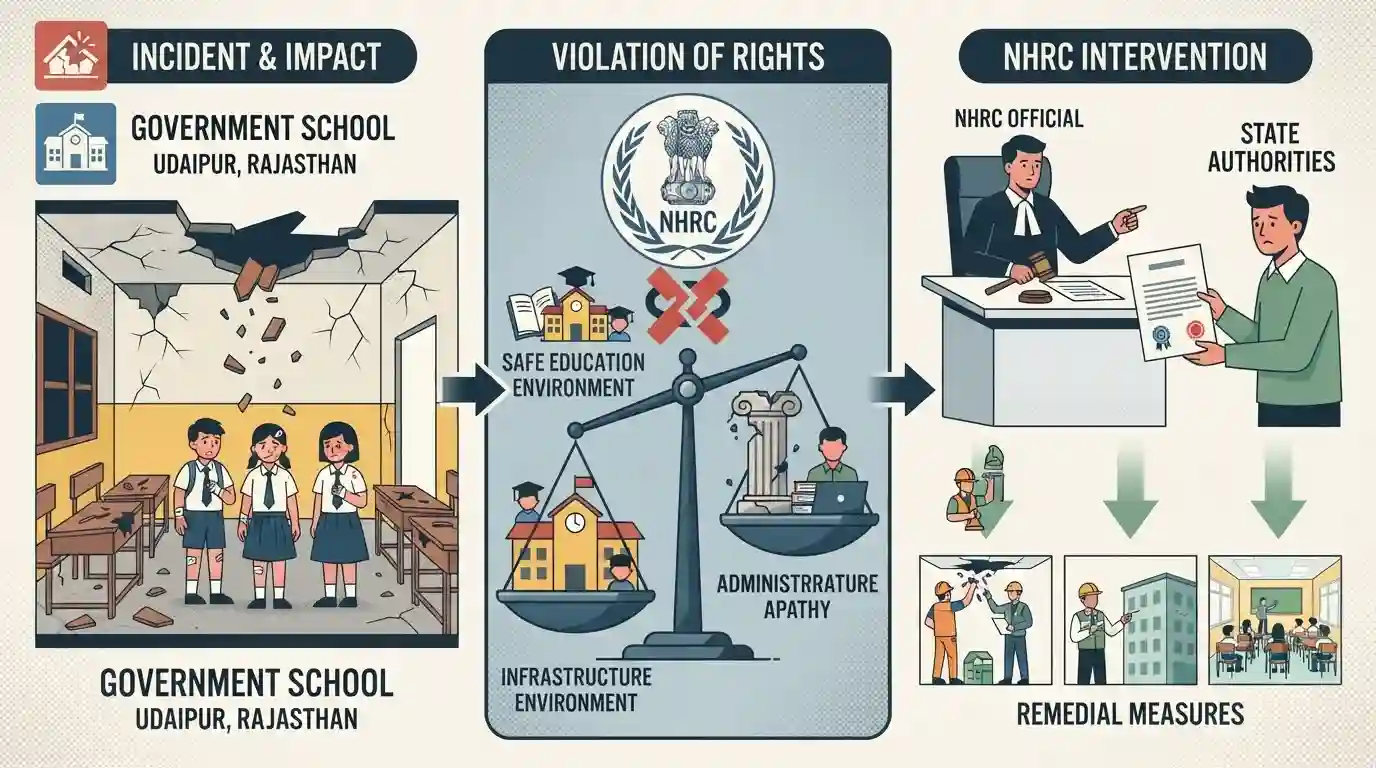
The National Human Rights Commission (NHRC) has taken suo motu cognizance of a ceiling collapse incident at a government school in Udaipur, Rajasthan, which left three students injured. Highlighting issues of infrastructure neglect, administrative apathy, and violation of children's rights to a safe education environment, the NHRC issued notices to state authorities for a detailed report and remedial measures.
मुख्य मुद्दे
- The National Human Rights Commission (NHRC) took suo motu cognizance of injuries sustained by three students due to a ceiling plaster collapse in a dilapidated government school classroom in Udaipur, Rajasthan.
- The NHRC observed that such incidents point to severe administrative apathy, negligence, and violation of the fundamental right to education and safe schooling environment for children.
- Notices have been issued to the state authorities seeking a detailed report on the incident, medical treatment of the injured students, and remedial action regarding dilapidated school buildings.
- Highlights systemic issues concerning public school infrastructure, safety standards, and accountability of governance mechanisms in welfare states.
महत्त्वाच्या संज्ञा
National Human Rights Commission (NHRC)

A statutory body established under the Protection of Human Rights Act, 1993, tasked with the protection and promotion of human rights in India, with powers to investigate violations and issue advisory recommendations.
UPSC context
UPSC Prelims & Mains (GS Paper II - Statutory Bodies / Human Rights): Tests knowledge of organizational mandates, powers, and quasi-judicial functions.
Right to Education (RTE) Act
A landmark legislation under Article 21-A that guarantees free and compulsory elementary education to all children aged 6 to 14, mandating basic school infrastructure and safety standards.
UPSC context
UPSC Mains (GS Paper II - Social Justice / Education): Tests understanding of children's rights, statutory obligations, and gaps in public school infrastructure.
संबंधित स्थिर संकल्पना
What are the composition, appointment, and binding nature of recommendations of the National Human Rights Commission (NHRC)?
- Statutory origin: Statutory Body: Established under the Protection of Human Rights Act, 1993, amended in 2019 to include more members and a shorter tenure.
- Composition: Chairperson: Must be a retired Chief Justice of India or a Judge of the Supreme Court.
- Nature of powers: Recommendatory: NHRC recommendations are advisory in nature; it lacks power to impose penalties or enforce compliance directly.
आंतर-विषय नमुने
NHRC + RTE Act Implementation Failures
NHRC suo motu powers and state-level implementation of the RTE Act are frequently tested together under GS Paper II governance frameworks.

NHRC's recommendatory nature vs statutory powers is a classic UPSC trap; expect a statement on whether its orders are legally binding.
संबंधित PYQ · 2
संबंधित PYQ · 2
- 2014MainsGS2
National Human Rights Commission (NHRC) in India can be most effective when its tasks are adequately supported by other mechanisms that ensure the accountability of a government. In light of the above observation assess the role of NHRC as an effective complement to the judiciary and other institutions in promoting and protecting human rights standards.
- 2021MainsGS2
Though the Human Rights Commissions have contributed immensely to the protection of human rights in India, yet they have failed to assert themselves against the mighty and powerful. Analyzing their structural and practical limitations, suggest remedial measures.
